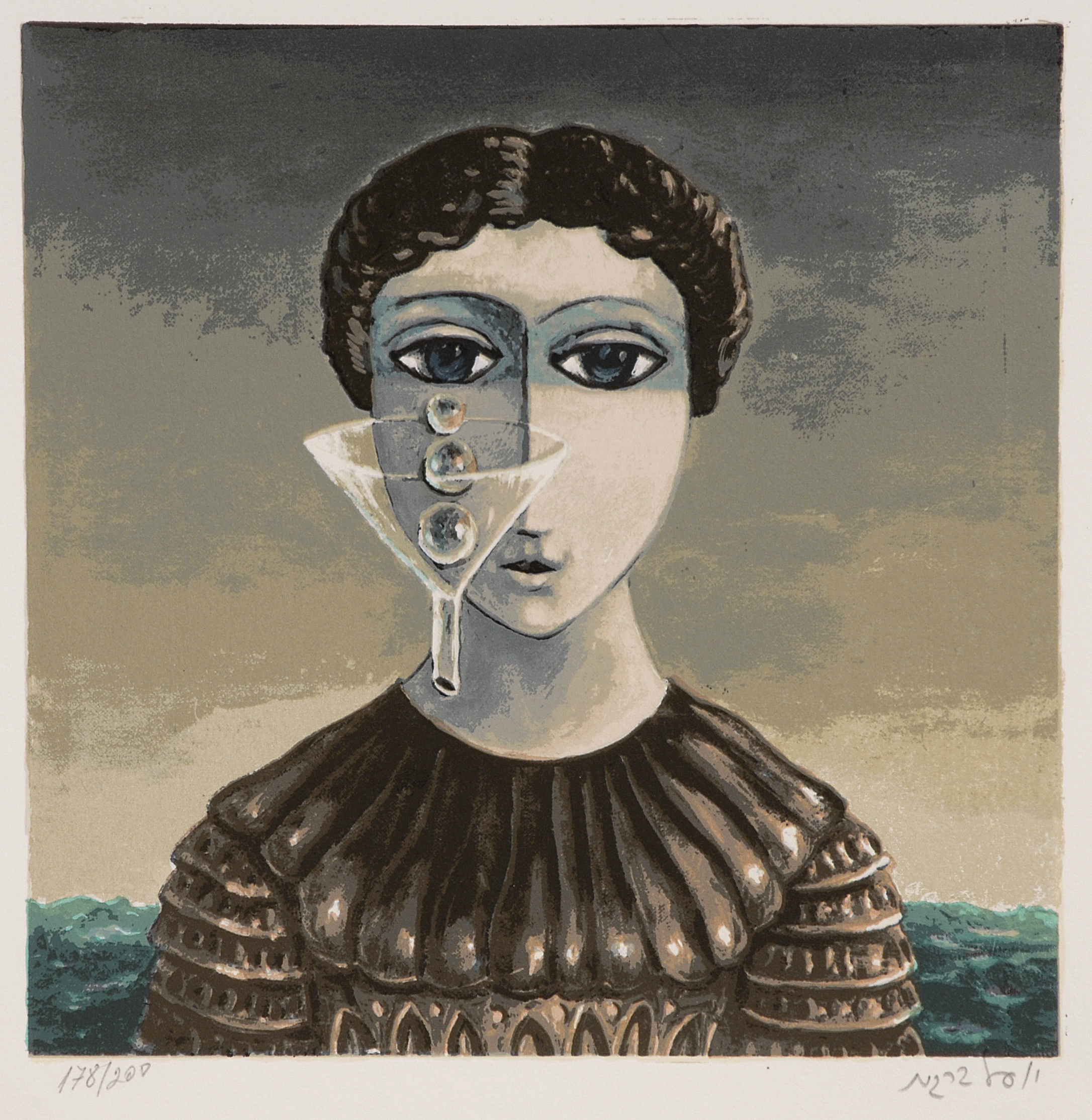
Bergner Yosel
Bergner 9
$150
13.75 inches wide x 19.75 inches high 35 cm wide x 50 cm high Serigraph
Shipping & Handling: $30
Yosl Bergner, a very well-known Israeli painter, awarded the 1979-80 Israel Prize, was born in Vienna in 1920. He grew up in Warsaw and immigrated to Australia with his family in 1920. The artist studied in the art school of the National Gallery. During World War II, he fought in the ranks of the Australian army for four and a half years. He reached Israel in 1950 after having wandered and exhibited in Paris, New York and Canada. Bergner is the son of the Yiddish poet, Melech Ravitz.
Bergner resided in Safed for some time and he has been living in Tel Aviv for the past 23 years. In addition to his paintings, he has designed scenery and costumes for various theaters (and for the plays of Nissim Aloni, in particular). Bergner has also illustrated many books.
Bergner’s style which was crystallized in the early sixties, extends from expressionism to illusory-surrealistic painting with characteristic Israeli elements. He explores themes of Holocaust and Return to the Land. In recent years, Bergner has returned to expressive painting void of surrealistic features. “The Weepers” uses an obvious, though moving, symbolism of windows that are illusions and through which there is no escape.
Since 1950 he has held a number of one-man shows. His works have also been displayed abroad, particularly in Paris. He participated in the Biennale in Venice (three times) and in Sao Paulo and in important international exhibitions. In 1975, a retrospective exhibition of his works was mounted at the Tel Aviv Museum. Included among the works displayed was his famous painting of the three crossed graters.
Paintings created by Yossl Bergner hang in numerous museums and private collections in Israel and throughout the world.
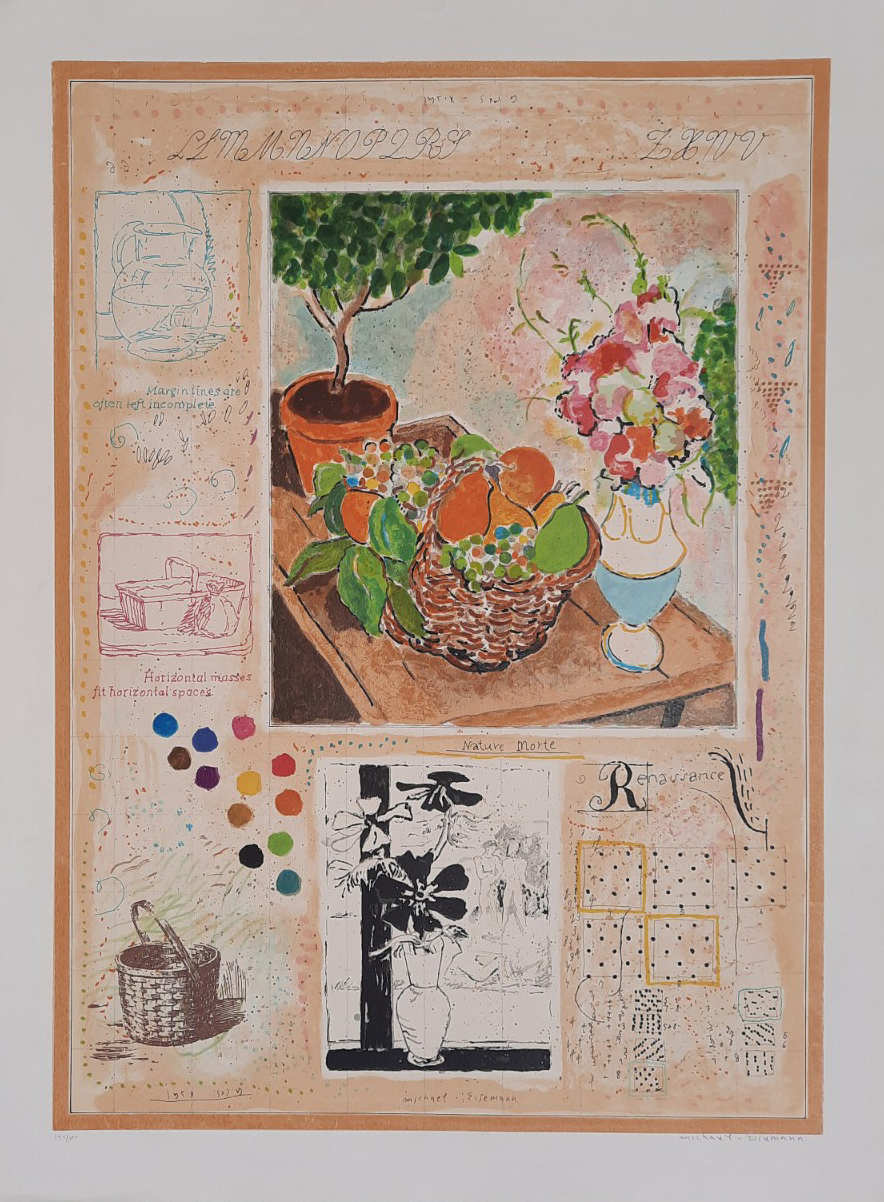
Eisenman Michael
Bowl of Flowers
$400
23.5 inches wide x 31.5 inches high 60 cm wide x 80 cm high Serigraph
Shipping & Handling: $30
MICHAEL EISEMANN
Born in Tel Aviv in 1943, Michael Eisemann studied at the Academy of Art in Weisbedan, Germany. Upon his return to Israel, Eisemann began teaching at the Art Institute in Bat Yam, and later at the Bezalel Academy in Jerusalem.
Michael Eisemann continues to explore and chart the odyssey of the artistic psyche in works combining freely executed, miniature versions of masterpieces by artists of the past and present. Through this process of selection, fragmentation and refinement, as well as their relationship with one another, these works assume a fresh identity. Renaissance portraits, Impressionistic marinescapes, academic nudes and color filled works, variously arranged on parchment colored paper, shed their weighty art historical baggage and are transformed before the viewers eyes.
Together, they engage in a dialogue which underscores their collective abstract rhythms of light, color (or its absence), texture and above all flattened linear pattern.
Eisemann weaves this animate, endlessly fascinating surface, with its simultaneity of ebb flow, dissolution and regeneration, into a magic carpet, airborne through the artist’s powers of craft and inspiration. One of Israel’s most distinguished artist’s, Eisemann has exhibited locally and internationally.
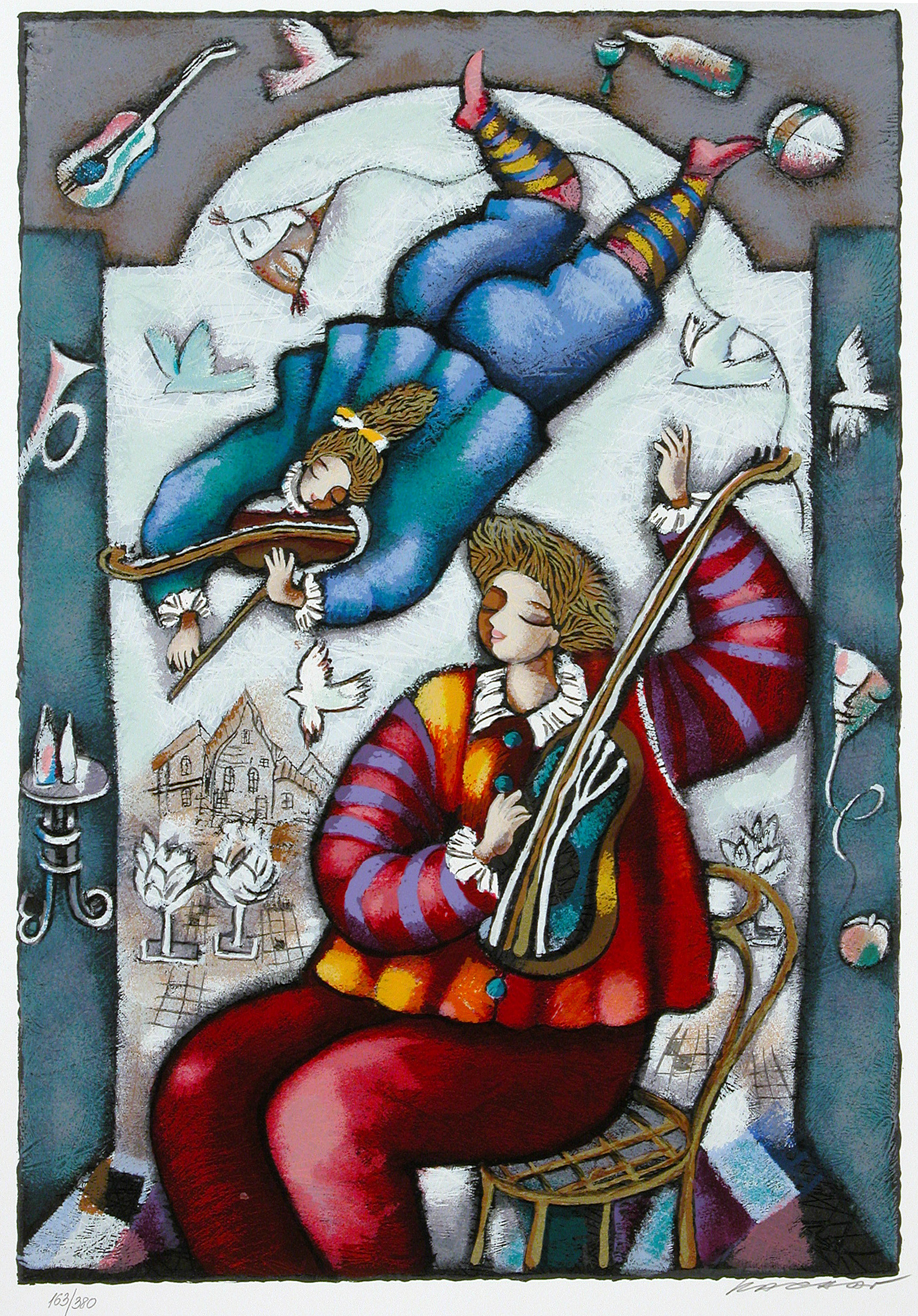
Michael Kachan
Clowns
$250$125
26.5x17.5 45x68cm Serigraph Edition 380
Shipping & Handling: $30
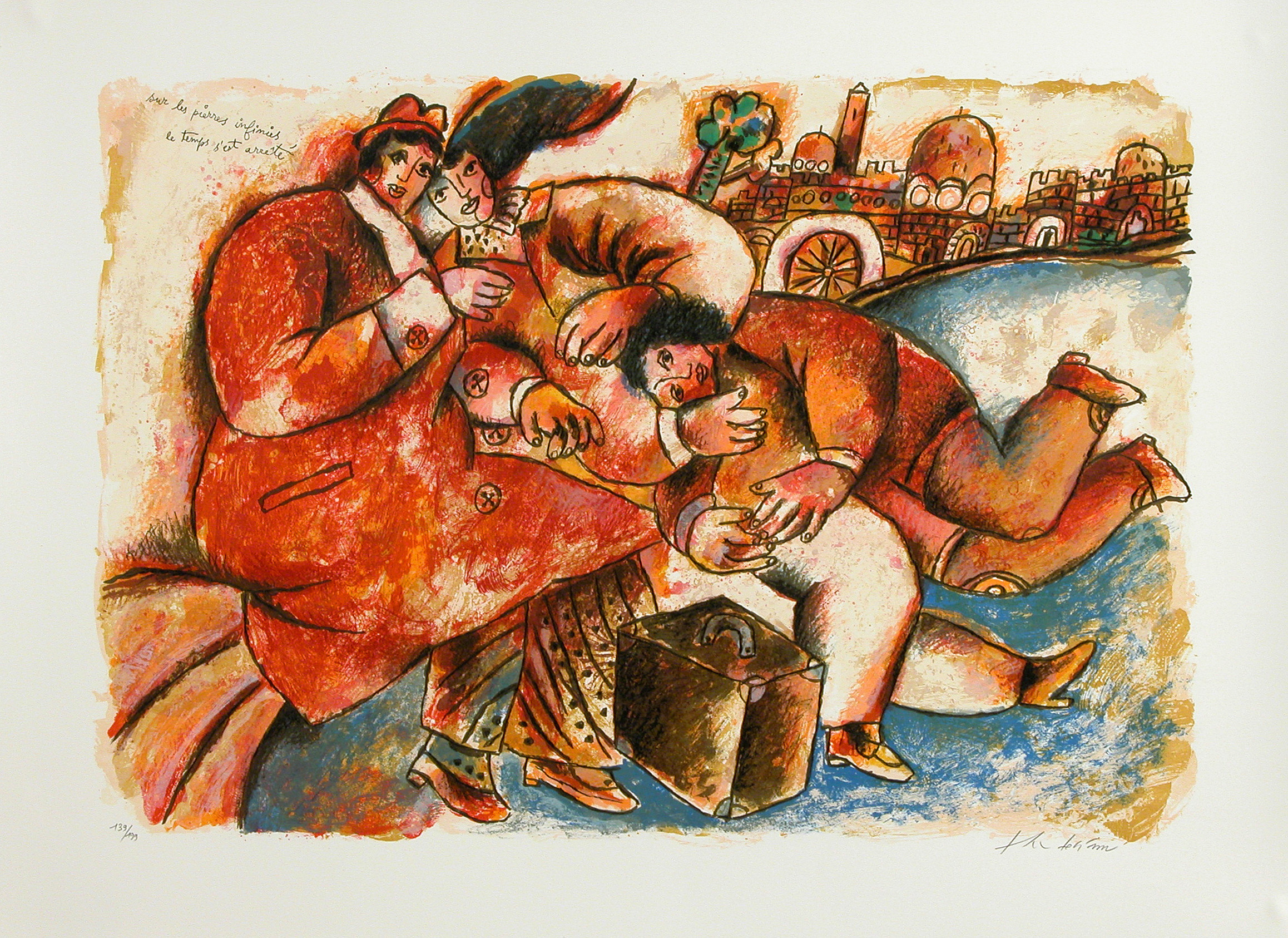
TOBIASSE
Coming to Israel
$200
32 inches wide by 24 inches high 80 cm wide by 60 cm high Serigraph Edition 199
Shipping & Handling: $30
TOBIASSE
In Paris, set apart from the other children by his strange clothes and Yiddish-Lithuanian accent, he grew up solitary, self-dependent and with a strong, prevailing sense of his Jewishness. Essentially self-trained in art, he emerged from the enforced isolation of the German occupation in Paris with an extensive portfolio which enabled him to find work in commercial fields. Continuing as a commercial artist for fifteen years, he developed his painting style in his spare time, often painting through the night.
Finally in 1960, Tobiasse took the Grand Prix at an exhibition of young artists at the Palais de la Mediterranee in Nice.
After 1962, he was at last able to devote himself exclusively to painting, for collectors and galleries have since not ceased to be interested in his work.
Author and colleague Andre Schwartzbart writes of “the strange adventures of Tobiasse, who sees canvasses surge straight from an Elie Wiesel story …” This reference is apt, with Tobiasse portraying his Hassidic-influenced stories on canvas. Schwartz-Bart continues: “I can as well conjure up in my mind my friend Elie deeply brooding over one of these marvels from which he would eventually derive a tale”.
Loading...