Lithograph
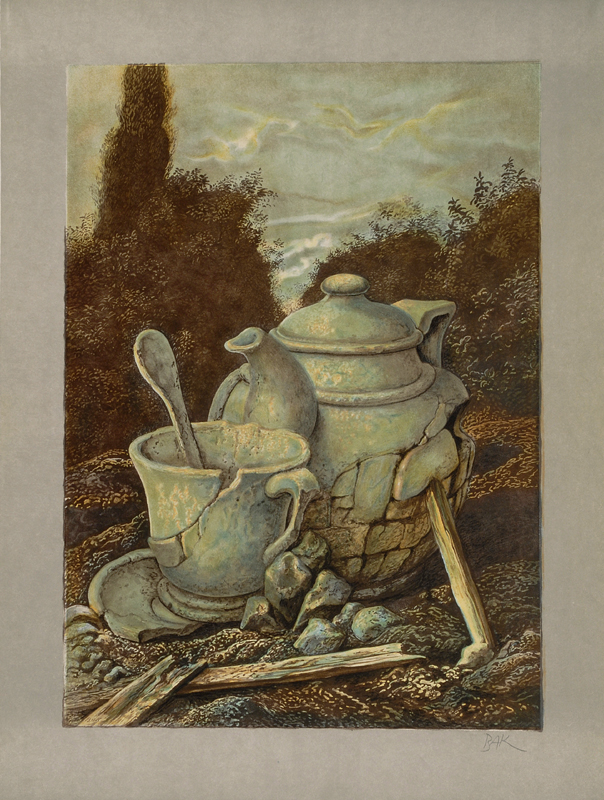
Bak Shemuel
Tea Pot
$400
19" x 26" Lithograph 1971 Edition 150
Shipping & Handling: $30
Samuel Bak was born in Vilna, Poland in 1933. His immense artistic talent was recognized early; the artist was only five years old when he was encouraged to dedicate his life to art by his great-uncle, Arno Nadel, the Jewish poet, painter and musician. The Nazi occupation of Vilna in 1940 interrupted those early aspirations. However, Bak was able to hold his first exhibition of drawings in the Vilna Ghetto in 1942. A year later, he and his parents were marched off by the SS to the HKP camp on the outskirts of Vilna, where his father was shot just a few days prior to the Russian liberation of the city. Bak was one of the 150 Vilna Jews who survived the war – out of a Jewish community of 80,000.
The trauma of the Holocaust had a tremendous influence on Bak’s later artistic works. As the artist himself explained: “For me, it is important to tell the story of that moment in my childhood when everything was disintegrated – despite arrangements for safety and protection. Nothing was sure anymore, only the knowledge that in a day, perhaps two, we would cease to exist.” The story that the artist wishes to relate, however, is so grotesque that he prefers the use of symbols. “Instead of speaking of people, I paint fruit, and somehow this helps me to get nearer to my subject.”
After the war, Bak and his mother attempted to reach Palestine, and Bak continued his artistic education whenever he was able. In 1948, the artist embarked on an illegal journey to Palestine through France, arriving in the newly established state during the War of Independence. During the next few years, Bak studied at the Bezalel Art School in Jerusalem, served in the army, and designed scenery.
Bak describes his mode of work as “a style founded on the classical tradition” where “the contents have remained linked to the spirit of our age and express its anguish.” He developed this style gradually, after experimentation; with “totems”, abstract figures in space; lyrical abstractions, especially beautiful in their subtle treatment of light and atmosphere; structural abstractions; relief-like collages; and a handsome and mysterious group of “labyrinth” paintings, from which stemmed Bak’s metaphysical, surrealistic works. Bak realizes that his style contradicts the age, but feels it fully his own. “There is danger,” the artist has claimed, “in just drifting along with current trends, in exerting false pressure to keep up to date. When one has to change every year, to hold the antennae erect and tuned in to fashion, where is the time for self-improvement? In fact, a lifetime is required to bring one form of art to perfection.”
While critics initially labeled Bak a ‘traitor’ for his ‘reactionary works’, Bak felt relief rather than apprehension in pursuing his own path. “I paint because art has the power to save me as an individual – to give me an identity in an epoch when individuality is being more and more suppressed by prefabricated systems.” And he feels that this identity can be most fully realized by his use of the classical style: “the classical direction would be the one to offer me all that I loved, wanted and so much enjoyed seeing in works of past centuries, and also in works bearing their influence.”
To understand Bak’s works, one must understand the symbols which the artist uses so freely. His three most central images are those of pears, chessmen and keys. Why did Bak choose these for his symbols, and what do they mean to him? “I chose the pear for its neutral features, deceptively neutral like the surface of everyday life and smooth like the skin of a pear. But give it a gentle scratch and see what a fearful world lies hidden just underneath! The chessmen stand for Rationality. They speak of the absurdity of war and of failure of the rational approach to prevent war and poverty.” The key motif, claims Bak, is unlike the pear, in that it “comes on the scene with firmly established connotations, a familiar symbol of man’s need to find explanations, to search for the meaning and find answers to the fundamental questions of existence.” It is these multi-faceted answers to the multitude of questions that Bak is trying to reach in his works: “As I am not very orthodox, my paintings pose multiple questions and seek numerous answers.
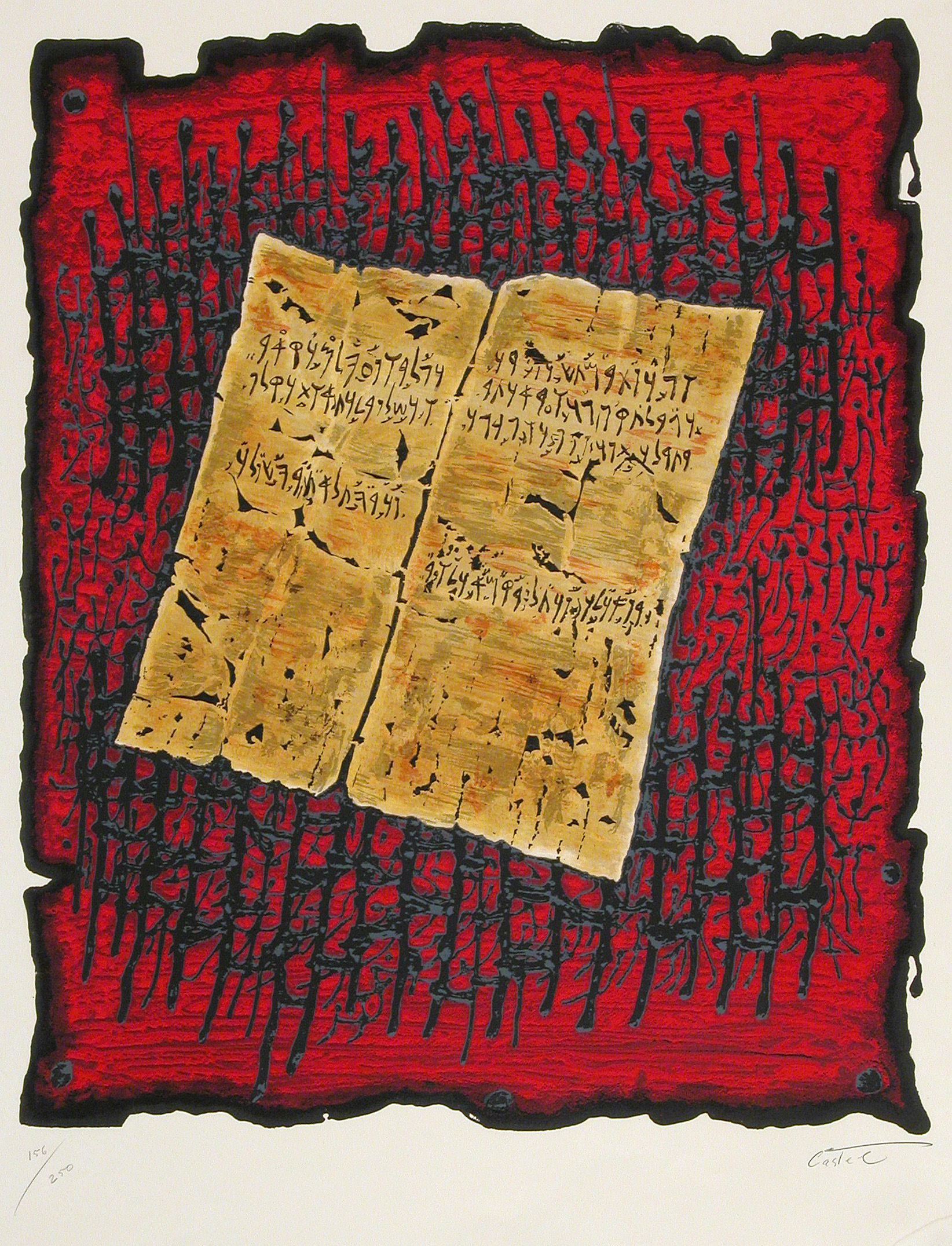
Castel Moshe
The Prophecy
$400
22" x 30" Lithograph 1983 Edition 250
Shipping & Handling: $30
MOSHE CASTEL
Painting, for Moshe Castel, is a vital preoccupation, at all times. He is one of the artists whose life is synonymous with and consecrated to his art. And while he has experimented with other trends, he always returns to the inspirational fonts from which he drank during childhood, filling his paintings with oriental landscapes, capturing the romantic atmosphere of Eretz Israel, the hues of burning heat and the shadows of the vaulted houses; capturing, too, the mingling of cultures evident here.
Born to Sephardic Jews who trace their ancestry back to the expulsion from Spain and settled in Hebron, Castel revealed a penchant for art at the youthful age of six. In this he was inspired by the artistic talents of his father, a scholar and scribe whose superb calligraphy on Torah scrolls and ornamental embroidery on silk Torah coverings was renowned.
Castel entered the Bezalel School of Art at the age of 13, and spent three years studying arts and crafts. The young man’s talents were so pronounced that his teachers suggested he be sent to France for further studies, and Castel left for Paris in 1927, at the age of 18. Ten years of struggle, hardship and assiduous study of the various techniques of art followed. Castel returned to Israel as the Second World War broke out. Drawn to the city of Safed, the seat of Jewish mysticism, he decided to settle in this city of twisting lanes, magnificent scenery and ancient synagogues. Ensconced in his studio, Castel closed his door to visitors, and devoted himself to his art.
Castel brought from Paris a fresh, Parisian flair, and the influence of Utrillo and Vlaminck. But his renewed affinity to the land of his forefathers induced him to depict the lives of Sephardic Jews in Israel. The influence of Persian miniatures is evident in his paintings, and Castel refined them, adding great charm to themes of local color and patriarchal motives. This period lasted through the thirties and forties. Castel achieved great renown, and was extremely successful in his exhibitions. Castel was influenced for a time by the oriental colorfulness of Georges Rouault and by an awareness of Chagall. But the impact of mysticism gradually took another form, and Moshe Castel discovered his own technique of painting, in which color and texture; picture and relief became joined. This turning point, realized in 1948, evolved around the use of a technique which utilized ground basalt rock, mixed with sand and glue and infused with the rich colors that were characteristic of the artist. Castel’s painting, regardless of epoch, always possessed a singular vitality of color, in which every bloc of color carries its own specific meaning. With this new technique, the artist produced paintings portraying indecipherable ancient Hebrew script, whose panels evoke the feeling of a union of past and present. Desolation can be sensed in the seared scenes of land. The Hebrew letters are used not to verbalize, but to fuse the mounting syllables to link the viewer with the past. An archaic spirit emanates from them, the ancient spirit of the people.
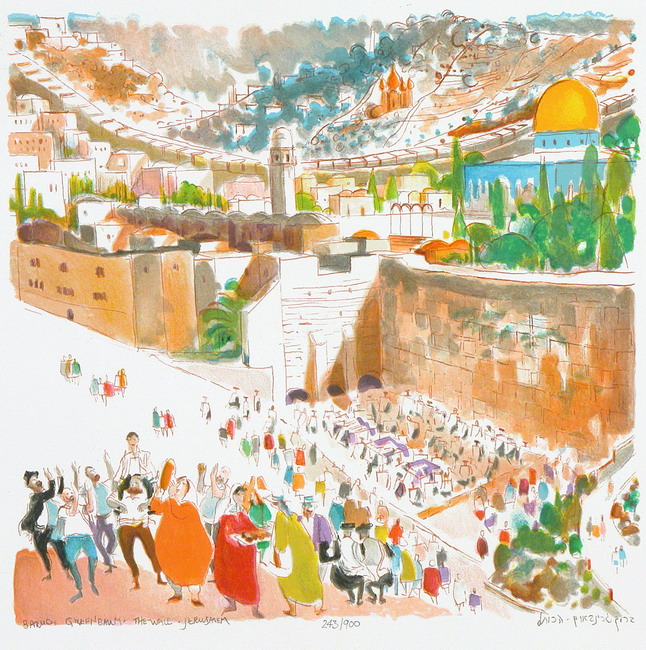
Greenbaum Baruch
The Wall
$125
15.75 inches wide x 14.5 inches high 40 cm wide X 37 cm high Lithograph 1998 Edition 900
Shipping & Handling: $30
BARUCH GREENBAUM
Baruch Greenbaum was born in Brighton, Sussex, England and studied at the Brighton College of Art.
He was one of the first freelance designers to work for B.B.C. Television. He studied painting with Bernard Meninsky.
Greenbaum served in the British 8th Army and was demobilized in 1946. He returned to London to study design. In 1950 he opened his illustration and design studio in Fleet Street.
Greenbaum worked continuously for the National Press, Advertising and Publishing. He emigrated in 1973 to Israel and lived and worked in Safed. He passed away in 1992.
Baruch Greenbaum’s landscapes of the Judean Hills and his more urban landscapes depicting life on the streets of Jerusalem are easily recognizable by their vibrant colors. Often using red, initially to delineate the scene, Greenbaum then overlays these almost sketchy lines with bright colors.
Greenbaum’s Jerusalem is one of verdant greens and warm yellows and oranges. Trees, streets, people and buildings – all are bright in the brilliant sunshine. Also, using artistic license to the full – or perhaps it is just wishful thinking on Greenbaum’s part – his Jerusalem is a relaxed, unhurried place where all different types of people belonging to many different faiths, stroll in leisurely fashion along traffic free streets – somewhat different to the noisy, fast moving reality of the modern city.
Greenbaum’s graphics and watercolors illustrate the concept of Jerusalem which many people hold in their minds and which has a separate entity to the city itself. It is Jerusalem as he would like it to be – and in fact Jerusalem as it is, without the extra layer of modernity – an ancient and spiritual city.
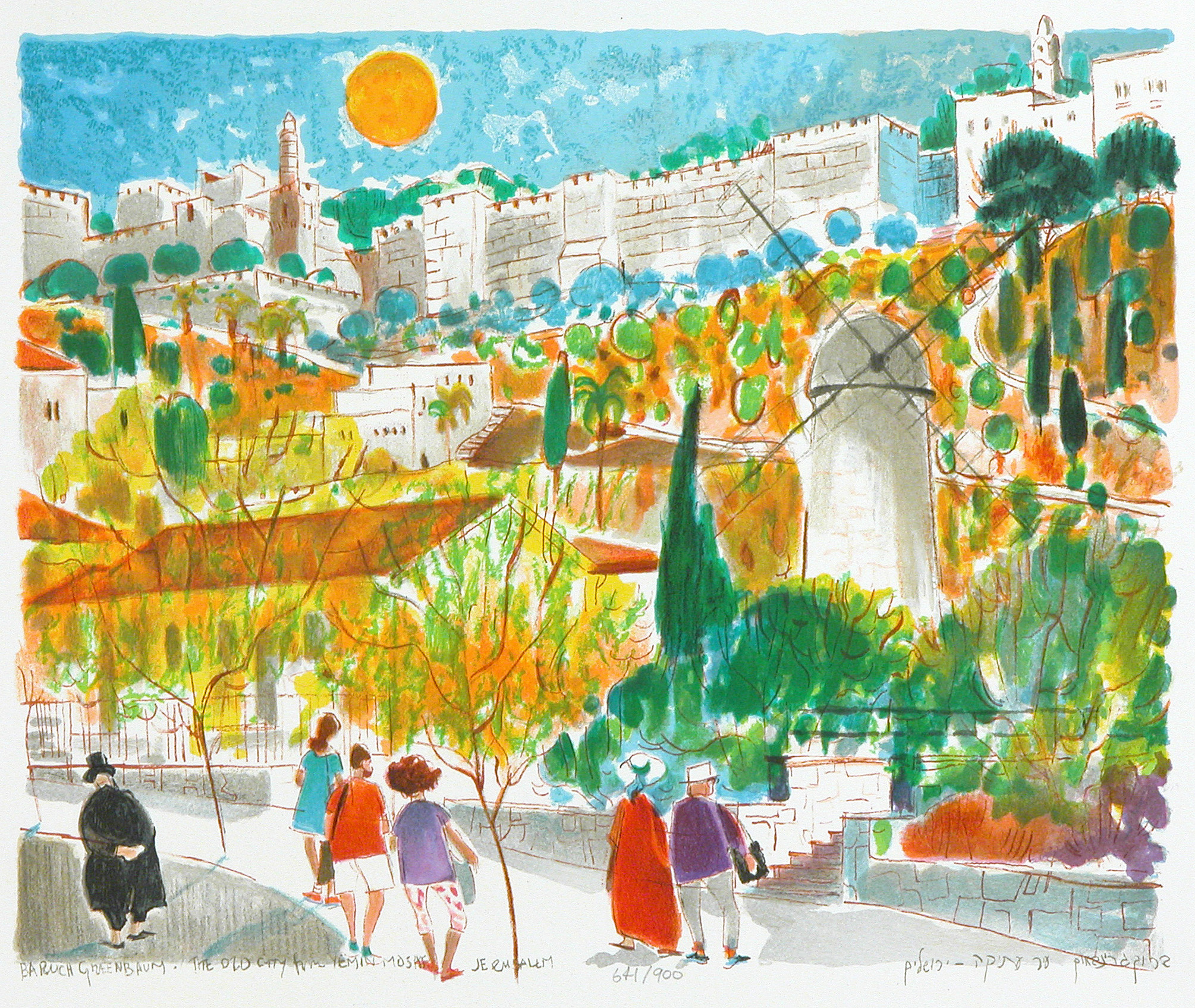
Greenbaum Baruch
Yemin Moshe
$125
16.5 inches wide x 13.75 inches high 42 cm wide X 35 cm high Lithograph 1998 Edition 900
Shipping & Handling: $30
BARUCH GREENBAUM
Baruch Greenbaum was born in Brighton, Sussex, England and studied at the Brighton College of Art.
He was one of the first freelance designers to work for B.B.C. Television. He studied painting with Bernard Meninsky.
Greenbaum served in the British 8th Army and was demobilized in 1946. He returned to London to study design. In 1950 he opened his illustration and design studio in Fleet Street.
Greenbaum worked continuously for the National Press, Advertising and Publishing. He emigrated in 1973 to Israel and lived and worked in Safed. He passed away in 1992.
Baruch Greenbaum’s landscapes of the Judean Hills and his more urban landscapes depicting life on the streets of Jerusalem are easily recognizable by their vibrant colors. Often using red, initially to delineate the scene, Greenbaum then overlays these almost sketchy lines with bright colors.
Greenbaum’s Jerusalem is one of verdant greens and warm yellows and oranges. Trees, streets, people and buildings – all are bright in the brilliant sunshine. Also, using artistic license to the full – or perhaps it is just wishful thinking on Greenbaum’s part – his Jerusalem is a relaxed, unhurried place where all different types of people belonging to many different faiths, stroll in leisurely fashion along traffic free streets – somewhat different to the noisy, fast moving reality of the modern city.
Greenbaum’s graphics and watercolors illustrate the concept of Jerusalem which many people hold in their minds and which has a separate entity to the city itself. It is Jerusalem as he would like it to be – and in fact Jerusalem as it is, without the extra layer of modernity – an ancient and spiritual city.
Loading...