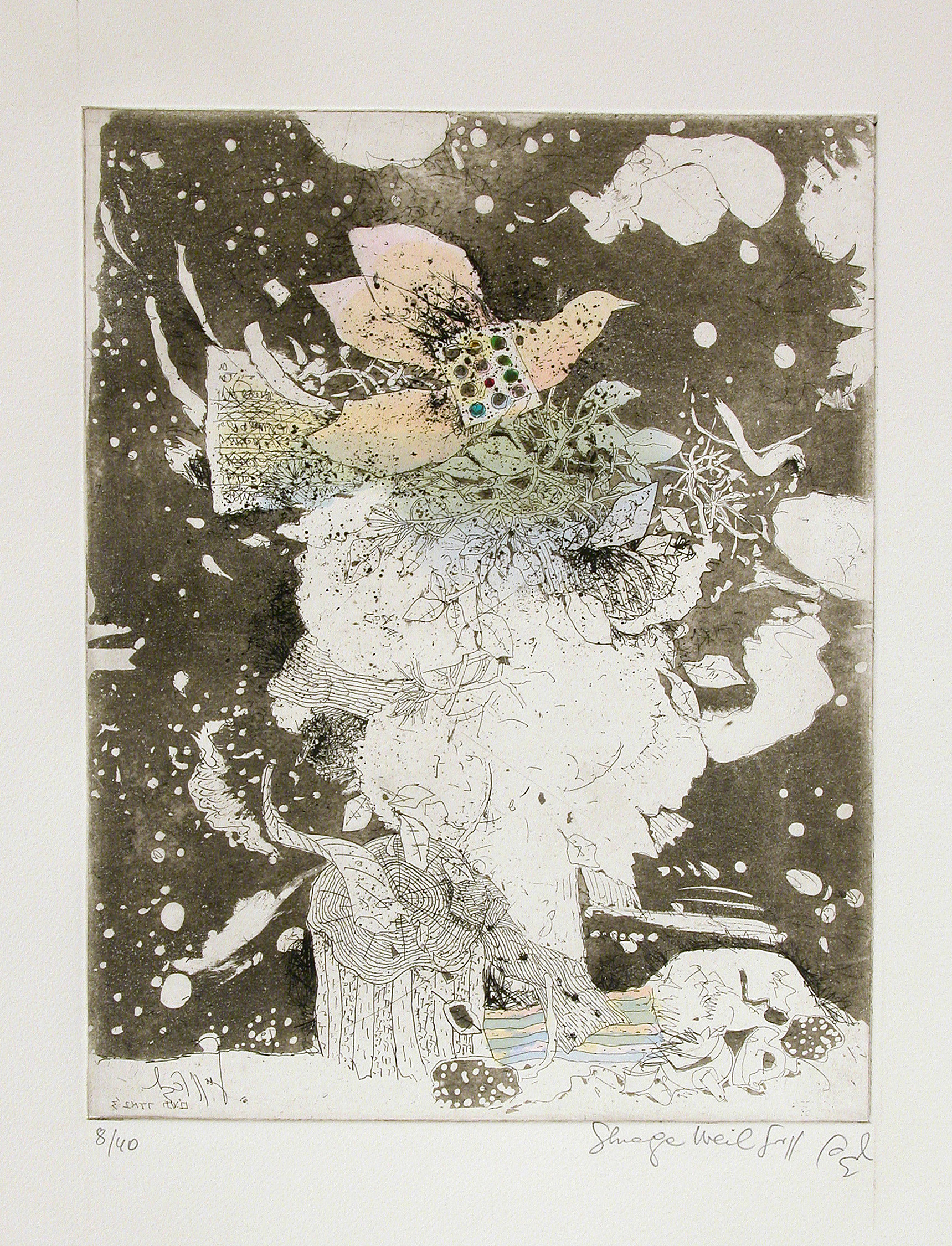
Weil Shraga
S-251 Phoenix III
$500$200
20 inches wide By 26 Inches high 50 cm wide By 65 cm high Etching 1983 Edition 40
Shipping & Handling: $30
Shraga Weil was born in Nitra, Czechoslovakia in 1918 to a family of teachers, journalists and merchants. His father, a building engineer, who was an amateur painter, sent him to study with a local sculptor and then to the Prague School of Art.
He produced his first graphic works during World War II, part of which he spent as a prisoner. After the war, Weil sailed for Israel on an illegal immigrant ship, eventually arriving in the new country in 1947 and becoming a member of Kibbutz Haogen, where he has been living ever since.
In 1954 Weil spent some time studying murals and graphic techniques at the Academie des Beaux Arts, Paris and Ravenna mosaics with Prof. Severinl.
Shraga Weil’s works have been exhibited in the United States, South America, Canada, Australia, France, the USSR, Switzerland, and in the International Exhibition of Graphic Arts, in Lugano. In 1959, Weil was awarded Tel Aviv’s Dizengoff Art Prize.
Museums and Public Collections
Brandeis University, Waltham, Massachusetts
Boston Public Library
Israel Museum, Jerusalem
William Rockhill Nelson Gallery, Kansas City, MO
Fogg Museum, Harvard University
Los Angeles County Museum
Jewish Museum, New York
Philadephia Museum of Art
Joslyn Museum, Omaha, Nebraska
Judah Magnes Museum, Berkeley, CA
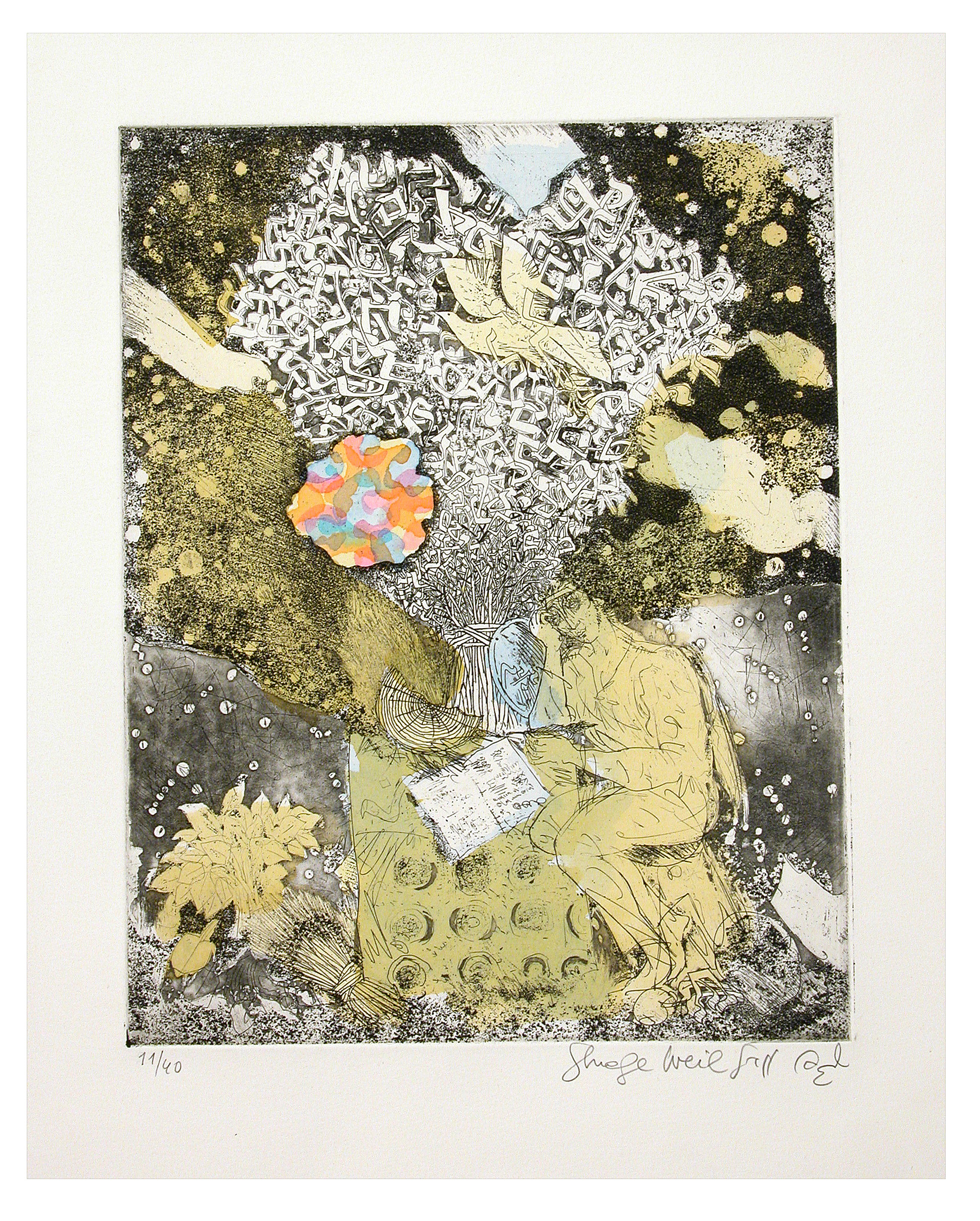
Weil Shraga
S-252 Phoenix II
$500$200
20 inches wide X 26 Inches high 50 cm wide X 65 cm high Etching 1983 Edition 40
Shipping & Handling: $30
Shraga Weil was born in Nitra, Czechoslovakia in 1918 to a family of teachers, journalists and merchants. His father, a building engineer, who was an amateur painter, sent him to study with a local sculptor and then to the Prague School of Art.
He produced his first graphic works during World War II, part of which he spent as a prisoner. After the war, Weil sailed for Israel on an illegal immigrant ship, eventually arriving in the new country in 1947 and becoming a member of Kibbutz Haogen, where he has been living ever since.
In 1954 Weil spent some time studying murals and graphic techniques at the Academie des Beaux Arts, Paris and Ravenna mosaics with Prof. Severinl.
Shraga Weil’s works have been exhibited in the United States, South America, Canada, Australia, France, the USSR, Switzerland, and in the International Exhibition of Graphic Arts, in Lugano. In 1959, Weil was awarded Tel Aviv’s Dizengoff Art Prize.
Museums and Public Collections
Brandeis University, Waltham, Massachusetts
Boston Public Library
Israel Museum, Jerusalem
William Rockhill Nelson Gallery, Kansas City, MO
Fogg Museum, Harvard University
Los Angeles County Museum
Jewish Museum, New York
Philadephia Museum of Art
Joslyn Museum, Omaha, Nebraska
Judah Magnes Museum, Berkeley, CA
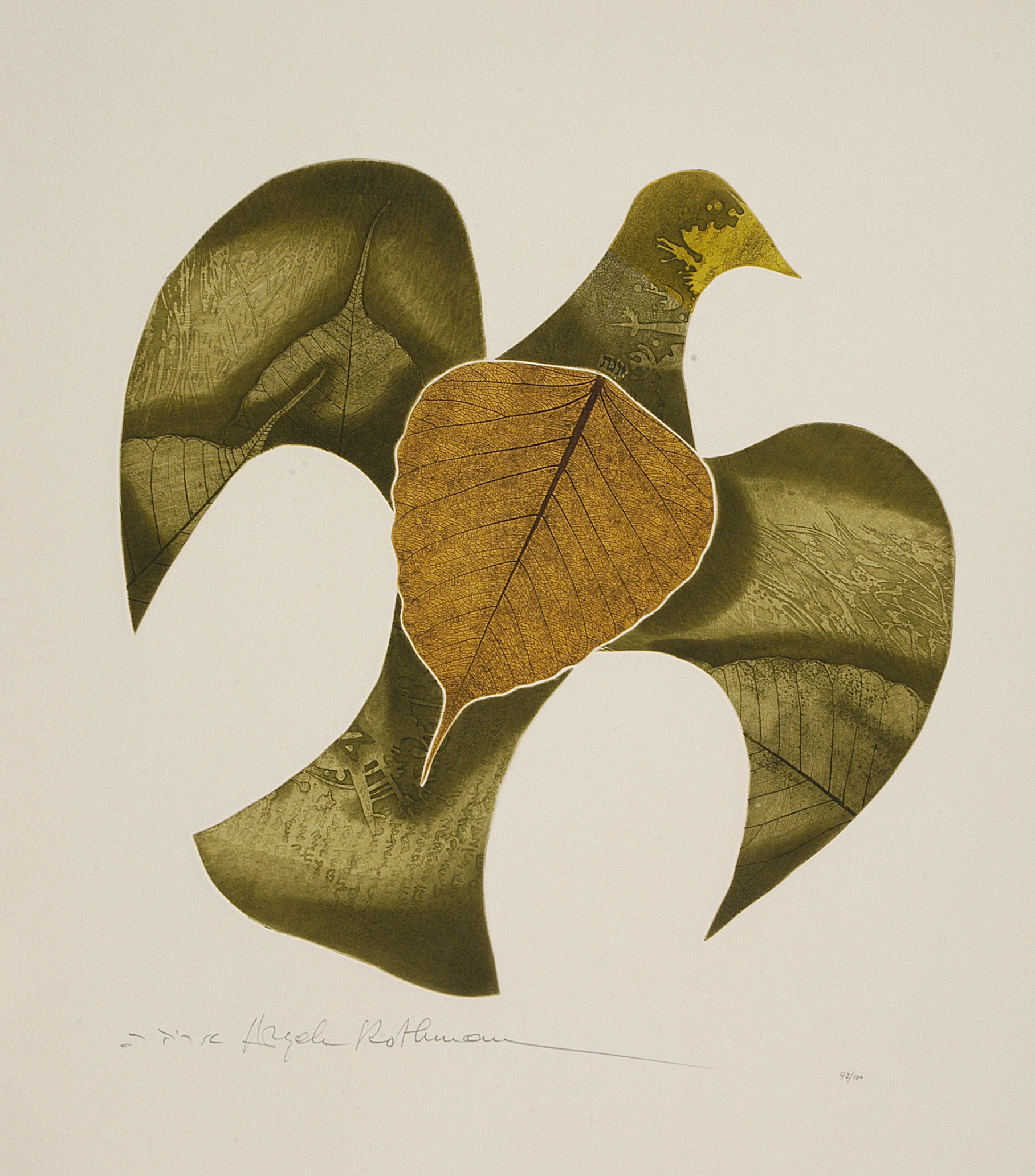
Rothman Aryeh
Dove of Peace
$150$75
22.5" x 30" Etching 1970 Edition 100
Shipping & Handling: $30
Aryeh Rothman was born in 1921 in Vienna, Austria. His religious background and traditional upbringing of his early childhood is not what encouraged him to draw – an activity he was always fond of as far back as he could remember. Aryeh’s father was an active and devoted Zionist which is what led to the family’s eventual immigration to Israel (then Palestine). At the age of 10 Aryeh joined the renowned Chayes Gymnasium, the well known Jewish high school in Vienna where the daily study of modern Hebrew was obligatory. At the age of 16 he became a member of Hashomer Hatzair, a Zionist and Socialist youth movement. However, high school came to an abrupt end in 1938 after Hitler’s invasion of Austria, and in October 1939 six weeks after the outbreak of World War II he boarded a ship, which sailed illegally along the Danube via the Black Sea and the Mediterranean, and eventually after 3 months, arrived at the shores of Palestine. Yet the ship was caught on the way by a British warship, and after its arrival in Haifa the entire group of over 700 immigrants were interned at the camp in Atlit. After he was released in the summer of 1940 A. Rothman spent a year and a half in various kibbutzim, and in 1943 he finally settled in Kibbutz Ein Hamifratz where he lived out his life. Agricultural work, together with the hardship of life, left little time for artistic activities. The artist devoted therefore all of his spare time and holidays to drawing and painting. Volens Nolens he turned into an audodidact. As a member of the “Organization of Painters and Sculptors of the Kibbutz Artzi Movement” he took part in several group exhibitions. From 1955 he served for almost three years as Chairman of the organization. From 1958-1959 he worked as an illustrator for the children’s weekly “Mishmar L’yeladim.” In 1959 he became member of the Association of Sculptors and Painters in Israel. It was not before 1959 that he was granted a trip to France by the Kibbutz. In Paris, after many trials in different places he finally settled in the studio of Johnny Friedlaender where he stayed for a year and a half, devoting all of his time to the thorough study of the art of etching. In 1961 the artist returned to Israel and established an etching studio in Kibbutz Ein Hamifratz. In 1966 he was awarded the Struck Prize by the Haifa Municipality. In 1973 he was invited to teach etching and drawing at the Art Department of Haifa University where he stayed for three years. In 1975 the Mabat Gallery in Tel Aviv published an album under the name “Reflections at War.” This album contained 10 original etchings which were created during the Yom Kippur War in 1973. From 1976-1980 A. Rothman taught etching in Tel Aviv at the “Printing Workshop” of the Association of Painters and Sculptors in Israel. From 1979 he taught drawing and etching at the “Art Teachers Seminary” in Oranim, near Haifa.
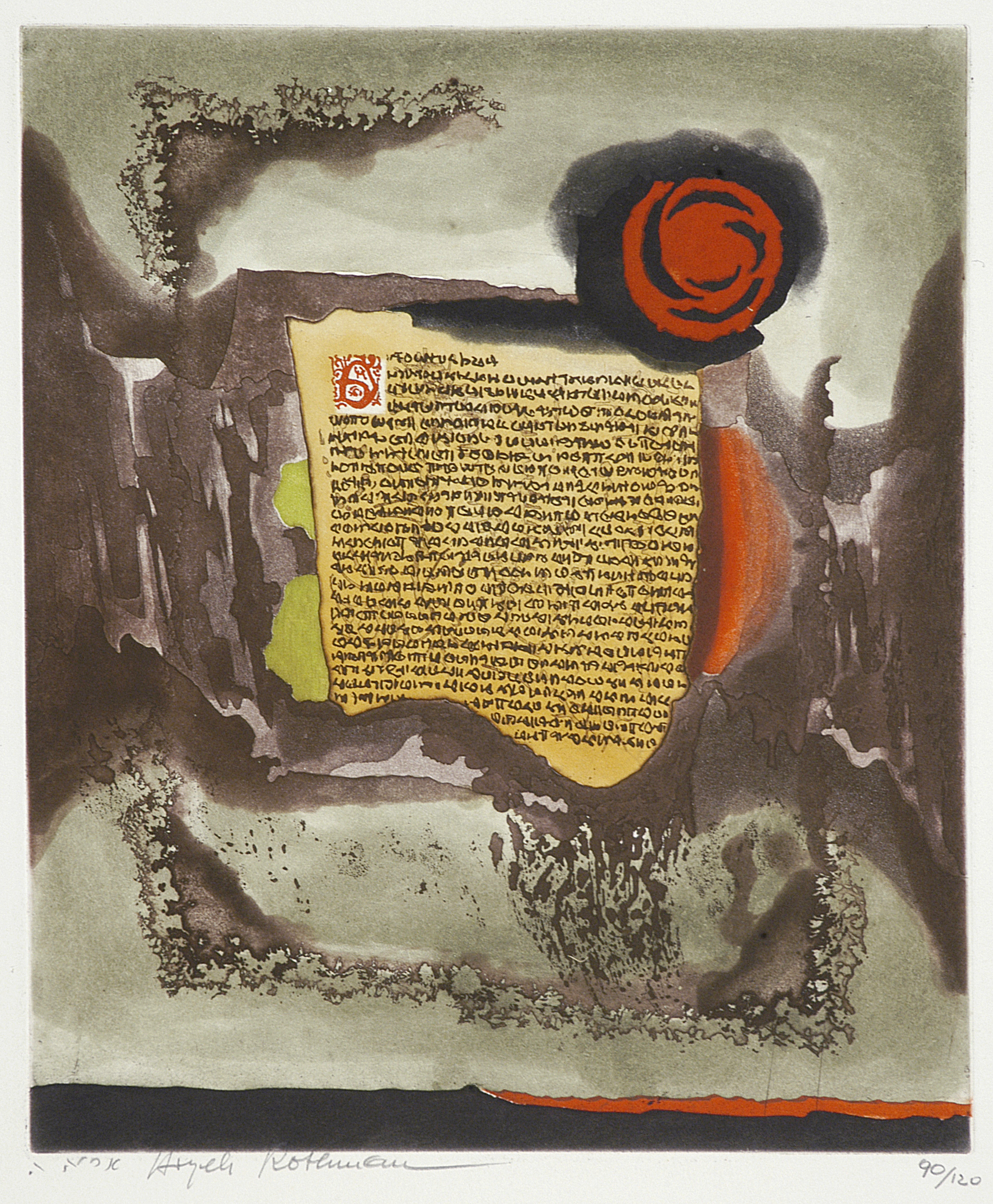
Rothman Aryeh
Illuminated Manuscript
$100$50
15" x 18" Etching 1966 Edition 120
Shipping & Handling: $30
Aryeh Rothman was born in 1921 in Vienna, Austria. His religious background and traditional upbringing of his early childhood is not what encouraged him to draw – an activity he was always fond of as far back as he could remember. Aryeh’s father was an active and devoted Zionist which is what led to the family’s eventual immigration to Israel (then Palestine). At the age of 10 Aryeh joined the renowned Chayes Gymnasium, the well known Jewish high school in Vienna where the daily study of modern Hebrew was obligatory. At the age of 16 he became a member of Hashomer Hatzair, a Zionist and Socialist youth movement. However, high school came to an abrupt end in 1938 after Hitler’s invasion of Austria, and in October 1939 six weeks after the outbreak of World War II he boarded a ship, which sailed illegally along the Danube via the Black Sea and the Mediterranean, and eventually after 3 months, arrived at the shores of Palestine. Yet the ship was caught on the way by a British warship, and after its arrival in Haifa the entire group of over 700 immigrants were interned at the camp in Atlit. After he was released in the summer of 1940 A. Rothman spent a year and a half in various kibbutzim, and in 1943 he finally settled in Kibbutz Ein Hamifratz where he lived out his life. Agricultural work, together with the hardship of life, left little time for artistic activities. The artist devoted therefore all of his spare time and holidays to drawing and painting. Volens Nolens he turned into an audodidact. As a member of the “Organization of Painters and Sculptors of the Kibbutz Artzi Movement” he took part in several group exhibitions. From 1955 he served for almost three years as Chairman of the organization. From 1958-1959 he worked as an illustrator for the children’s weekly “Mishmar L’yeladim.” In 1959 he became member of the Association of Sculptors and Painters in Israel. It was not before 1959 that he was granted a trip to France by the Kibbutz. In Paris, after many trials in different places he finally settled in the studio of Johnny Friedlaender where he stayed for a year and a half, devoting all of his time to the thorough study of the art of etching. In 1961 the artist returned to Israel and established an etching studio in Kibbutz Ein Hamifratz. In 1966 he was awarded the Struck Prize by the Haifa Municipality. In 1973 he was invited to teach etching and drawing at the Art Department of Haifa University where he stayed for three years. In 1975 the Mabat Gallery in Tel Aviv published an album under the name “Reflections at War.” This album contained 10 original etchings which were created during the Yom Kippur War in 1973. From 1976-1980 A. Rothman taught etching in Tel Aviv at the “Printing Workshop” of the Association of Painters and Sculptors in Israel. From 1979 he taught drawing and etching at the “Art Teachers Seminary” in Oranim, near Haifa.
Loading...