Weil Shraga
S-110 Sod
$850
20 inches wide x 28 inches high 51 cm wide x 71 cm high Serigraph 1975 Edition 100
Shipping & Handling: $30
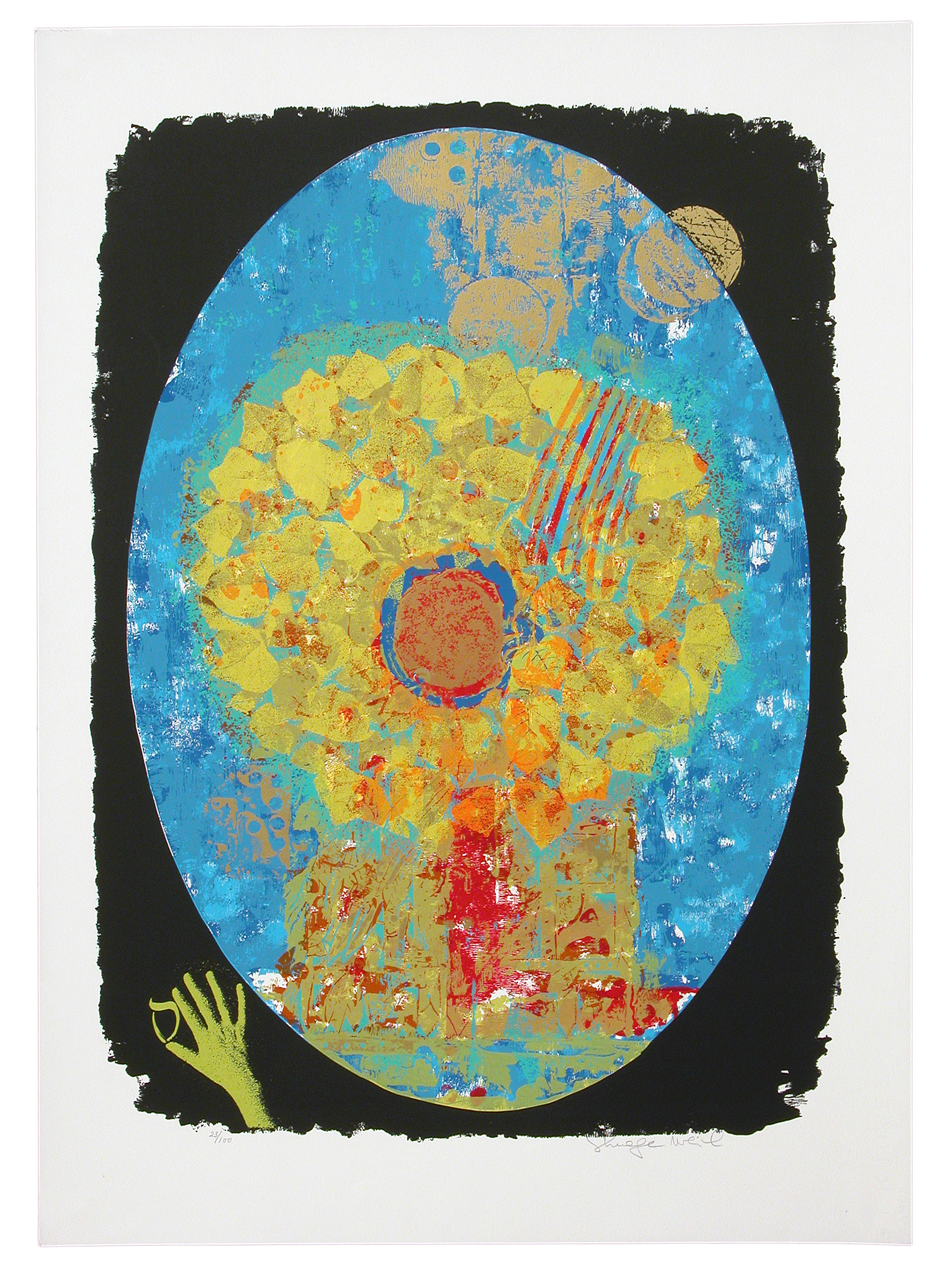
Weil’s image is deliberately mysterious. The oval shape here seems to be the elliptical orbit of a foreign planet – or of the moon – or of an atom around the nucleus of leaves. The darkness beyond may be just a black border to set off the oval or a suggestion of the vast unknown of the universe. The only knowable fragment besides the leaves is the hand which holds the letter between its thumb and forefinger.
Shraga Weil was born in Nitra, Czechoslovakia in 1918 to a family of teachers, journalists and merchants. His father, a building engineer, who was an amateur painter, sent him to study with a local sculptor and then to the Prague School of Art.
He produced his first graphic works during World War II, part of which he spent as a prisoner. After the war, Weil sailed for Israel on an illegal immigrant ship, eventually arriving in the new country in 1947 and becoming a member of Kibbutz Haogen, where he has been living ever since.
In 1954 Weil spent some time studying murals and graphic techniques at the Academie des Beaux Arts, Paris and Ravenna mosaics with Prof. Severinl.
Shraga Weil’s works have been exhibited in the United States, South America, Canada, Australia, France, the USSR, Switzerland, and in the International Exhibition of Graphic Arts, in Lugano. In 1959, Weil was awarded Tel Aviv’s Dizengoff Art Prize
Weil Shraga
S-113 Kabbalah
$1200
21.5 inches wide x 29.5 inches high 55 cm wide x 75 cm high Serigraph 1976 Edition 200
Shipping & Handling: $30
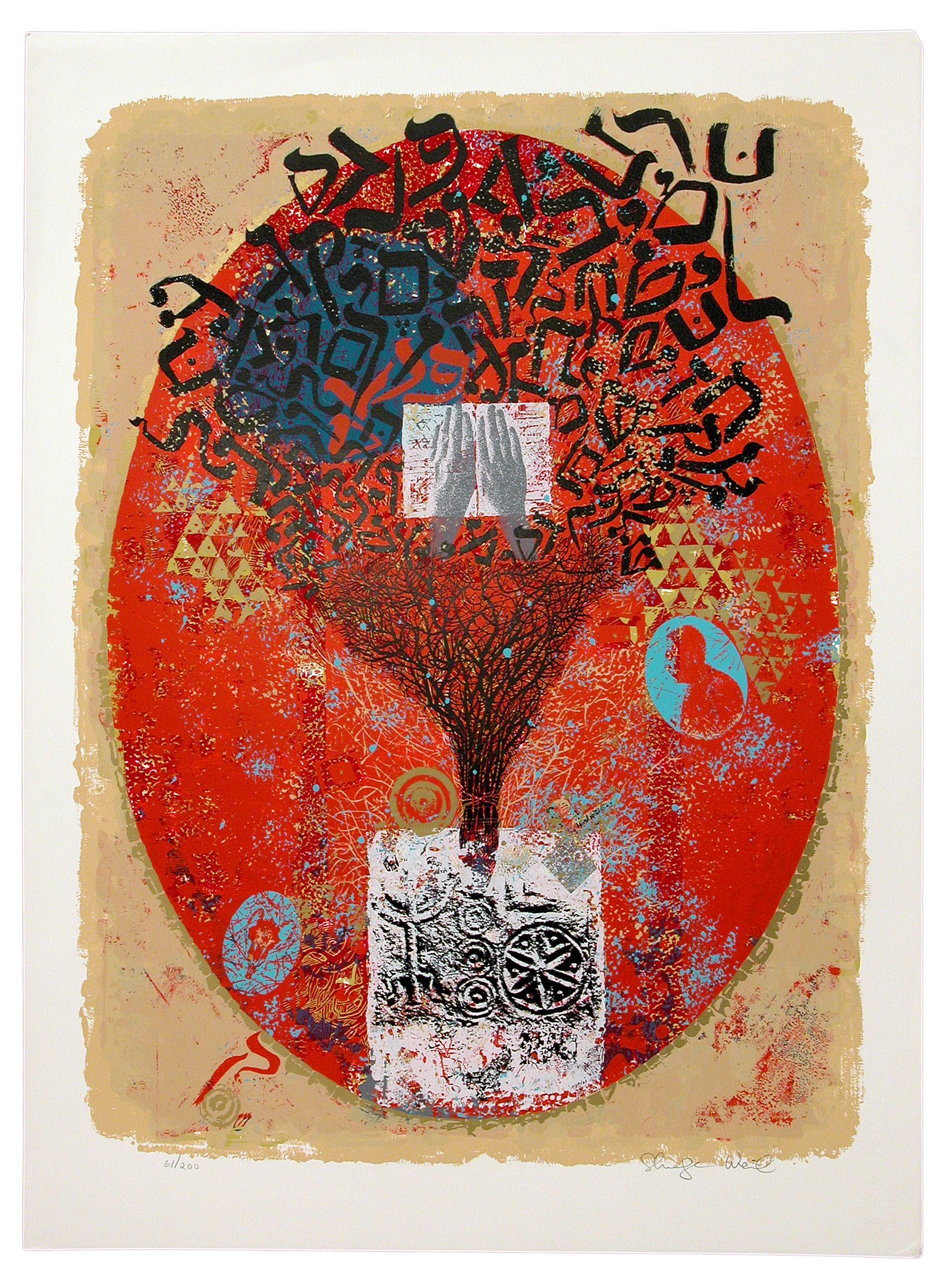
Weil’s respect for the “the Word” is again evident here. The bond between tradition and a literary history remains unbroken and is visually expressed in the blossoming of the brambles of a thicket into the letters of the Hebrew alphabet. The hands and book superimposed on the “bouquet” of letters suggests reverence; while below, the vase-like bas-relief fragment depicting a candlestick and six-pointed star reminds us that all springs from a tangible historical past.
Shraga Weil was born in Nitra, Czechoslovakia in 1918 to a family of teachers, journalists and merchants. His father, a building engineer, who was an amateur painter, sent him to study with a local sculptor and then to the Prague School of Art.
He produced his first graphic works during World War II, part of which he spent as a prisoner. After the war, Weil sailed for Israel on an illegal immigrant ship, eventually arriving in the new country in 1947 and becoming a member of Kibbutz Haogen, where he has been living ever since.
In 1954 Weil spent some time studying murals and graphic techniques at the Academie des Beaux Arts, Paris and Ravenna mosaics with Prof. Severinl.
Shraga Weil’s works have been exhibited in the United States, South America, Canada, Australia, France, the USSR, Switzerland, and in the International Exhibition of Graphic Arts, in Lugano. In 1959, Weil was awarded Tel Aviv’s Dizengoff Art Prize
Loading...