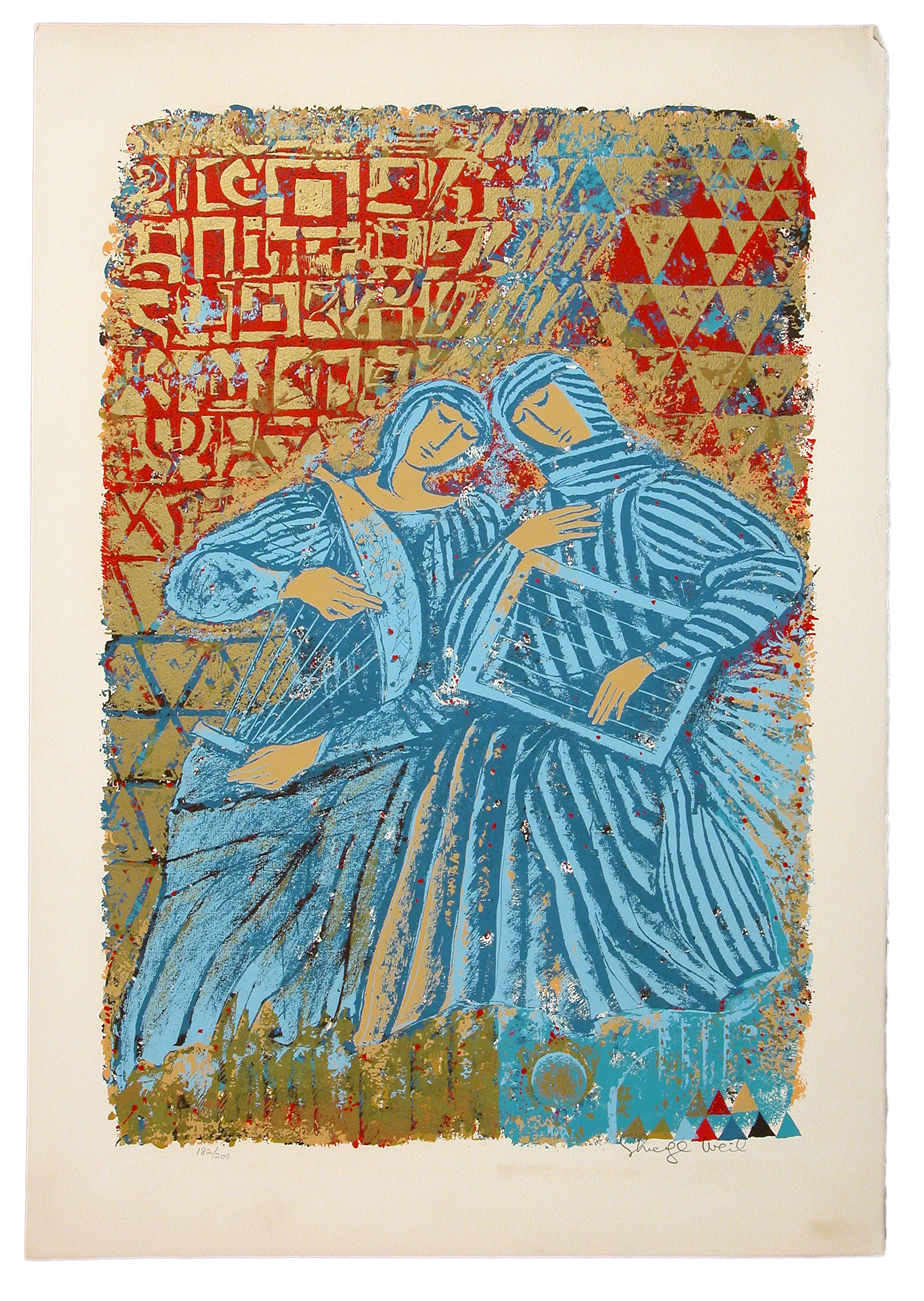
Weil Shraga
S-122 The Harpists
$500
21 inches wide x 29.5 inches high 53 cm wide x 75 cm high Serigraph 1975 Edition 200
Shipping & Handling: $30
Shraga Weil was born in Nitra, Czechoslovakia in 1918 to a family of teachers, journalists and merchants. His father, a building engineer, who was an amateur painter, sent him to study with a local sculptor and then to the Prague School of Art.
He produced his first graphic works during World War II, part of which he spent as a prisoner. After the war, Weil sailed for Israel on an illegal immigrant ship, eventually arriving in the new country in 1947 and becoming a member of Kibbutz Haogen, where he has been living ever since.
In 1954 Weil spent some time studying murals and graphic techniques at the Academie des Beaux Arts, Paris and Ravenna mosaics with Prof. Severinl.
Shraga Weil’s works have been exhibited in the United States, South America, Canada, Australia, France, the USSR, Switzerland, and in the International Exhibition of Graphic Arts, in Lugano. In 1959, Weil was awarded Tel Aviv’s Dizengoff Art Prize.
Museums and Public Collections
Brandeis University, Waltham, Massachusetts
Boston Public Library
Israel Museum, Jerusalem
William Rockhill Nelson Gallery, Kansas City, MO
Fogg Museum, Harvard University
Los Angeles County Museum
Jewish Museum, New York
Philadephia Museum of Art
Joslyn Museum, Omaha, Nebraska
Judah Magnes Museum, Berkeley, CA
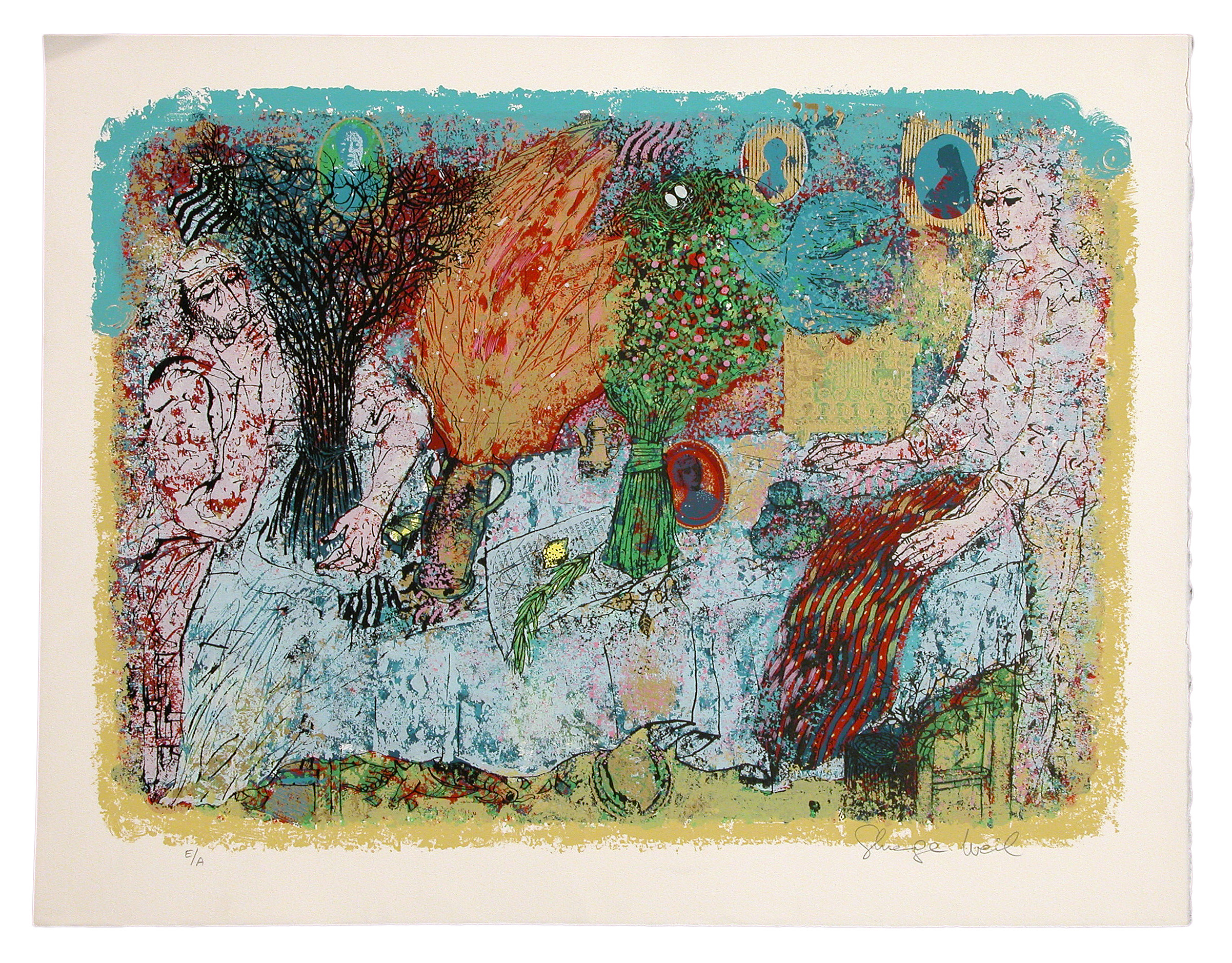
Weil Shraga
S-123 Vayehi
$500
26 inches wide X 19.75 inches high 66 cm wide X 50 cm high Serigraph 1977 Edition 200
Shipping & Handling: $30
An allegory of the Generations, beginning with the younger, at the right, and progressing to the older, at left, from whom the succeeding generation receives the personal symbols of life.
Shraga Weil was born in Nitra, Czechoslovakia in 1918 to a family of teachers, journalists and merchants. His father, a building engineer, who was an amateur painter, sent him to study with a local sculptor and then to the Prague School of Art.
He produced his first graphic works during World War II, part of which he spent as a prisoner. After the war, Weil sailed for Israel on an illegal immigrant ship, eventually arriving in the new country in 1947 and becoming a member of Kibbutz Haogen, where he has been living ever since.
In 1954 Weil spent some time studying murals and graphic techniques at the Academie des Beaux Arts, Paris and Ravenna mosaics with Prof. Severinl.
Shraga Weil’s works have been exhibited in the United States, South America, Canada, Australia, France, the USSR, Switzerland, and in the International Exhibition of Graphic Arts, in Lugano. In 1959, Weil was awarded Tel Aviv’s Dizengoff Art Prize.
Museums and Public Collections
Brandeis University, Waltham, Massachusetts
Boston Public Library
Israel Museum, Jerusalem
William Rockhill Nelson Gallery, Kansas City, MO
Fogg Museum, Harvard University
Los Angeles County Museum
Jewish Museum, New York
Philadephia Museum of Art
Joslyn Museum, Omaha, Nebraska
Judah Magnes Museum, Berkeley, CA
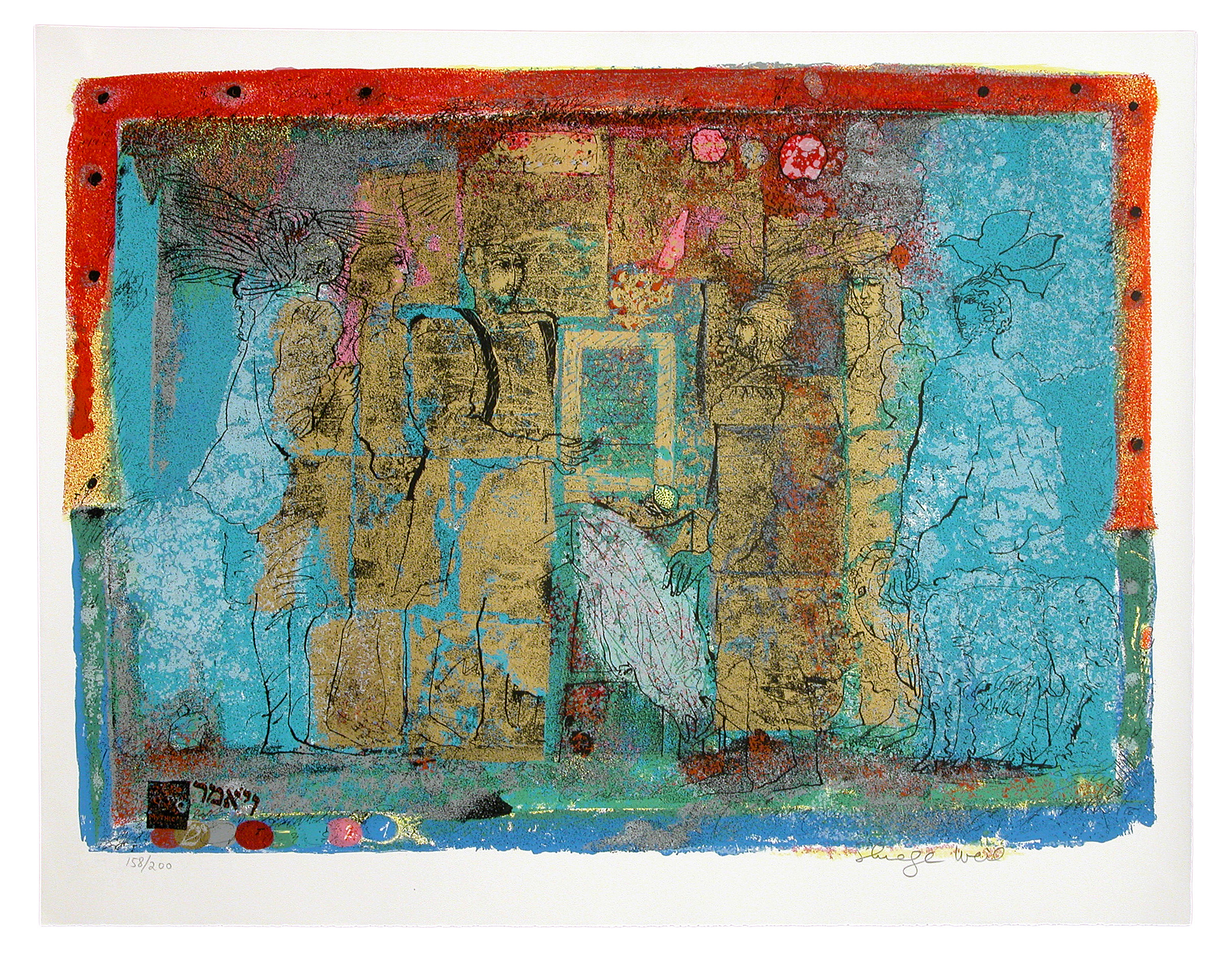
Weil Shraga
S-124 Vayomer
$500
25 inches wide X 19.75 inches high 64 cm wide X 50 cm high Serigraph 1977 Edition 200
Shipping & Handling: $30
Against the solid foundation of a rock wall fragment the artist juxtaposes ghost-like figures from his repertoire of familiar characters. There is the carrier of wood (which is used to burn offerings) at left, the shepherd with ram at right (with a bird alighting on his head), and a teacher at center (gesturing toward the central alter with etrog upon it). The work is a summary of all the legends of the Midrash that have nourished the artist, all the stories and tales that culminate in Vayomer – and he said – to bring home their moral points
Shraga Weil was born in Nitra, Czechoslovakia in 1918 to a family of teachers, journalists and merchants. His father, a building engineer, who was an amateur painter, sent him to study with a local sculptor and then to the Prague School of Art.
He produced his first graphic works during World War II, part of which he spent as a prisoner. After the war, Weil sailed for Israel on an illegal immigrant ship, eventually arriving in the new country in 1947 and becoming a member of Kibbutz Haogen, where he has been living ever since.
In 1954 Weil spent some time studying murals and graphic techniques at the Academie des Beaux Arts, Paris and Ravenna mosaics with Prof. Severinl.
Shraga Weil’s works have been exhibited in the United States, South America, Canada, Australia, France, the USSR, Switzerland, and in the International Exhibition of Graphic Arts, in Lugano. In 1959, Weil was awarded Tel Aviv’s Dizengoff Art Prize.
Museums and Public Collections
Brandeis University, Waltham, Massachusetts
Boston Public Library
Israel Museum, Jerusalem
William Rockhill Nelson Gallery, Kansas City, MO
Fogg Museum, Harvard University
Los Angeles County Museum
Jewish Museum, New York
Philadephia Museum of Art
Joslyn Museum, Omaha, Nebraska
Judah Magnes Museum, Berkeley, CA
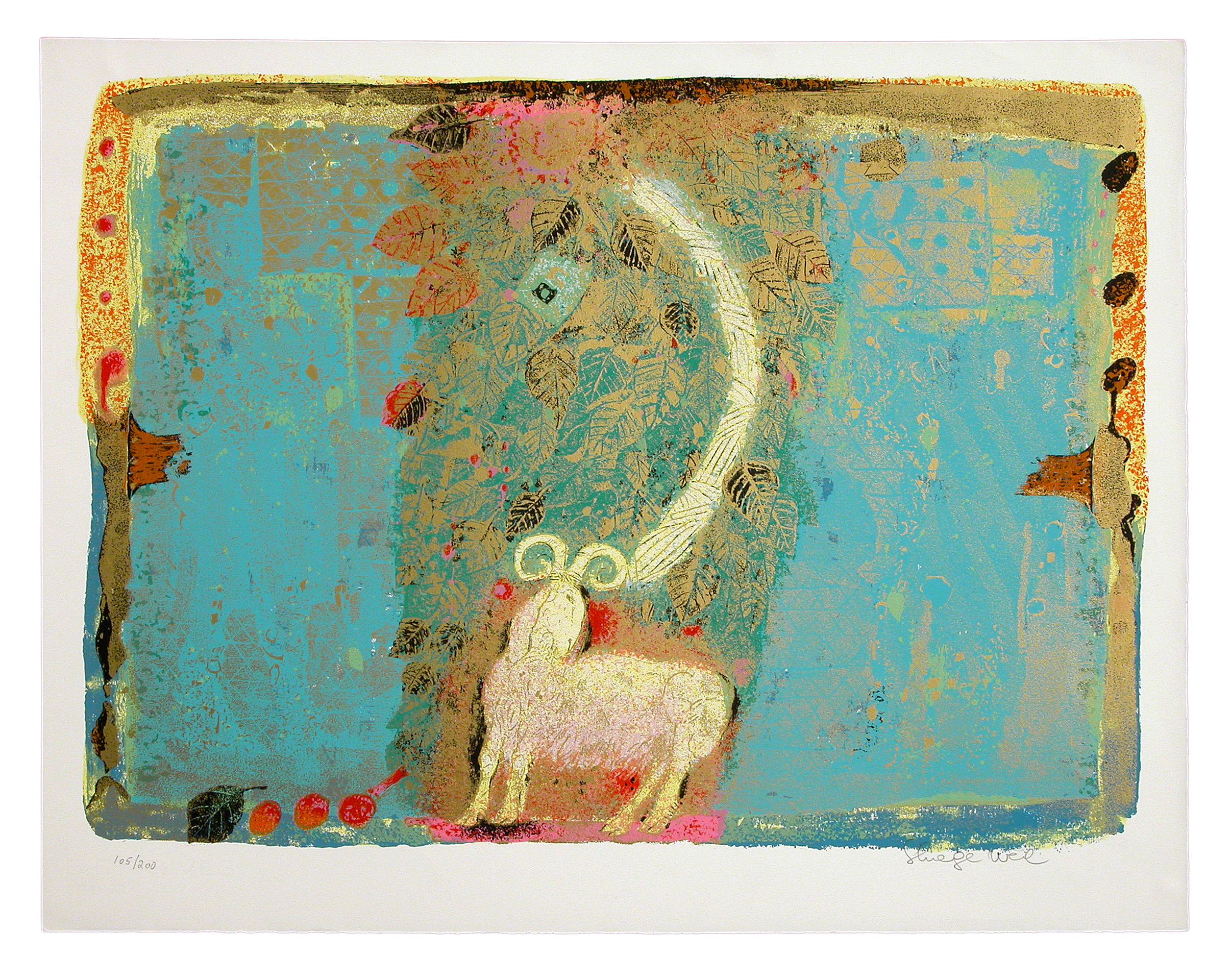
Weil Shraga
S-125 Tam
$500
25 inches wide X 19.75 inches high 64 cm wide X 50 cm high Serigraph 1977 Edition 200
Shipping & Handling: $30
For Weil the ram has always been a subject of special attraction. Is it because of those symmetrical spirals crowning its head? Because of its role as a symbol of sacrifice? Or is it just a natural part of the bucolic scenery which is the background of Weil’s world of images? No single reason lies behind the artist’s choice o;f the ram as subject matter. But the title of the work tells us of its importance as the embodiment of the notion of sacrifice. The ram’s luminous glow and the arc reaching heavenward bespeak a spiritual end to be gained from sacrifice, while the purity and delicacy of color of the gold-heightened ground attain an other worldly beauty
Shraga Weil was born in Nitra, Czechoslovakia in 1918 to a family of teachers, journalists and merchants. His father, a building engineer, who was an amateur painter, sent him to study with a local sculptor and then to the Prague School of Art.
He produced his first graphic works during World War II, part of which he spent as a prisoner. After the war, Weil sailed for Israel on an illegal immigrant ship, eventually arriving in the new country in 1947 and becoming a member of Kibbutz Haogen, where he has been living ever since.
In 1954 Weil spent some time studying murals and graphic techniques at the Academie des Beaux Arts, Paris and Ravenna mosaics with Prof. Severinl.
Shraga Weil’s works have been exhibited in the United States, South America, Canada, Australia, France, the USSR, Switzerland, and in the International Exhibition of Graphic Arts, in Lugano. In 1959, Weil was awarded Tel Aviv’s Dizengoff Art Prize.
Museums and Public Collections
Brandeis University, Waltham, Massachusetts
Boston Public Library
Israel Museum, Jerusalem
William Rockhill Nelson Gallery, Kansas City, MO
Fogg Museum, Harvard University
Los Angeles County Museum
Jewish Museum, New York
Philadephia Museum of Art
Joslyn Museum, Omaha, Nebraska
Judah Magnes Museum, Berkeley, CA
Loading...