Weil Shraga
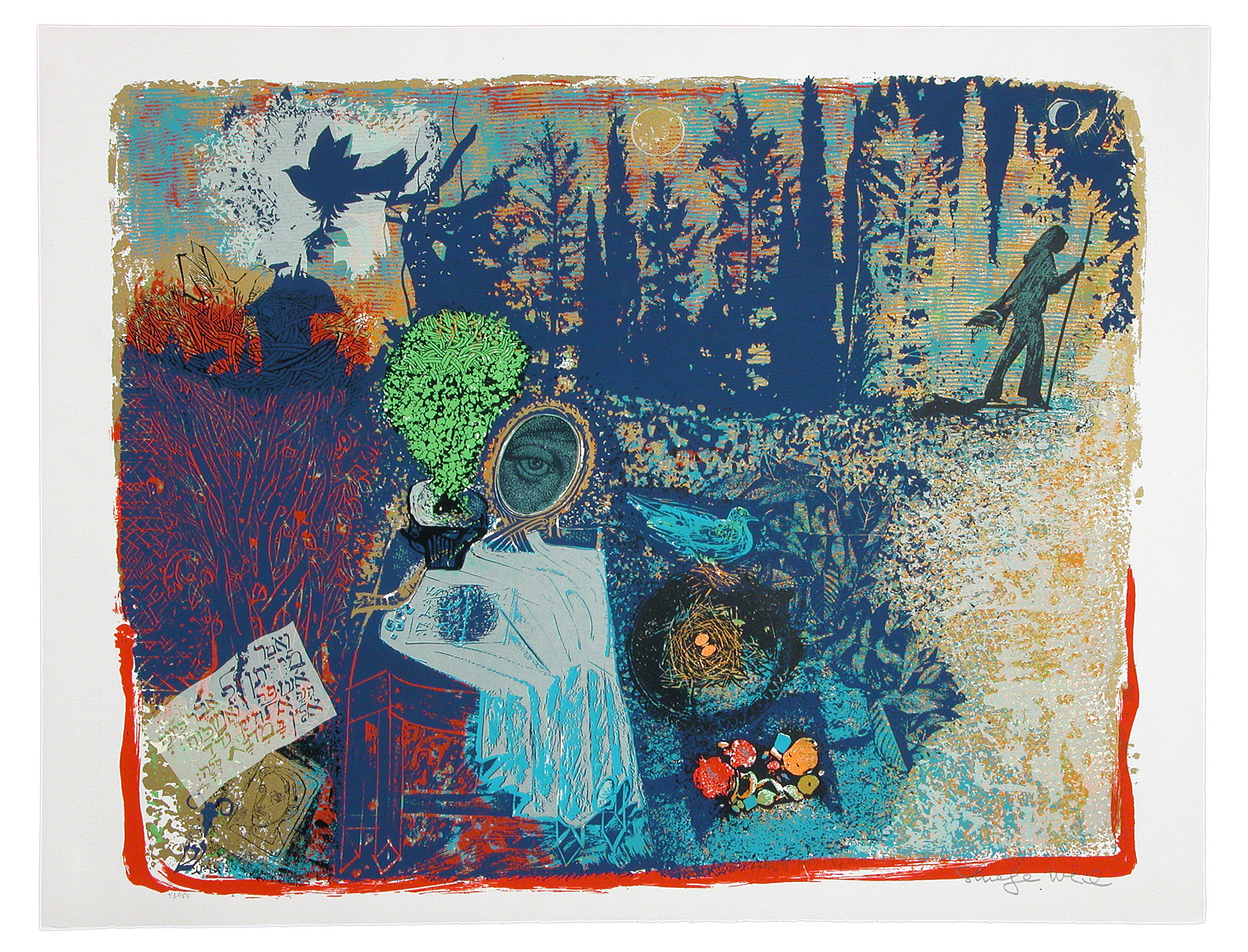
S-104 Spring
$500
25.5 Inches wide x 19.75 Inches high 65 cm wide x 50 cm high Serigraph 1971 Edition 150
Shipping & Handling: $30
Shraga Weil was born in Nitra, Czechoslovakia in 1918 to a family of teachers, journalists and merchants. His father, a building engineer, who was an amateur painter, sent him to study with a local sculptor and then to the Prague School of Art.
He produced his first graphic works during World War II, part of which he spent as a prisoner. After the war, Weil sailed for Israel on an illegal immigrant ship, eventually arriving in the new country in 1947 and becoming a member of Kibbutz Haogen, where he has been living ever since.
In 1954 Weil spent some time studying murals and graphic techniques at the Academie des Beaux Arts, Paris and Ravenna mosaics with Prof. Severinl.
Shraga Weil’s works have been exhibited in the United States, South America, Canada, Australia, France, the USSR, Switzerland, and in the International Exhibition of Graphic Arts, in Lugano. In 1959, Weil was awarded Tel Aviv’s Dizengoff Art Prize.
Museums and Public Collections
Brandeis University, Waltham, Massachusetts
Boston Public Library
Israel Museum, Jerusalem
William Rockhill Nelson Gallery, Kansas City, MO
Fogg Museum, Harvard University
Los Angeles County Museum
Jewish Museum, New York
Philadephia Museum of Art
Joslyn Museum, Omaha, Nebraska
Judah Magnes Museum, Berkeley, CA
Weil Shraga
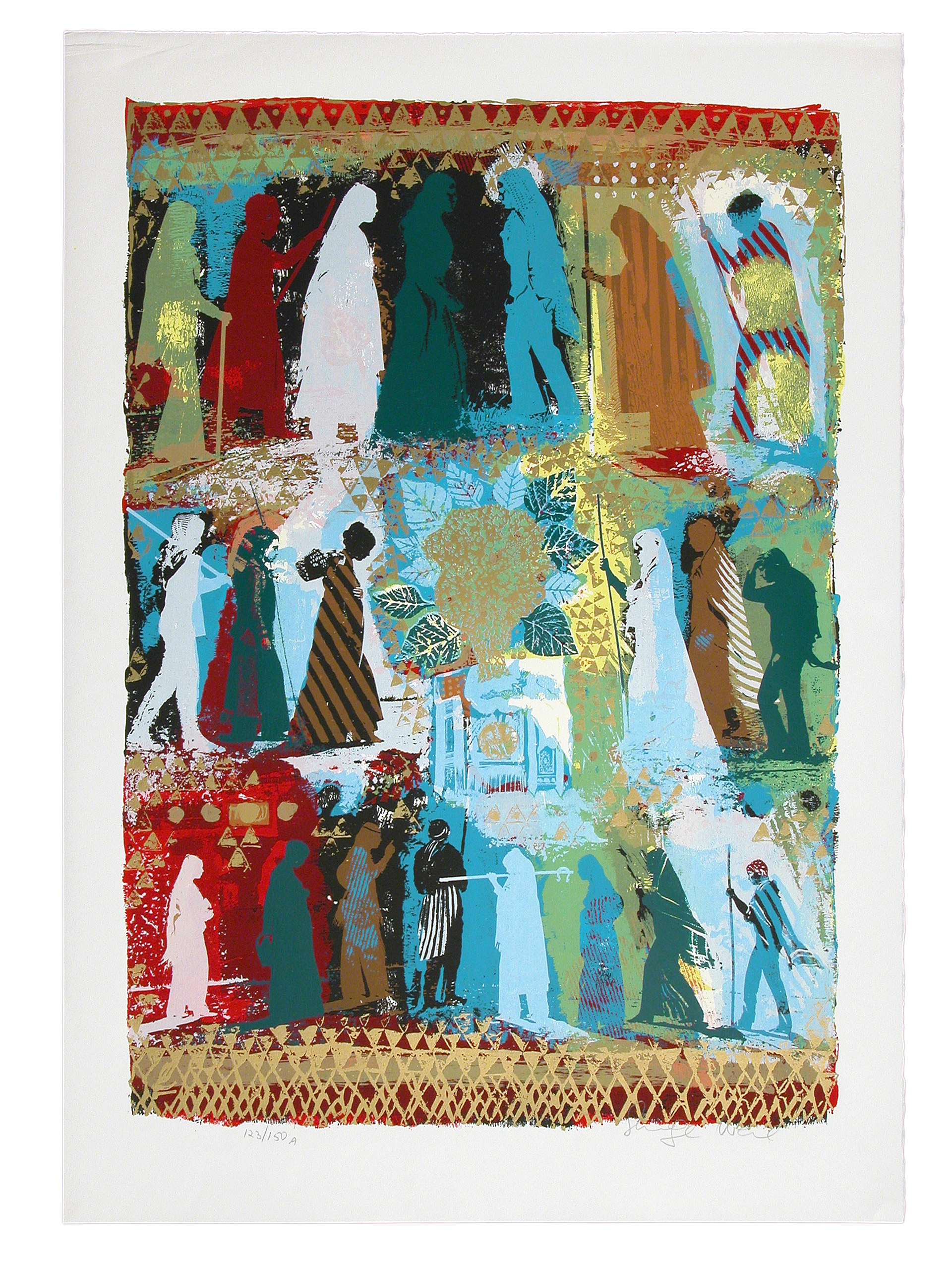
S-106 Pilgrimage
$500
19.75 Inches wide x 27.5 Inches high 50 cm wide x 70 cm high Serigraph 1971
Shipping & Handling: $30
Weil’s unorthodox arrangement of rows of diminishing figures, directed toward the central axis of this work and focused upon the “bouquet” at center, is typical of this artist’s visual solution to a complex idea. The figures appear and disappear, silhouetted against contrasting or harmonizing backgrounds. While an over-all pattern of varying textures keeps the surface active, it also suggests the constant restless movement of the pilgrims on an unspecific but inevitable journey.
Shraga Weil was born in Nitra, Czechoslovakia in 1918 to a family of teachers, journalists and merchants. His father, a building engineer, who was an amateur painter, sent him to study with a local sculptor and then to the Prague School of Art.
He produced his first graphic works during World War II, part of which he spent as a prisoner. After the war, Weil sailed for Israel on an illegal immigrant ship, eventually arriving in the new country in 1947 and becoming a member of Kibbutz Haogen, where he has been living ever since.
In 1954 Weil spent some time studying murals and graphic techniques at the Academie des Beaux Arts, Paris and Ravenna mosaics with Prof. Severinl.
Shraga Weil’s works have been exhibited in the United States, South America, Canada, Australia, France, the USSR, Switzerland, and in the International Exhibition of Graphic Arts, in Lugano. In 1959, Weil was awarded Tel Aviv’s Dizengoff Art Prize.
Museums and Public Collections
Brandeis University, Waltham, Massachusetts
Boston Public Library
Israel Museum, Jerusalem
William Rockhill Nelson Gallery, Kansas City, MO
Fogg Museum, Harvard University
Los Angeles County Museum
Jewish Museum, New York
Philadephia Museum of Art
Joslyn Museum, Omaha, Nebraska
Judah Magnes Museum, Berkeley, CA
Weil Shraga
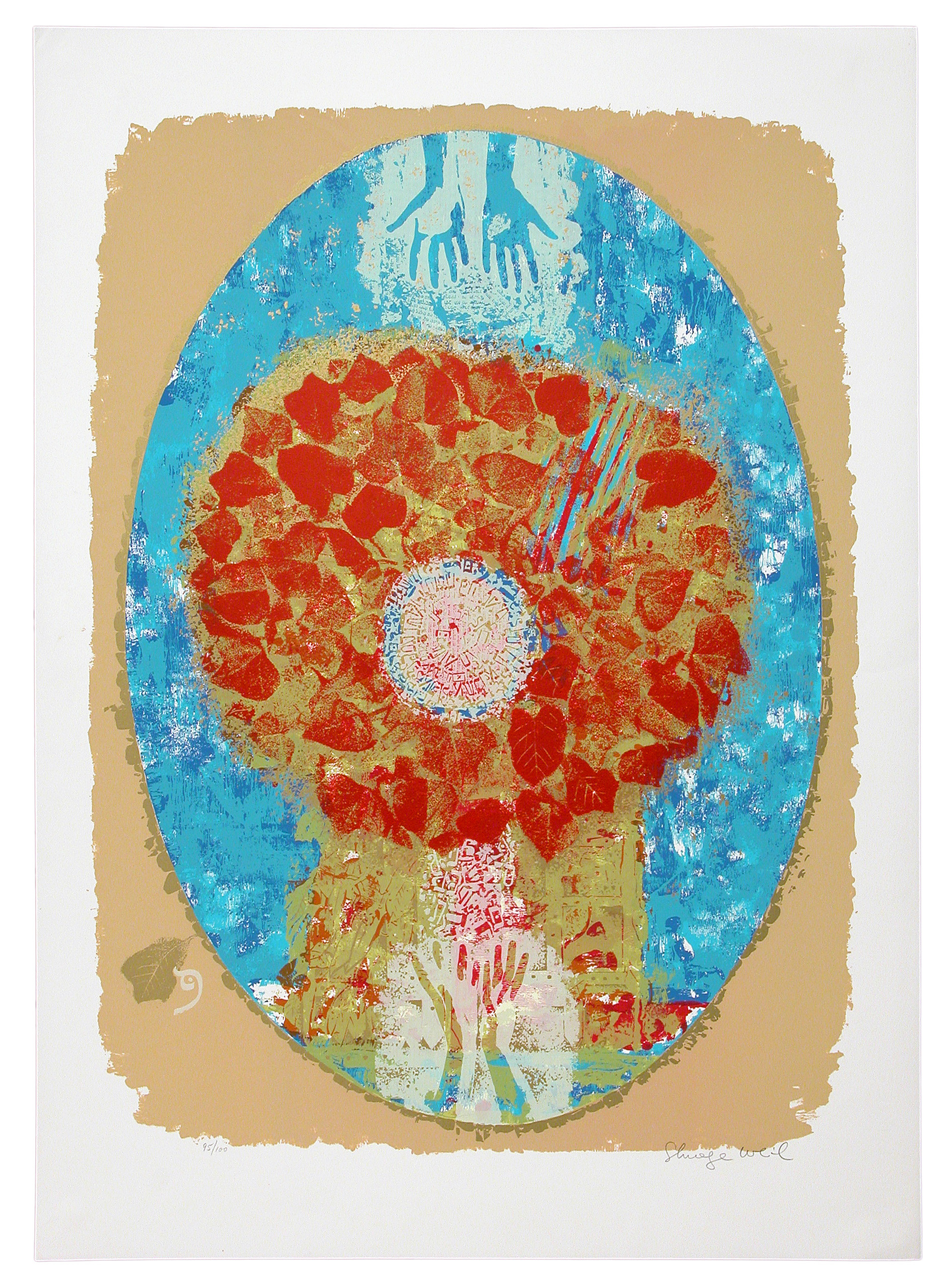
S-107 Peshat
$850
20 inches wide x 28 inches high 51 cm wide x 71 cm high Serigraph 1975 Edition 100
Shipping & Handling: $30
Peshat (literal) has at its center a spiral of Hebrew characters enclosed in a crown of leaves, suggesting the tree of knowledge. Hands from above and below reach toward the center. The symbolism suggests the hands of the Giver and receiver, or the hands of those who reach out for knowledge. One is left to contemplate the glowing colors and intimations of spirituality
Shraga Weil was born in Nitra, Czechoslovakia in 1918 to a family of teachers, journalists and merchants. His father, a building engineer, who was an amateur painter, sent him to study with a local sculptor and then to the Prague School of Art.
He produced his first graphic works during World War II, part of which he spent as a prisoner. After the war, Weil sailed for Israel on an illegal immigrant ship, eventually arriving in the new country in 1947 and becoming a member of Kibbutz Haogen, where he has been living ever since.
In 1954 Weil spent some time studying murals and graphic techniques at the Academie des Beaux Arts, Paris and Ravenna mosaics with Prof. Severinl.
Shraga Weil’s works have been exhibited in the United States, South America, Canada, Australia, France, the USSR, Switzerland, and in the International Exhibition of Graphic Arts, in Lugano. In 1959, Weil was awarded Tel Aviv’s Dizengoff Art Prize
Weil Shraga
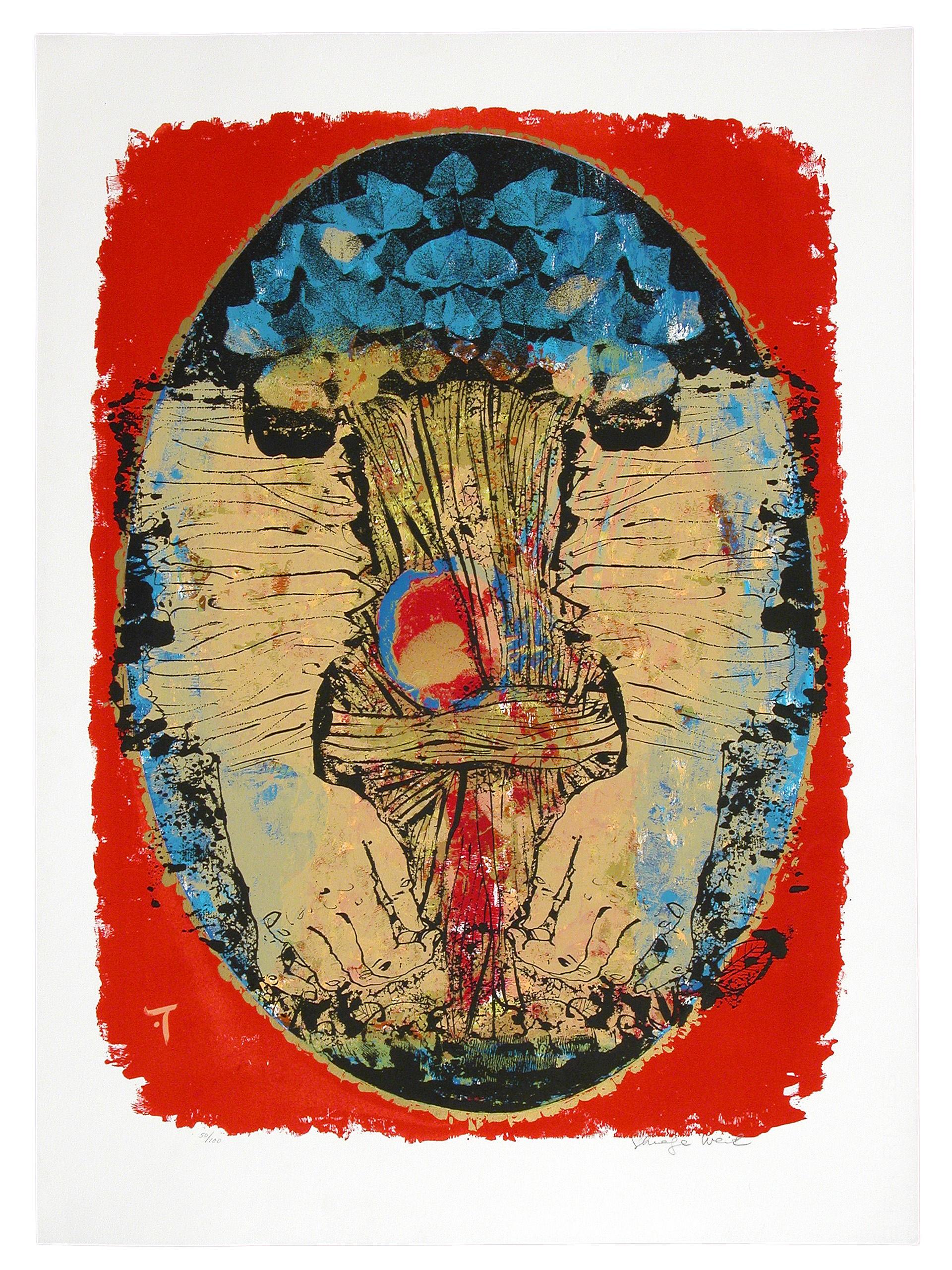
S-109 Derash
$850
20 inches wide x 28 inches high 51 cm wide x 71 cm high Serigraph 1975 Edition 100
Shipping & Handling: $30
The suggestion here is of tying together of ideas. The great hands, arranged symmetrically at the sides of the stalks convey a feeling of strength and formality.
Shraga Weil was born in Nitra, Czechoslovakia in 1918 to a family of teachers, journalists and merchants. His father, a building engineer, who was an amateur painter, sent him to study with a local sculptor and then to the Prague School of Art.
He produced his first graphic works during World War II, part of which he spent as a prisoner. After the war, Weil sailed for Israel on an illegal immigrant ship, eventually arriving in the new country in 1947 and becoming a member of Kibbutz Haogen, where he has been living ever since.
In 1954 Weil spent some time studying murals and graphic techniques at the Academie des Beaux Arts, Paris and Ravenna mosaics with Prof. Severinl.
Shraga Weil’s works have been exhibited in the United States, South America, Canada, Australia, France, the USSR, Switzerland, and in the International Exhibition of Graphic Arts, in Lugano. In 1959, Weil was awarded Tel Aviv’s Dizengoff Art Prize
Loading...