Weil Shraga
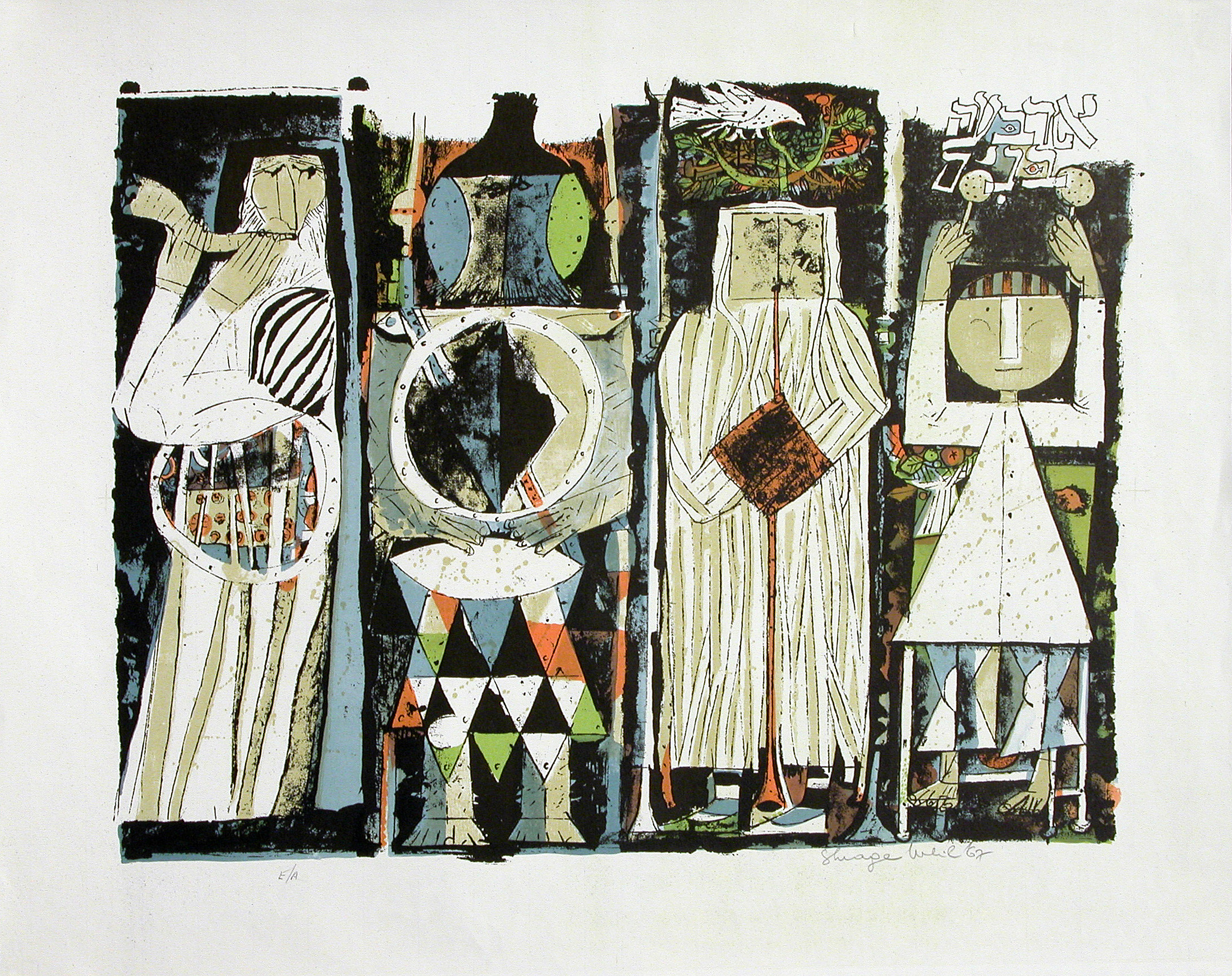
S-3 Four Sons
$400
24.5 inches wide x 19 Inches high 62 cm wide x 48 cm high Serigraph 1963
Shipping & Handling: $30
“The Rabbis enumerated four kinds of sons: the wise, the wicked, the simple, and the one who does not even know how to ask. Each one should be told the story of the Exodus (of Passover) in a different manner.” Likewise, each generation presents its artists with different costumes for each of the sons. For example, medieval illustrations depicted the ‘wicked’ son as a murderous crusader, the early 20th century artist showed him as a Prussian officer. Weil has drawn from ancient and modern garb for his “Four Sons”.
Shraga Weil was born in Nitra, Czechoslovakia in 1918 to a family of teachers, journalists and merchants. His father, a building engineer, who was an amateur painter, sent him to study with a local sculptor and then to the Prague School of Art.
He produced his first graphic works during World War II, part of which he spent as a prisoner. After the war, Weil sailed for Israel on an illegal immigrant ship, eventually arriving in the new country in 1947 and becoming a member of Kibbutz Haogen, where he has been living ever since.
In 1954 Weil spent some time studying murals and graphic techniques at the Academie des Beaux Arts, Paris and Ravenna mosaics with Prof. Severinl.
Shraga Weil’s works have been exhibited in the United States, South America, Canada, Australia, France, the USSR, Switzerland, and in the International Exhibition of Graphic Arts, in Lugano. In 1959, Weil was awarded Tel Aviv’s Dizengoff Art Prize.
Museums and Public Collections
Brandeis University, Waltham, Massachusetts
Boston Public Library
Israel Museum, Jerusalem
William Rockhill Nelson Gallery, Kansas City, MO
Fogg Museum, Harvard University
Los Angeles County Museum
Jewish Museum, New York
Philadephia Museum of Art
Joslyn Museum, Omaha, Nebraska
Judah Magnes Museum, Berkeley, CA
Weil Shraga
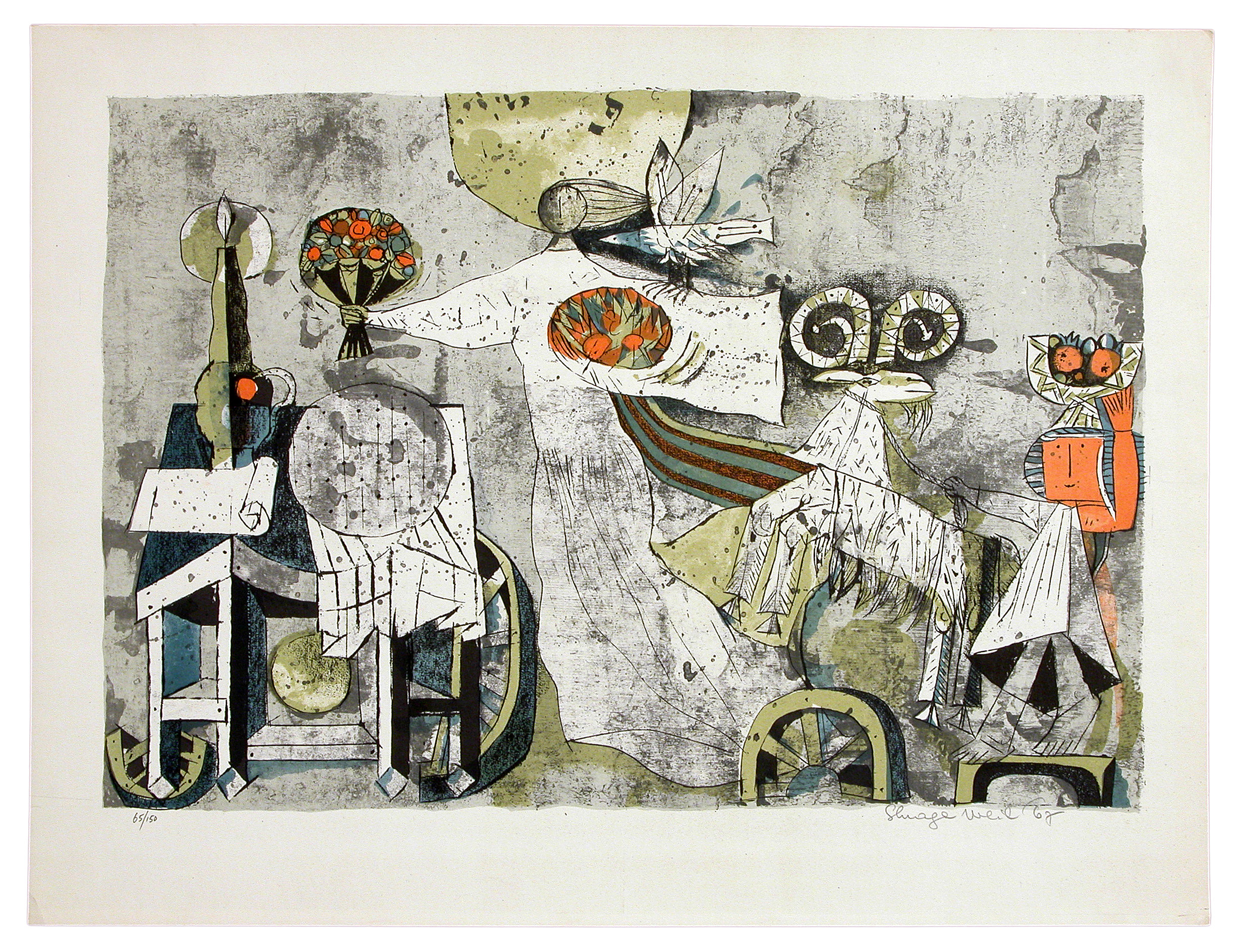
S-4 Symbols of Pessach
$400
24.5 inches wide x 18.5 Inches high 62 cm wide x 47 cm high Serigraph 1963 Edition 150
Shipping & Handling: $30
Weil has selected symbols from Jewish tradition and from his Kibbutz experience in his search to fashion a new, viable tradition. Emphasis is placed upon the produce, e.g., flowers fruits; the animals, e.g., birds and goats of the agricultural settlement as well as references to the round matzah and the candle welcoming the festival. The woman moving across the field of textures is gathering the symbols of spring.
Shraga Weil was born in Nitra, Czechoslovakia in 1918 to a family of teachers, journalists and merchants. His father, a building engineer, who was an amateur painter, sent him to study with a local sculptor and then to the Prague School of Art.
He produced his first graphic works during World War II, part of which he spent as a prisoner. After the war, Weil sailed for Israel on an illegal immigrant ship, eventually arriving in the new country in 1947 and becoming a member of Kibbutz Haogen, where he has been living ever since.
In 1954 Weil spent some time studying murals and graphic techniques at the Academie des Beaux Arts, Paris and Ravenna mosaics with Prof. Severinl.
Shraga Weil’s works have been exhibited in the United States, South America, Canada, Australia, France, the USSR, Switzerland, and in the International Exhibition of Graphic Arts, in Lugano. In 1959, Weil was awarded Tel Aviv’s Dizengoff Art Prize.
Museums and Public Collections
Brandeis University, Waltham, Massachusetts
Boston Public Library
Israel Museum, Jerusalem
William Rockhill Nelson Gallery, Kansas City, MO
Fogg Museum, Harvard University
Los Angeles County Museum
Jewish Museum, New York
Philadephia Museum of Art
Joslyn Museum, Omaha, Nebraska
Judah Magnes Museum, Berkeley, CA
Weil Shraga
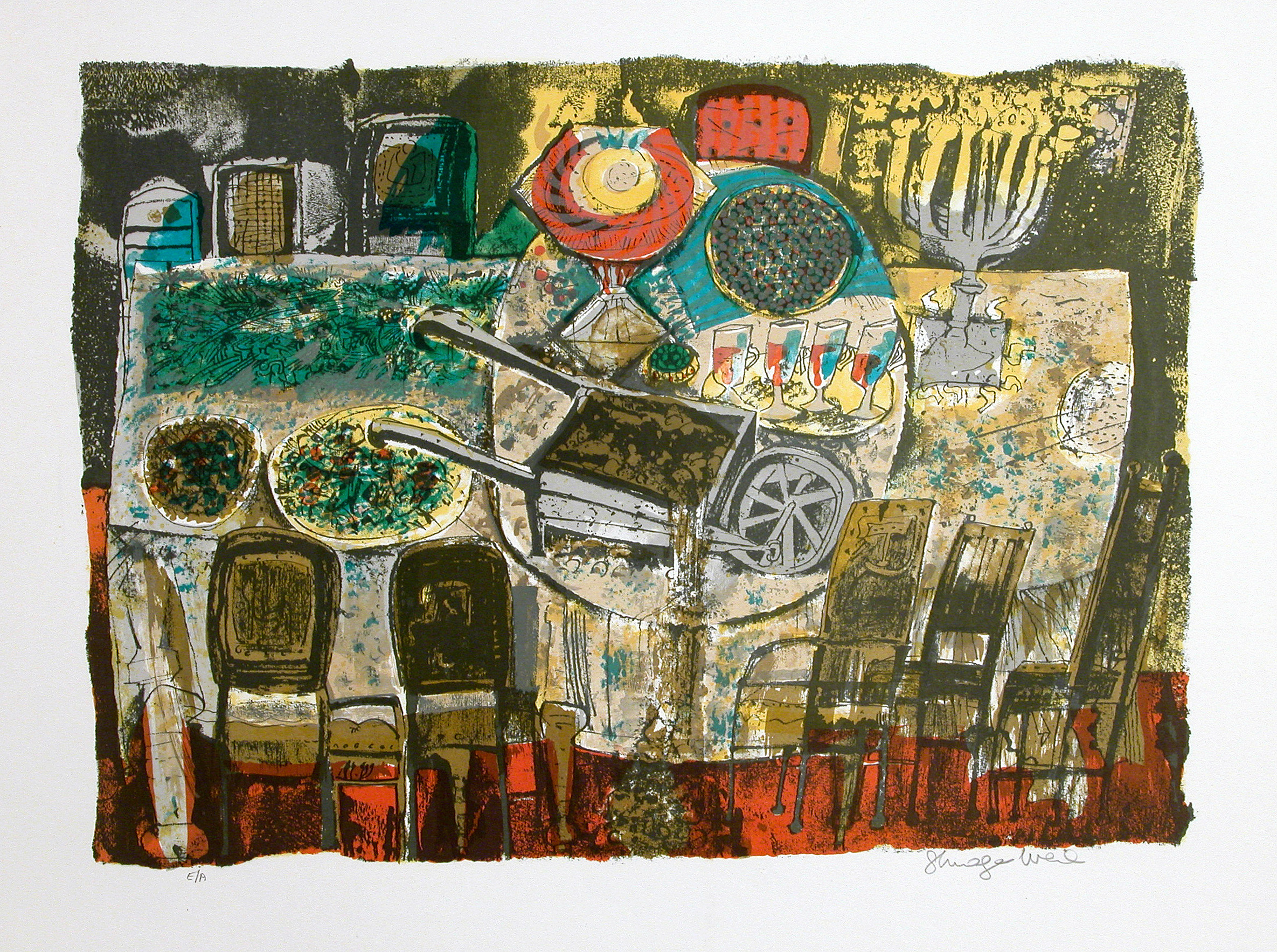
S-5 Seder Table
$400
24.5 inches wide x 18.5 Inches high 62 cm wide x 47 cm high Serigraph 1963
Shipping & Handling: $30
Shraga Weil was born in Nitra, Czechoslovakia in 1918 to a family of teachers, journalists and merchants. His father, a building engineer, who was an amateur painter, sent him to study with a local sculptor and then to the Prague School of Art.
He produced his first graphic works during World War II, part of which he spent as a prisoner. After the war, Weil sailed for Israel on an illegal immigrant ship, eventually arriving in the new country in 1947 and becoming a member of Kibbutz Haogen, where he has been living ever since.
In 1954 Weil spent some time studying murals and graphic techniques at the Academie des Beaux Arts, Paris and Ravenna mosaics with Prof. Severinl.
Shraga Weil’s works have been exhibited in the United States, South America, Canada, Australia, France, the USSR, Switzerland, and in the International Exhibition of Graphic Arts, in Lugano. In 1959, Weil was awarded Tel Aviv’s Dizengoff Art Prize.
Museums and Public Collections
Brandeis University, Waltham, Massachusetts
Boston Public Library
Israel Museum, Jerusalem
William Rockhill Nelson Gallery, Kansas City, MO
Fogg Museum, Harvard University
Los Angeles County Museum
Jewish Museum, New York
Philadephia Museum of Art
Joslyn Museum, Omaha, Nebraska
Judah Magnes Museum, Berkeley, CA
Weil Shraga
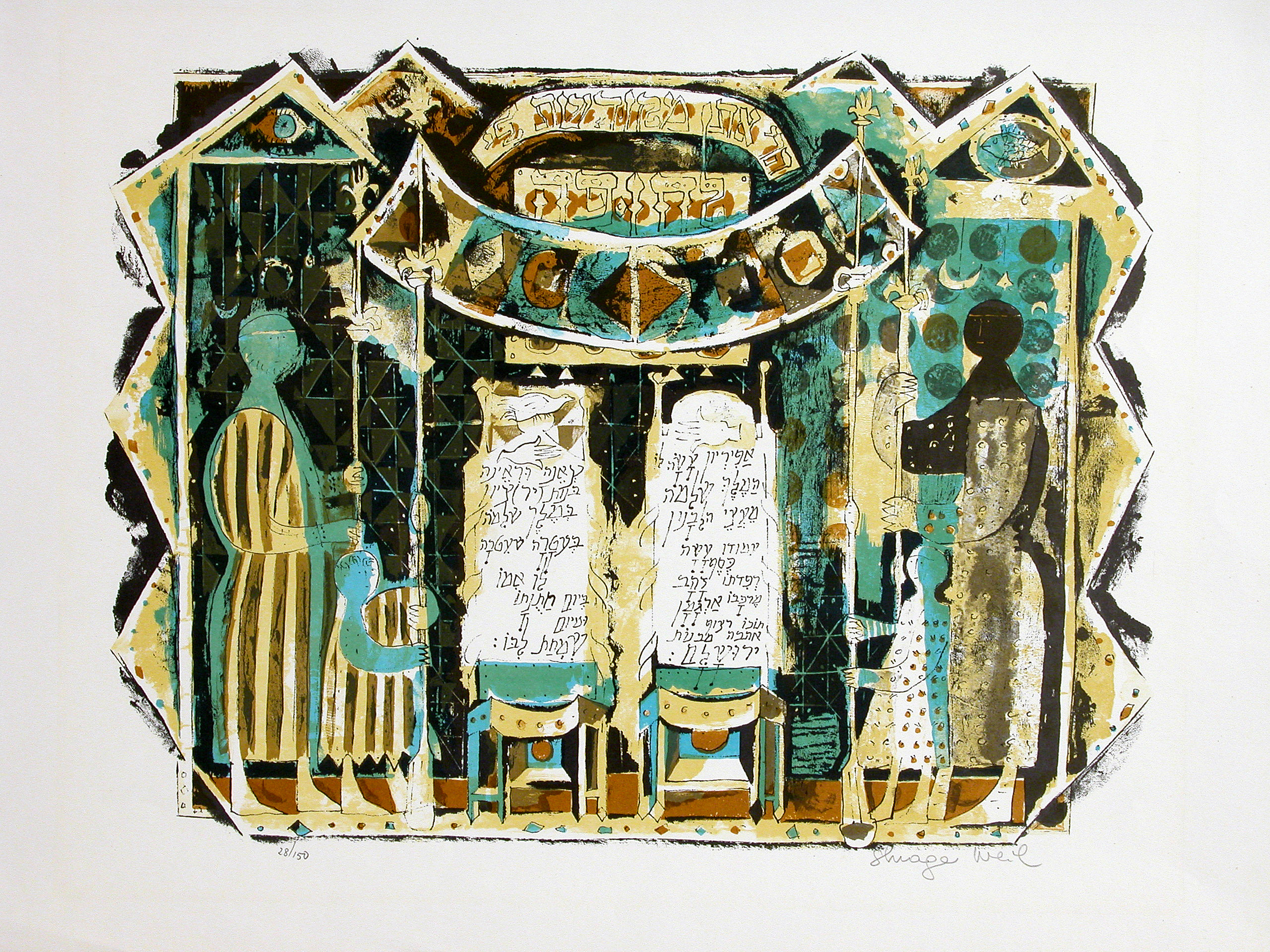
S-7 The Huppa
$400
24.5 inches wide x 18.5 Inches high 62 cm wide x 47 cm high Serigraph 1963 Edition 150
Shipping & Handling: $30
Above the Hupah (the wedding canopy) the words from the marriage ceremony “Behold thou art made holy unto me” are inscribed. The four corners of the canopy are supported by decorated poles held by celebrants. The bride and groom are represented by thrones inscribed with the following quotation from The Song of Songs (III 9-11): “King Solomon made himself a palanquin of the wood of Lebanon. He made pillars of silver, the top of gold, the seat of purple, the inside thereof being inlaid of love, from the daughters of Jerusalem. Go forth, O ye daughters of Zion, and gaze upon King Solomon, even upon the crown with which his mother has crowned him on the day of his wedding and on the day of supreme joy.”
Shraga Weil was born in Nitra, Czechoslovakia in 1918 to a family of teachers, journalists and merchants. His father, a building engineer, who was an amateur painter, sent him to study with a local sculptor and then to the Prague School of Art.
He produced his first graphic works during World War II, part of which he spent as a prisoner. After the war, Weil sailed for Israel on an illegal immigrant ship, eventually arriving in the new country in 1947 and becoming a member of Kibbutz Haogen, where he has been living ever since.
In 1954 Weil spent some time studying murals and graphic techniques at the Academie des Beaux Arts, Paris and Ravenna mosaics with Prof. Severinl.
Shraga Weil’s works have been exhibited in the United States, South America, Canada, Australia, France, the USSR, Switzerland, and in the International Exhibition of Graphic Arts, in Lugano. In 1959, Weil was awarded Tel Aviv’s Dizengoff Art Prize
Loading...