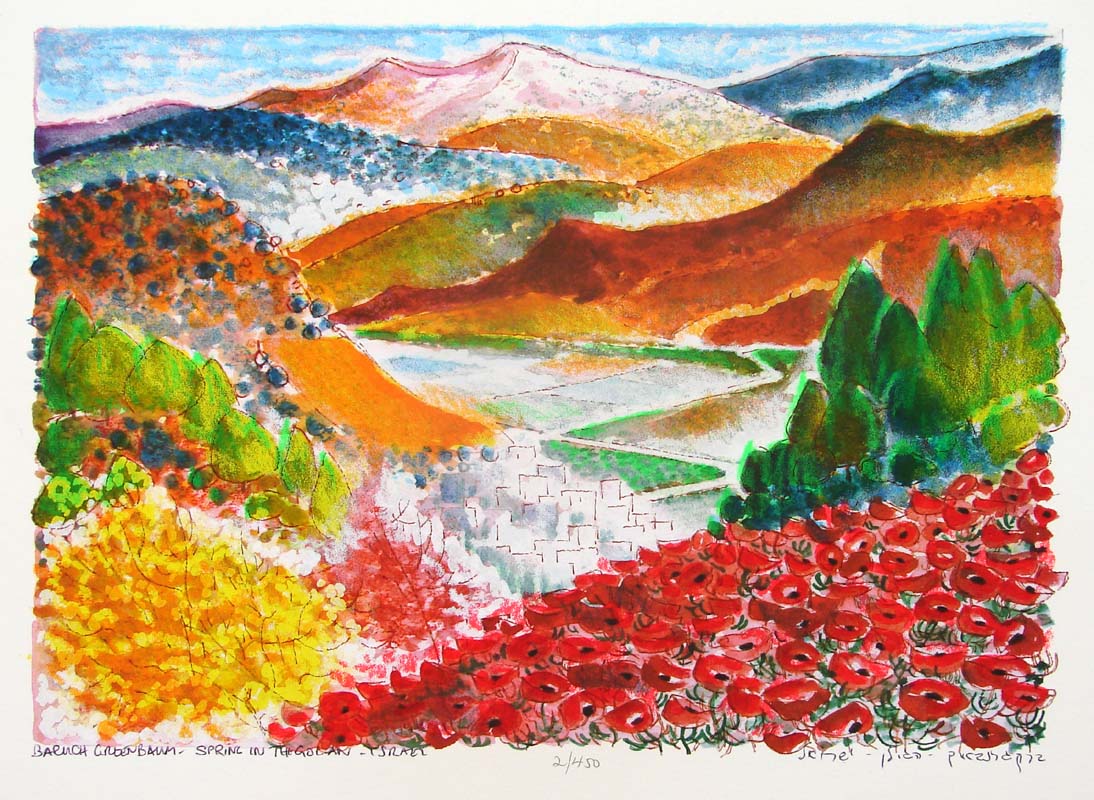
Greenbaum Baruch
Spring in the Golan
$125
19.75 inches wide X 13.75 inches high 50 cm wide X 35 cm high Lithograph 2012 Edition 450
Shipping & Handling: $30
BARUCH GREENBAUM
Baruch Greenbaum was born in Brighton, Sussex, England and studied at the Brighton College of Art.
He was one of the first freelance designers to work for B.B.C. Television. He studied painting with Bernard Meninsky.
Greenbaum served in the British 8th Army and was demobilized in 1946. He returned to London to study design. In 1950 he opened his illustration and design studio in Fleet Street.
Greenbaum worked continuously for the National Press, Advertising and Publishing. He emigrated in 1973 to Israel and lived and worked in Safed. He passed away in 1992.
Baruch Greenbaum’s landscapes of the Judean Hills and his more urban landscapes depicting life on the streets of Jerusalem are easily recognizable by their vibrant colors. Often using red, initially to delineate the scene, Greenbaum then overlays these almost sketchy lines with bright colors.
Greenbaum’s Jerusalem is one of verdant greens and warm yellows and oranges. Trees, streets, people and buildings – all are bright in the brilliant sunshine. Also, using artistic license to the full – or perhaps it is just wishful thinking on Greenbaum’s part – his Jerusalem is a relaxed, unhurried place where all different types of people belonging to many different faiths, stroll in leisurely fashion along traffic free streets – somewhat different to the noisy, fast moving reality of the modern city.
Greenbaum’s graphics and watercolors illustrate the concept of Jerusalem which many people hold in their minds and which has a separate entity to the city itself. It is Jerusalem as he would like it to be – and in fact Jerusalem as it is, without the extra layer of modernity – an ancient and spiritual city.
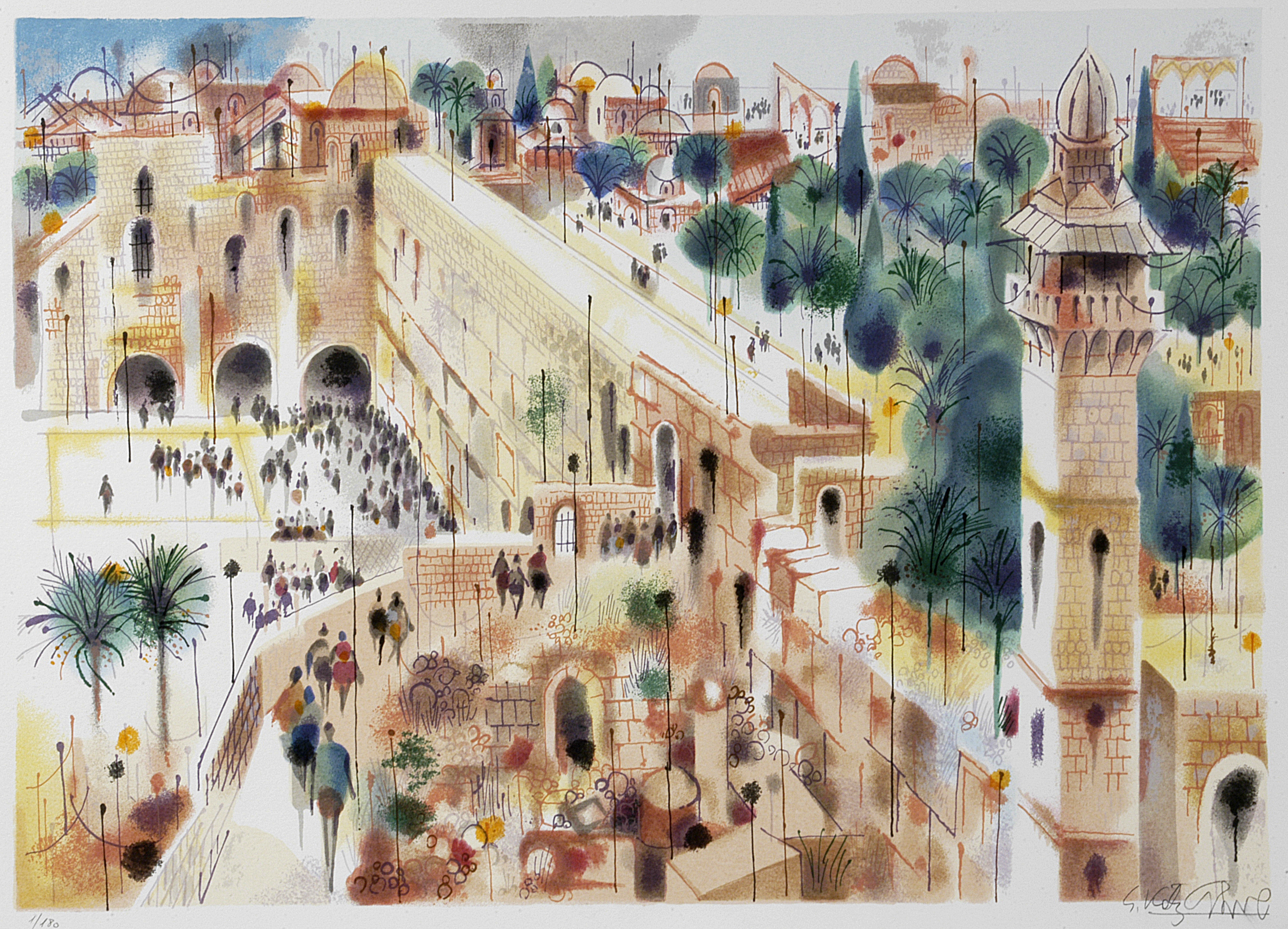
Katz Shemuel
The Wall
$300$150
26.5 Inches wide x 20 inches high 67 cm wide X 51 cm high Serigraph 1996
Shipping & Handling: $30
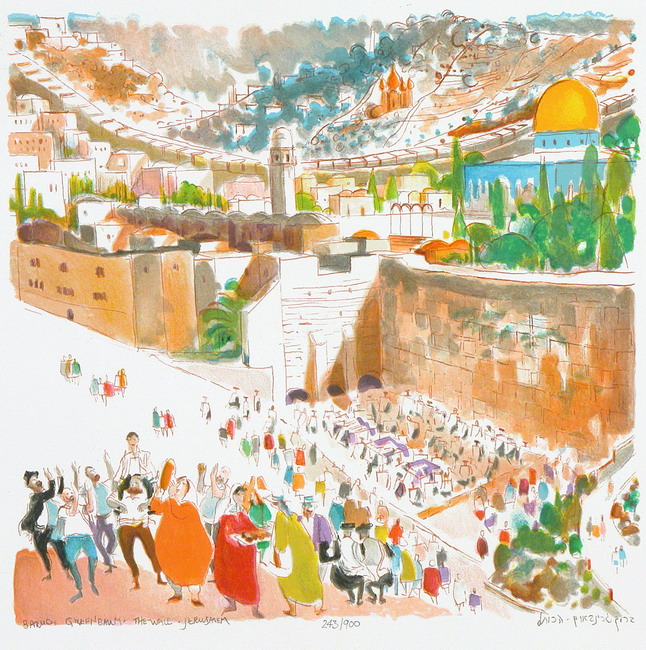
Greenbaum Baruch
The Wall
$125
15.75 inches wide x 14.5 inches high 40 cm wide X 37 cm high Lithograph 1998 Edition 900
Shipping & Handling: $30
BARUCH GREENBAUM
Baruch Greenbaum was born in Brighton, Sussex, England and studied at the Brighton College of Art.
He was one of the first freelance designers to work for B.B.C. Television. He studied painting with Bernard Meninsky.
Greenbaum served in the British 8th Army and was demobilized in 1946. He returned to London to study design. In 1950 he opened his illustration and design studio in Fleet Street.
Greenbaum worked continuously for the National Press, Advertising and Publishing. He emigrated in 1973 to Israel and lived and worked in Safed. He passed away in 1992.
Baruch Greenbaum’s landscapes of the Judean Hills and his more urban landscapes depicting life on the streets of Jerusalem are easily recognizable by their vibrant colors. Often using red, initially to delineate the scene, Greenbaum then overlays these almost sketchy lines with bright colors.
Greenbaum’s Jerusalem is one of verdant greens and warm yellows and oranges. Trees, streets, people and buildings – all are bright in the brilliant sunshine. Also, using artistic license to the full – or perhaps it is just wishful thinking on Greenbaum’s part – his Jerusalem is a relaxed, unhurried place where all different types of people belonging to many different faiths, stroll in leisurely fashion along traffic free streets – somewhat different to the noisy, fast moving reality of the modern city.
Greenbaum’s graphics and watercolors illustrate the concept of Jerusalem which many people hold in their minds and which has a separate entity to the city itself. It is Jerusalem as he would like it to be – and in fact Jerusalem as it is, without the extra layer of modernity – an ancient and spiritual city.
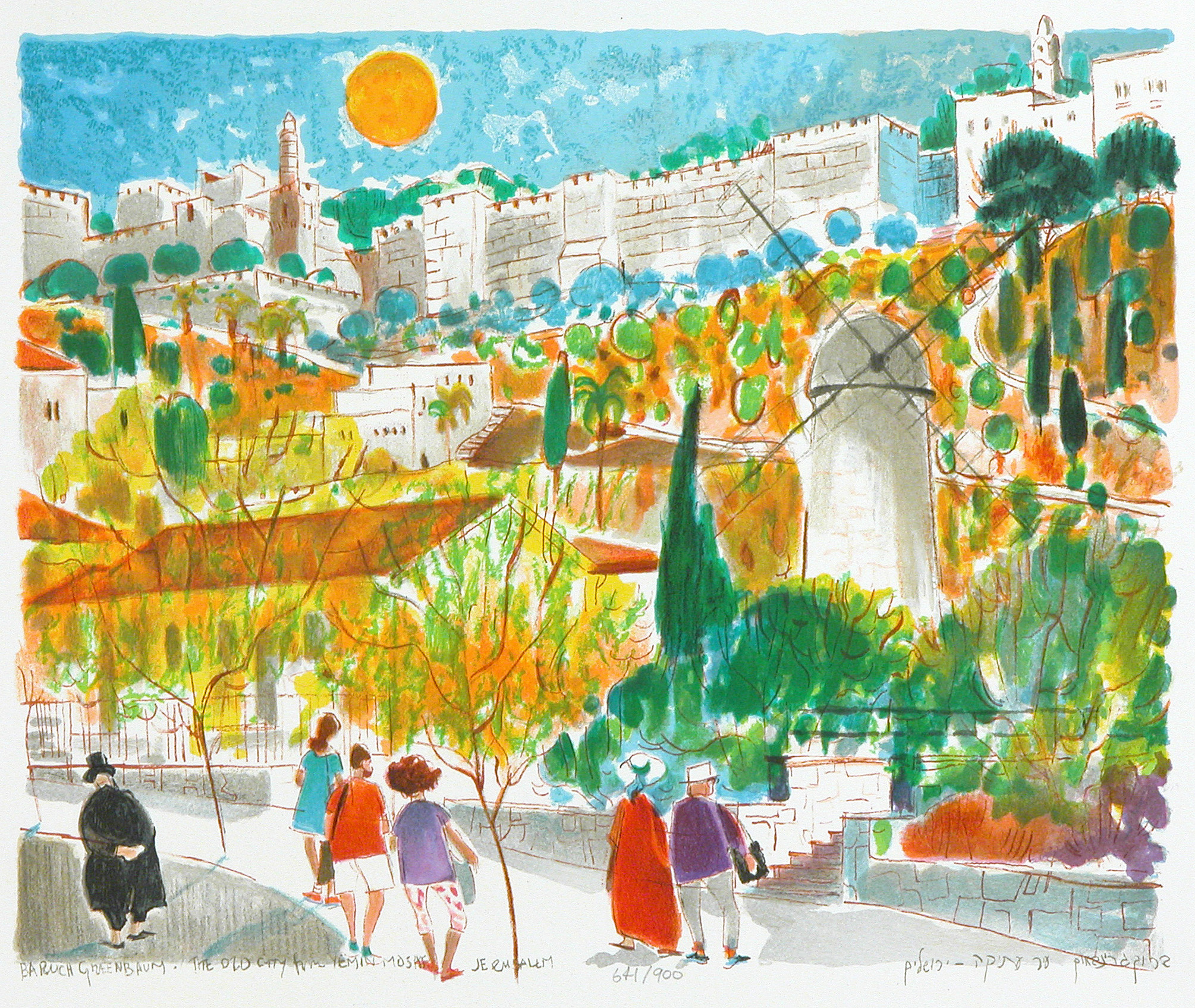
Greenbaum Baruch
Yemin Moshe
$125
16.5 inches wide x 13.75 inches high 42 cm wide X 35 cm high Lithograph 1998 Edition 900
Shipping & Handling: $30
BARUCH GREENBAUM
Baruch Greenbaum was born in Brighton, Sussex, England and studied at the Brighton College of Art.
He was one of the first freelance designers to work for B.B.C. Television. He studied painting with Bernard Meninsky.
Greenbaum served in the British 8th Army and was demobilized in 1946. He returned to London to study design. In 1950 he opened his illustration and design studio in Fleet Street.
Greenbaum worked continuously for the National Press, Advertising and Publishing. He emigrated in 1973 to Israel and lived and worked in Safed. He passed away in 1992.
Baruch Greenbaum’s landscapes of the Judean Hills and his more urban landscapes depicting life on the streets of Jerusalem are easily recognizable by their vibrant colors. Often using red, initially to delineate the scene, Greenbaum then overlays these almost sketchy lines with bright colors.
Greenbaum’s Jerusalem is one of verdant greens and warm yellows and oranges. Trees, streets, people and buildings – all are bright in the brilliant sunshine. Also, using artistic license to the full – or perhaps it is just wishful thinking on Greenbaum’s part – his Jerusalem is a relaxed, unhurried place where all different types of people belonging to many different faiths, stroll in leisurely fashion along traffic free streets – somewhat different to the noisy, fast moving reality of the modern city.
Greenbaum’s graphics and watercolors illustrate the concept of Jerusalem which many people hold in their minds and which has a separate entity to the city itself. It is Jerusalem as he would like it to be – and in fact Jerusalem as it is, without the extra layer of modernity – an ancient and spiritual city.
Loading...