Weil Shraga
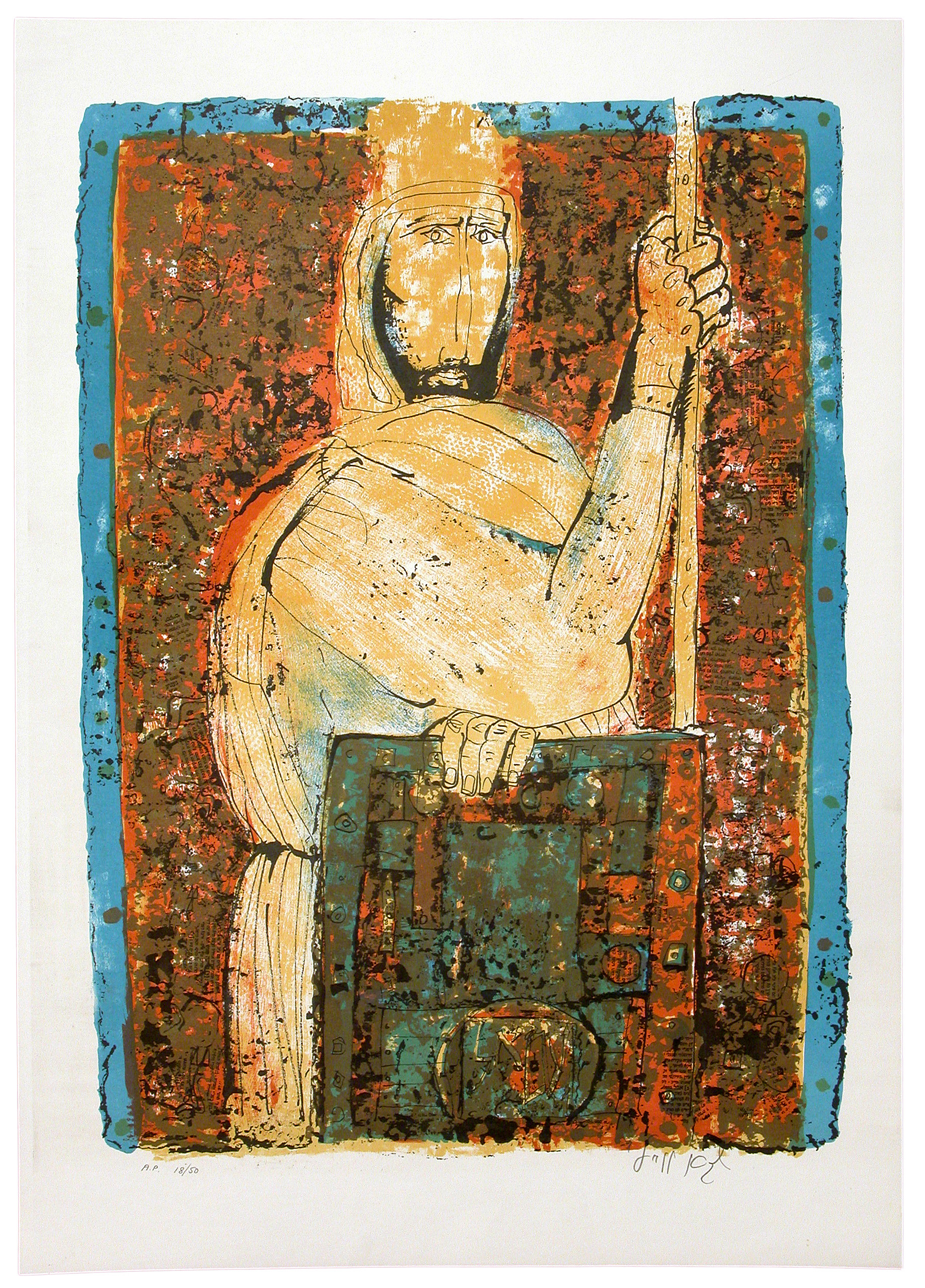
S-13 Guardian of Qumran
$850
19.75 Inches wide x 27.5 Inches high 50 cm wide x 70 cm high Serigraph 1965 Edition 150
Shipping & Handling: $30
In 1947, ancient manuscripts were discovered at Khirbet Qumran (near the Dead Sea). Scholarly disputation has continued since their discovery about the nature of the community which created these valuable documents. The structure of the community was outlined in one of the Scrolls entitled The Manual of Discipline: “The members were all Jewish and regarded themselves as the true Israel; they understood the history of Israel and the promises to the patriarchs as being fulfilled in them, the actually existing community.”
Shraga Weil was born in Nitra, Czechoslovakia in 1918 to a family of teachers, journalists and merchants. His father, a building engineer, who was an amateur painter, sent him to study with a local sculptor and then to the Prague School of Art.
He produced his first graphic works during World War II, part of which he spent as a prisoner. After the war, Weil sailed for Israel on an illegal immigrant ship, eventually arriving in the new country in 1947 and becoming a member of Kibbutz Haogen, where he has been living ever since.
In 1954 Weil spent some time studying murals and graphic techniques at the Academie des Beaux Arts, Paris and Ravenna mosaics with Prof. Severinl.
Shraga Weil’s works have been exhibited in the United States, South America, Canada, Australia, France, the USSR, Switzerland, and in the International Exhibition of Graphic Arts, in Lugano. In 1959, Weil was awarded Tel Aviv’s Dizengoff Art Prize.
Weil Shraga
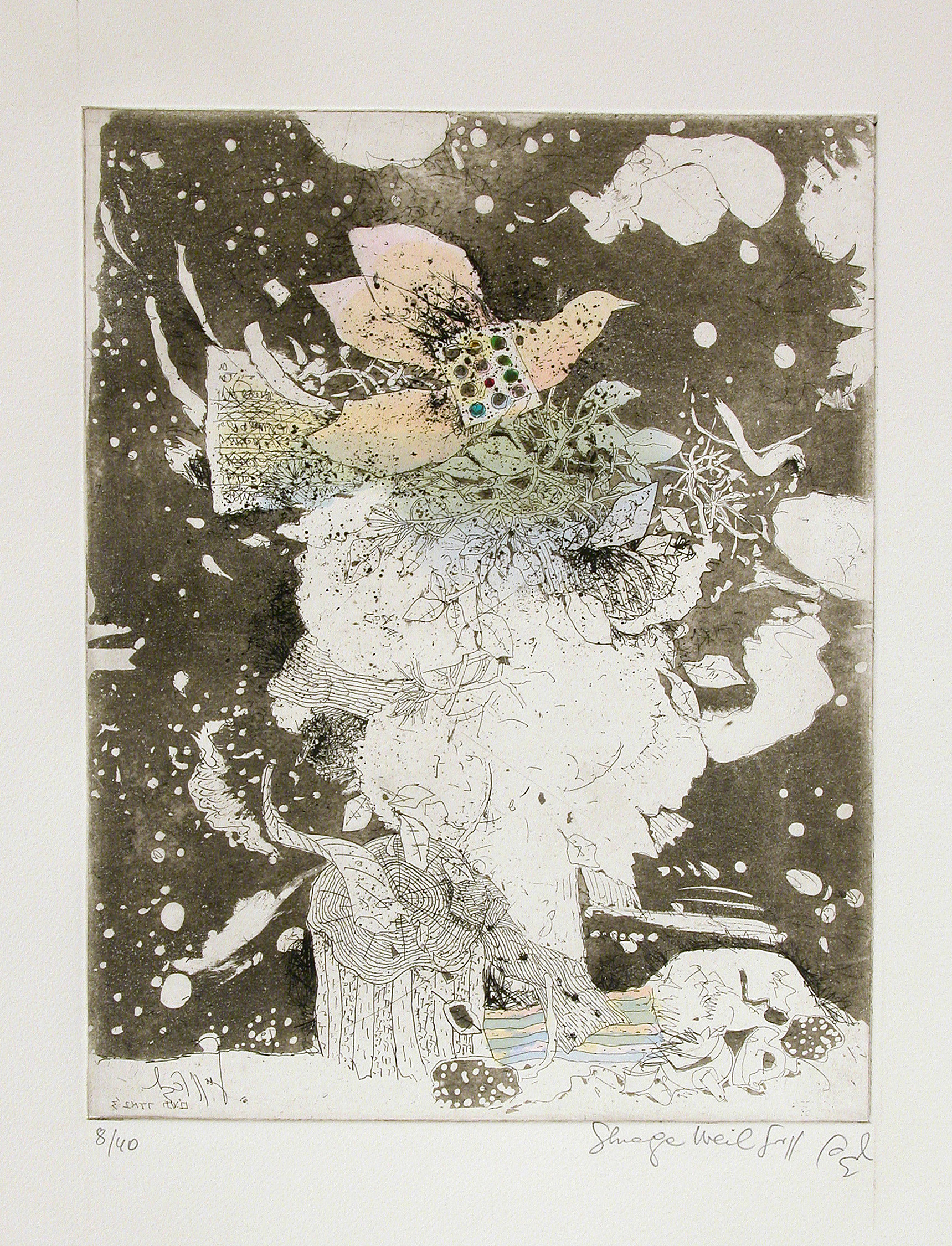
S-251 Phoenix III
$500$200
20 inches wide By 26 Inches high 50 cm wide By 65 cm high Etching 1983 Edition 40
Shipping & Handling: $30
Shraga Weil was born in Nitra, Czechoslovakia in 1918 to a family of teachers, journalists and merchants. His father, a building engineer, who was an amateur painter, sent him to study with a local sculptor and then to the Prague School of Art.
He produced his first graphic works during World War II, part of which he spent as a prisoner. After the war, Weil sailed for Israel on an illegal immigrant ship, eventually arriving in the new country in 1947 and becoming a member of Kibbutz Haogen, where he has been living ever since.
In 1954 Weil spent some time studying murals and graphic techniques at the Academie des Beaux Arts, Paris and Ravenna mosaics with Prof. Severinl.
Shraga Weil’s works have been exhibited in the United States, South America, Canada, Australia, France, the USSR, Switzerland, and in the International Exhibition of Graphic Arts, in Lugano. In 1959, Weil was awarded Tel Aviv’s Dizengoff Art Prize.
Museums and Public Collections
Brandeis University, Waltham, Massachusetts
Boston Public Library
Israel Museum, Jerusalem
William Rockhill Nelson Gallery, Kansas City, MO
Fogg Museum, Harvard University
Los Angeles County Museum
Jewish Museum, New York
Philadephia Museum of Art
Joslyn Museum, Omaha, Nebraska
Judah Magnes Museum, Berkeley, CA
Weil Shraga
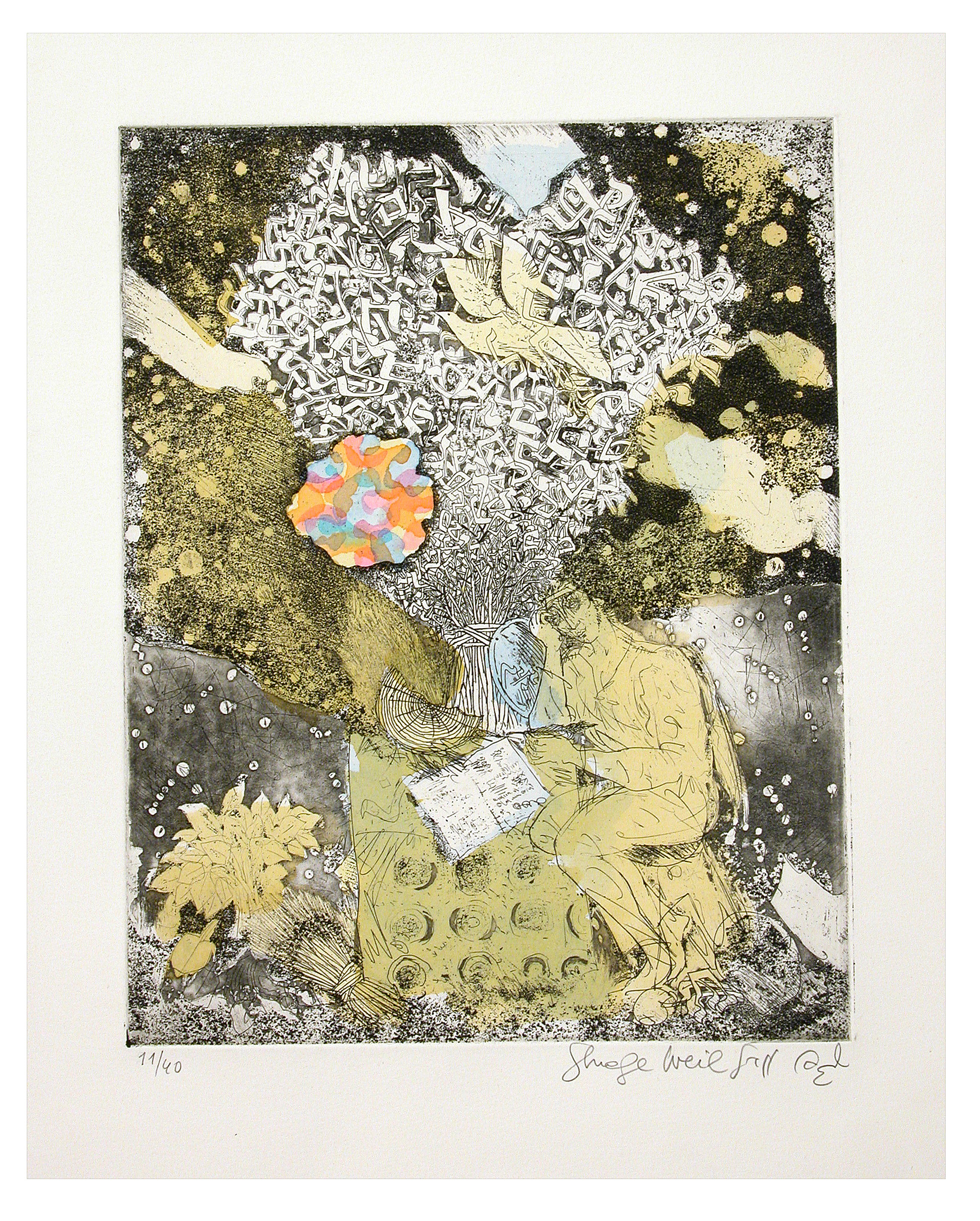
S-252 Phoenix II
$500$200
20 inches wide X 26 Inches high 50 cm wide X 65 cm high Etching 1983 Edition 40
Shipping & Handling: $30
Shraga Weil was born in Nitra, Czechoslovakia in 1918 to a family of teachers, journalists and merchants. His father, a building engineer, who was an amateur painter, sent him to study with a local sculptor and then to the Prague School of Art.
He produced his first graphic works during World War II, part of which he spent as a prisoner. After the war, Weil sailed for Israel on an illegal immigrant ship, eventually arriving in the new country in 1947 and becoming a member of Kibbutz Haogen, where he has been living ever since.
In 1954 Weil spent some time studying murals and graphic techniques at the Academie des Beaux Arts, Paris and Ravenna mosaics with Prof. Severinl.
Shraga Weil’s works have been exhibited in the United States, South America, Canada, Australia, France, the USSR, Switzerland, and in the International Exhibition of Graphic Arts, in Lugano. In 1959, Weil was awarded Tel Aviv’s Dizengoff Art Prize.
Museums and Public Collections
Brandeis University, Waltham, Massachusetts
Boston Public Library
Israel Museum, Jerusalem
William Rockhill Nelson Gallery, Kansas City, MO
Fogg Museum, Harvard University
Los Angeles County Museum
Jewish Museum, New York
Philadephia Museum of Art
Joslyn Museum, Omaha, Nebraska
Judah Magnes Museum, Berkeley, CA
Ardon Mordechai
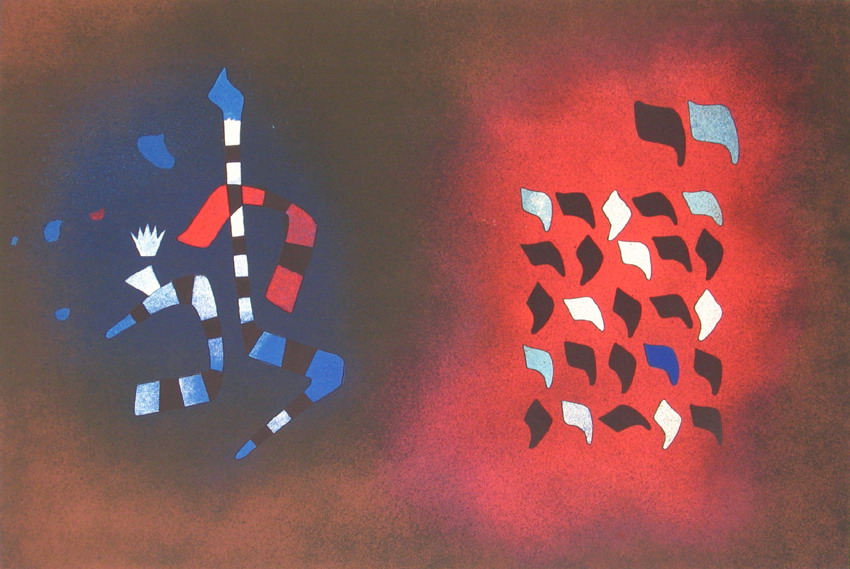
Yod Kaf Lamed Mem
$250
34" x 23.5" 86 x 60 cm Lithograph
Shipping & Handling: $30
Ardon painted within the European Jewish tradition. He has sought to express what for him is the mystical aspect of the Holy Land and the impact of the Holocaust on the emerging nation. His style is abstract, with a complex vocabulary of personal symbols that are also frequently drawn from Midrash and Kabbalah.
Born in Poland 1896.
1920-26: Studied in the “Bauhaus” in Weimar and then in Munich.
1929-33: Taught at the Berlin Art Institute.
1935-52: Taught at the Bezalel Art Institute, then became its director.
1940-52: In charge of Art Education Ministry of Education and Culture, and Advisor to the Israeli Government on Art Matters.
Since 1928, participated in group exhibitions in Berlin.
First one man exhibition 1948, New York.
1949-59: Exhibitions, Stedljik Museum Amsterdam, Marlborough Gallery, London – New York.
Bezalel Museum Jerusalem – Haifa Art Museum documenta I Kassel Germany.
1959: Venice Biennale
1968: Works in Collections of the Metropolitan Museum NY Tate Gallery, London, Museum of Modern Art, Rome.
1963: Awarded Israel Prize for Art.
Loading...