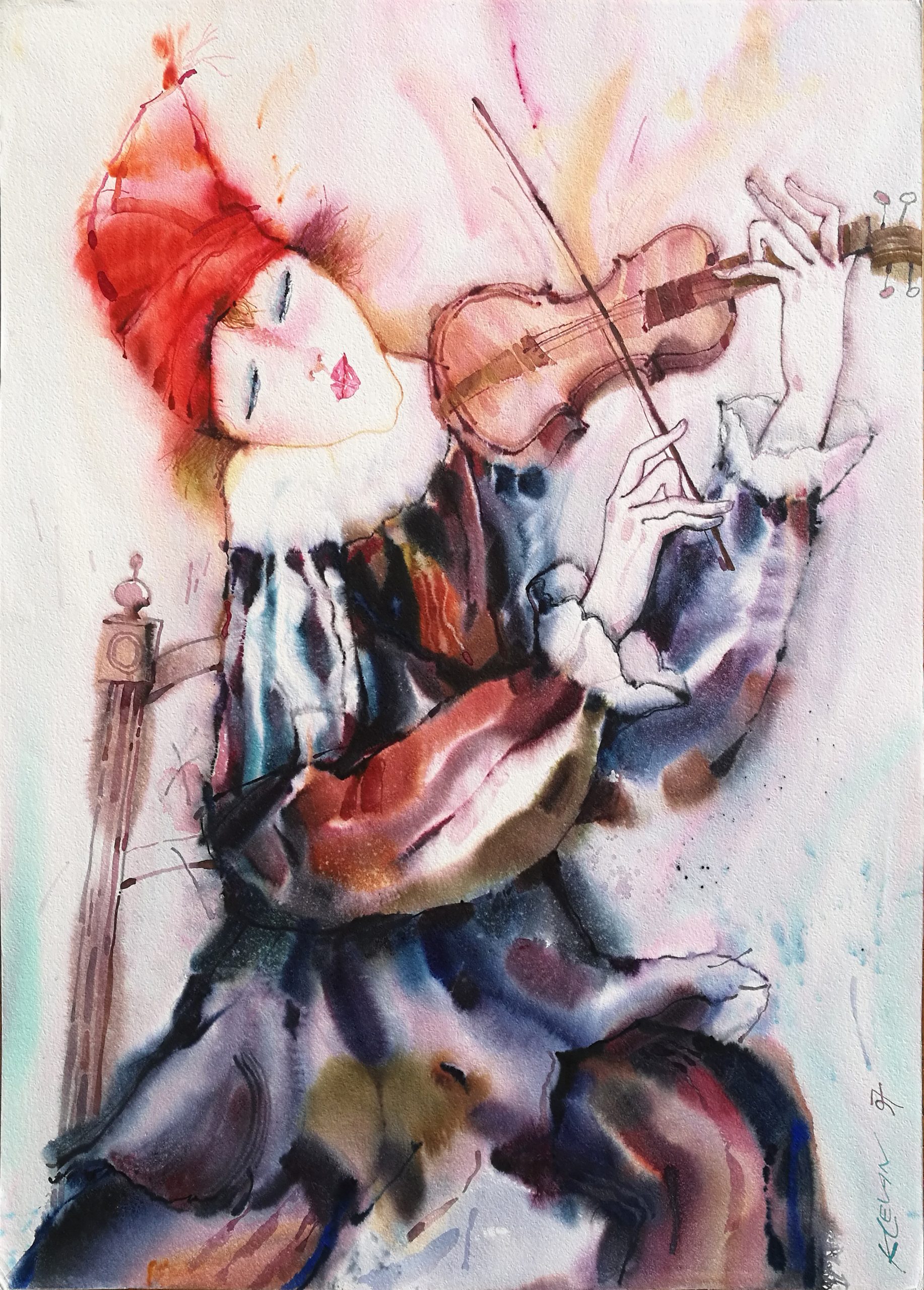
Klevan Alexander
K-808
$600
25.5x35 65x90 Watercolors
Shipping & Handling: $30
Alexander Klevan was born in Siberia Russia, October, in 1950 and he learned from 1974-1979 at the Academy for Monumental, and Art Design in Lvov , Ukraina
It seems, that at the end of our cruel, so dramatic and tragic age, there is no room left for romanticism with its striving for happiness and passion for carnival-like metamorphoses. But deep down, even for a pragmatist and realist, this need exists and he, having at least for a little while shaken from his shoulders the load of everyday concerns, is again drawn towards mirages and nostalgic memories, as fragile as card houses. Only when reconstructed through art, this world receives a special reality, no less tangible, than that which is around us.
Alexander Klevan is a romanticist in his art, not because he has chosen this “role”, but due to the disposition of his soul, his world view and attitude. The artist sharply senses the movement of real life, its momentary changeability. Clocks, which are frequently present in A. Klevan’s still life, landscape paintings and compositions, measure the time, but there is no way of knowing whether the arms of the clock are going forward to the next day or back to the day before, returning our memory to the past. The houses have unexpectedly become displaced along their axes, ripples have obscured the town’s reflection in water, and on the quay in Jaffa a gray bearded Jew with a hat appears sitting on a chair and it seems, that Tel-Aviv does not yet exist, but only the old stones of Jaffa. Why then is there a modern road sign?…
According to Kant, art was created by the human need for “pure” play, without any practical interest. Shakespeare raised this to a comprehensive formula: the whole world’s a stage and men are the actors, the atmosphere of play, stage, a carnival, where people skilfully hide their faces, is also present in the many works of Alexander Klevan. He likes to paint clowns and jesters, made wiser by life, puppets play people, while people pull their strings, unaware that it may be painful to them. Or lay out cards, looking at the fickle and unstable signs of fate. Sometimes the artist dresses his characters in new clothes, the king changes his crown for a fool’s cap, and the girl from the cafe becomes a real lady… But now the show is over, the actors take off their masks and everything returns to usual – tired eyes, bitterness, hidden in the curve of the lips, a T-shirt instead of a king’s cloak…Only the asymmetry and disproportion, characteristic of acting, are not washed off with the make-up and stay forever. In love with the “Retro-style Bohemia” atmosphere, A. Klevan paints women’s portraits, with the reflection of the epoch of Toulouse-Lautrec and Modigliani, Parisian charm, some kind of understatement, hard to capture. In these portraits triumphs an eternal femininity, beauty, life completeness, but why, unexpectedly and sharply, a glance wet with tears sparkles beneath the lowered brim of a hat?!.. Life is only life, romanticism may adorn it, but is unable to change it.
The feelings of instability of the world and its object environment creates an instability of feelings, which wipes off the border between reality and imagination: reality is as fantastic, as fantasy is real. A. Klevan expresses this mobility, perhaps not so much in his topics, romantic or commonplace, as in colour. Water-colours, as it seems to me, became his favorite painting technique not because he controls it freely and confidently, but because it is adequate to his creative outlook. The specific character of water-colours is such, that is demands from the artist quickness and lightness of performance, purity and clarity of the colour layer and its interaction with the whiteness of paper, masterly control of colour, drawing and form. As a wide range artist, A. Klevan works willingly and successfully with oil paints as well. He knows their characteristics and possibilities, senses it not as a traditional technique, but as a spiritual creature, usually obedient, but sometimes unpredictibly capricious. He sees and hears its vibrating tonality, pitch of the “colour-sound”, harmony and dissonance, solo parts of one colour, colour multiplicity of chords, poliphony of arrangement. Probably this is why A. Klevan frequently returns to the theme of music. Musicians: violinists, cellists and conductors are welcome guests among his characters.
Grigory Ostrovsky
Doctor of History of Fine Art
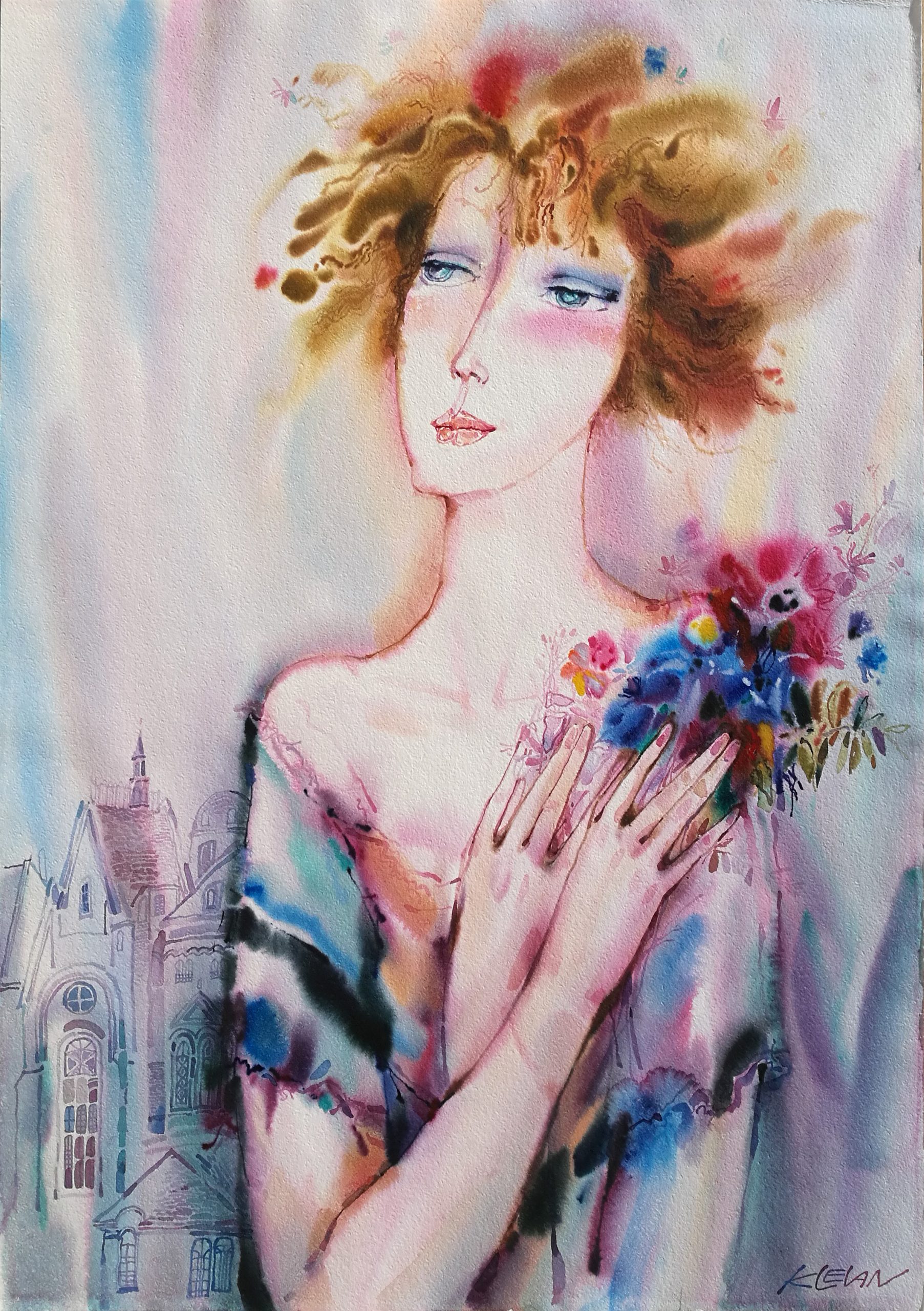
Klevan Alexander
K-984
$600
25.5x35 65x90 Watercolors
Shipping & Handling: $30
Alexander Klevan was born in Siberia Russia, October, in 1950 and he learned from 1974-1979 at the Academy for Monumental, and Art Design in Lvov , Ukraina
It seems, that at the end of our cruel, so dramatic and tragic age, there is no room left for romanticism with its striving for happiness and passion for carnival-like metamorphoses. But deep down, even for a pragmatist and realist, this need exists and he, having at least for a little while shaken from his shoulders the load of everyday concerns, is again drawn towards mirages and nostalgic memories, as fragile as card houses. Only when reconstructed through art, this world receives a special reality, no less tangible, than that which is around us.
Alexander Klevan is a romanticist in his art, not because he has chosen this “role”, but due to the disposition of his soul, his world view and attitude. The artist sharply senses the movement of real life, its momentary changeability. Clocks, which are frequently present in A. Klevan’s still life, landscape paintings and compositions, measure the time, but there is no way of knowing whether the arms of the clock are going forward to the next day or back to the day before, returning our memory to the past. The houses have unexpectedly become displaced along their axes, ripples have obscured the town’s reflection in water, and on the quay in Jaffa a gray bearded Jew with a hat appears sitting on a chair and it seems, that Tel-Aviv does not yet exist, but only the old stones of Jaffa. Why then is there a modern road sign?…
According to Kant, art was created by the human need for “pure” play, without any practical interest. Shakespeare raised this to a comprehensive formula: the whole world’s a stage and men are the actors, the atmosphere of play, stage, a carnival, where people skilfully hide their faces, is also present in the many works of Alexander Klevan. He likes to paint clowns and jesters, made wiser by life, puppets play people, while people pull their strings, unaware that it may be painful to them. Or lay out cards, looking at the fickle and unstable signs of fate. Sometimes the artist dresses his characters in new clothes, the king changes his crown for a fool’s cap, and the girl from the cafe becomes a real lady… But now the show is over, the actors take off their masks and everything returns to usual – tired eyes, bitterness, hidden in the curve of the lips, a T-shirt instead of a king’s cloak…Only the asymmetry and disproportion, characteristic of acting, are not washed off with the make-up and stay forever. In love with the “Retro-style Bohemia” atmosphere, A. Klevan paints women’s portraits, with the reflection of the epoch of Toulouse-Lautrec and Modigliani, Parisian charm, some kind of understatement, hard to capture. In these portraits triumphs an eternal femininity, beauty, life completeness, but why, unexpectedly and sharply, a glance wet with tears sparkles beneath the lowered brim of a hat?!.. Life is only life, romanticism may adorn it, but is unable to change it.
The feelings of instability of the world and its object environment creates an instability of feelings, which wipes off the border between reality and imagination: reality is as fantastic, as fantasy is real. A. Klevan expresses this mobility, perhaps not so much in his topics, romantic or commonplace, as in colour. Water-colours, as it seems to me, became his favorite painting technique not because he controls it freely and confidently, but because it is adequate to his creative outlook. The specific character of water-colours is such, that is demands from the artist quickness and lightness of performance, purity and clarity of the colour layer and its interaction with the whiteness of paper, masterly control of colour, drawing and form. As a wide range artist, A. Klevan works willingly and successfully with oil paints as well. He knows their characteristics and possibilities, senses it not as a traditional technique, but as a spiritual creature, usually obedient, but sometimes unpredictibly capricious. He sees and hears its vibrating tonality, pitch of the “colour-sound”, harmony and dissonance, solo parts of one colour, colour multiplicity of chords, poliphony of arrangement. Probably this is why A. Klevan frequently returns to the theme of music. Musicians: violinists, cellists and conductors are welcome guests among his characters.
Grigory Ostrovsky
Doctor of History of Fine Art
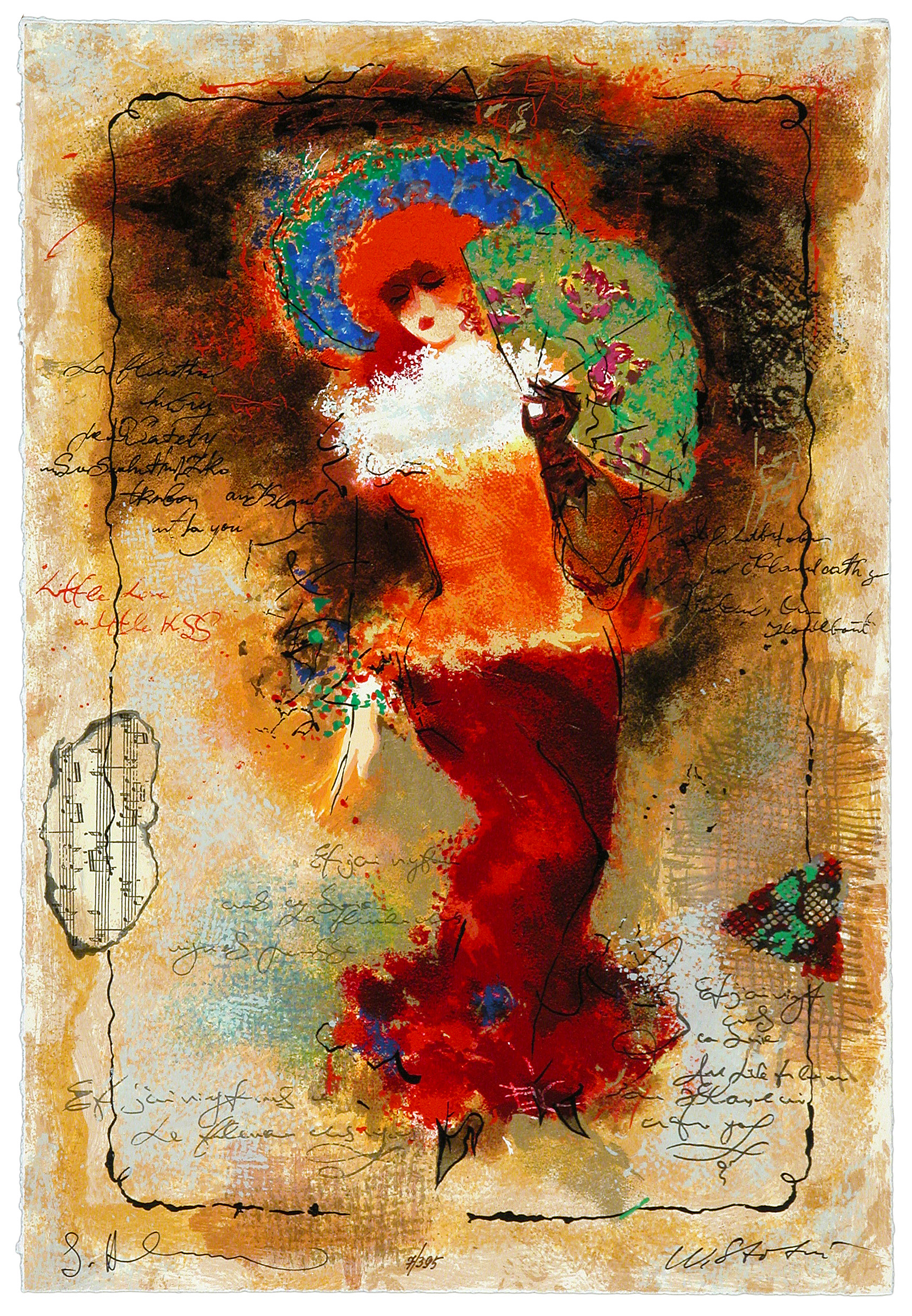
Wissotzky
Lady with Red Hat
$200
19 inches wide x 25 inches high 48 cm wide x 65 cm high Serigraph Edition 380
Shipping & Handling: $30
TANYA WISSOTZKY AND ALEXANDER GLATCHANSKY
The works of Tanya Wissotzky and Alexander Glatchansky are created by the interaction of two independent imaginations working in intellectual and aesthetic harmony. Each complements the other, producing works in which the process of creation is revealed as it reaches a harmonious yet complex resolution.
They have achieved a painterly idiom which is a visual dynamic of crescendo and diminuendo, a vibration between the sensuous and cerebral. Working in acrylic, pen and ink, and collage on specially prepared canvas, they speak in many voices which are yet one voice. The subdued pastel tones of the background swirl and gather romantically to focal points as rich in association as they are in colour. Superimposed upon them are the learned and expert line drawings of scenes both evocative and ironic.
These scenes, like sketches from the artist’s notebook, each contain a world of their own while commenting on the canvas as a whole. The excerpts of calligraphy from old English flower painting manuals underline the concern with process as well as result, while other calligraphic quotations celebrate Paris of the Twenties which is certainly one of the artists’ many sources of visual reference. In the still lifes, the classically executed centrepiece has all the nostalgia and romanticism of a time past, the colour rich and sensuous.
Juxtaposed against this are the music scores, totally dry and abstract and yet evocative of gaiety and pleasure. The eye is caught in pleasant surprise as the smaller quotations, in collage ink or paint, reveal themselves, linking the chain of associations in fascinatingly various ways. The work of this pair of young Israeli artists has received critical acclaim and success both in Israel and abroad and their works are to be found in public and private collections all over the world.
Tanya Wissotzky and Alexander Glatchansky were born in the same year, 1959, and studied at the Odessa Academy of Fine Arts. One of Ms. Wissotzky’s main interests besides her work as an artist is in the conservation of Nature. Alexander Glatchansky is a fine book illustrator in his own right and has been awarded prizes for his achievements in this field.
EXHIBITIONS:
Union of Artists House – Kiev USSR 1990
Cultural Centre, The Old Synagogue, Florence Italy 1992
Community Centre, Brighton, England 1993
Art Expo, New York, USA 1994
Art Expo, Las Vegas, USA 1994
Gallery Safrai, Tel Aviv, Israel 1994
Binyanei Ha’uma, Jerusalem, (permanent Exhibition)
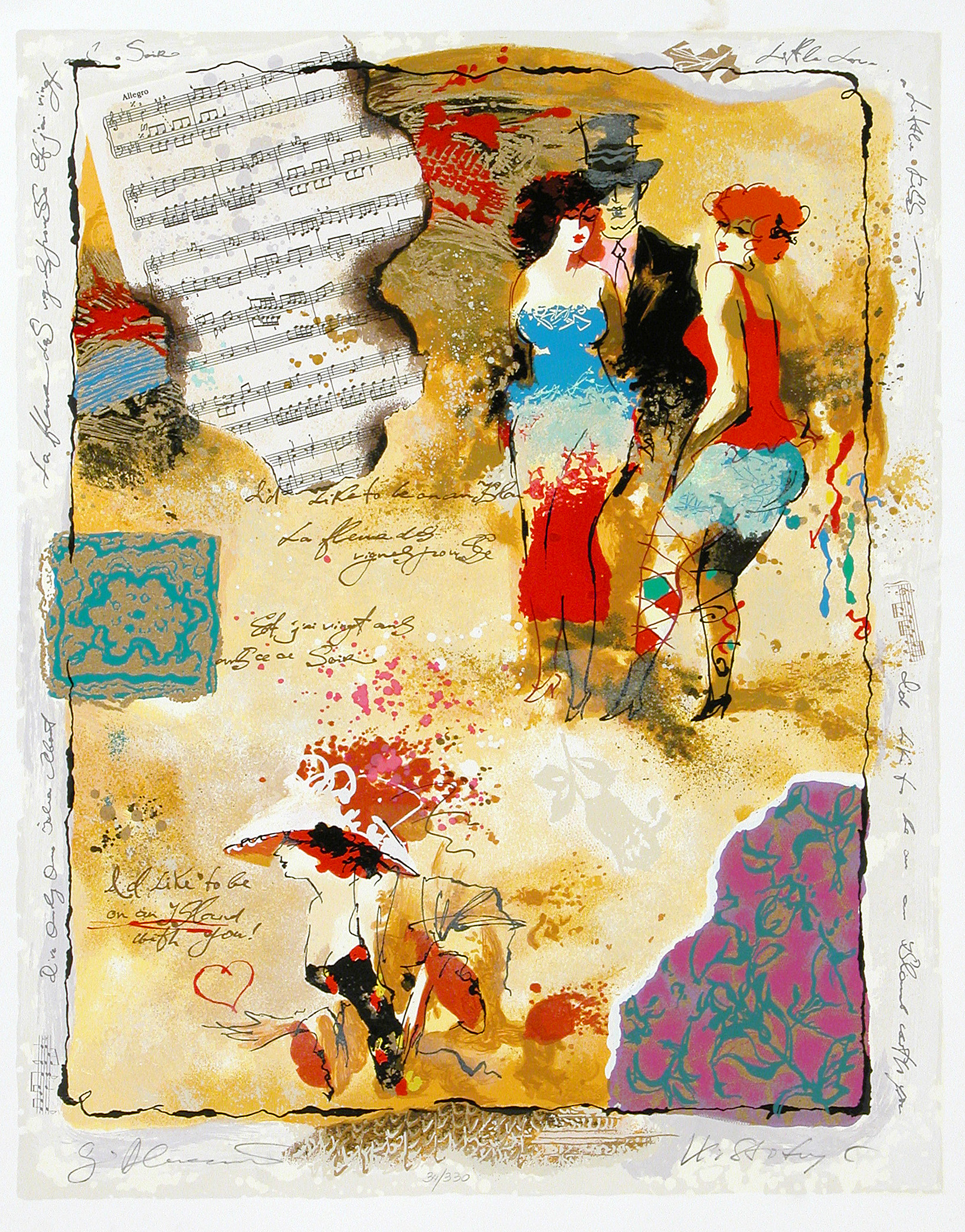
Wissotzky
Wissotzky 24
$200
18 inches wide x 23.75 inches high 46 cm wide x 60 cm high Serigraph Edition 380
Shipping & Handling: $30
TANYA WISSOTZKY AND ALEXANDER GLATCHANSKY
The works of Tanya Wissotzky and Alexander Glatchansky are created by the interaction of two independent imaginations working in intellectual and aesthetic harmony. Each complements the other, producing works in which the process of creation is revealed as it reaches a harmonious yet complex resolution.
They have achieved a painterly idiom which is a visual dynamic of crescendo and diminuendo, a vibration between the sensuous and cerebral. Working in acrylic, pen and ink, and collage on specially prepared canvas, they speak in many voices which are yet one voice. The subdued pastel tones of the background swirl and gather romantically to focal points as rich in association as they are in colour. Superimposed upon them are the learned and expert line drawings of scenes both evocative and ironic.
These scenes, like sketches from the artist’s notebook, each contain a world of their own while commenting on the canvas as a whole. The excerpts of calligraphy from old English flower painting manuals underline the concern with process as well as result, while other calligraphic quotations celebrate Paris of the Twenties which is certainly one of the artists’ many sources of visual reference. In the still lifes, the classically executed centrepiece has all the nostalgia and romanticism of a time past, the colour rich and sensuous.
Juxtaposed against this are the music scores, totally dry and abstract and yet evocative of gaiety and pleasure. The eye is caught in pleasant surprise as the smaller quotations, in collage ink or paint, reveal themselves, linking the chain of associations in fascinatingly various ways. The work of this pair of young Israeli artists has received critical acclaim and success both in Israel and abroad and their works are to be found in public and private collections all over the world.
Tanya Wissotzky and Alexander Glatchansky were born in the same year, 1959, and studied at the Odessa Academy of Fine Arts. One of Ms. Wissotzky’s main interests besides her work as an artist is in the conservation of Nature. Alexander Glatchansky is a fine book illustrator in his own right and has been awarded prizes for his achievements in this field.
EXHIBITIONS:
Union of Artists House – Kiev USSR 1990
Cultural Centre, The Old Synagogue, Florence Italy 1992
Community Centre, Brighton, England 1993
Art Expo, New York, USA 1994
Art Expo, Las Vegas, USA 1994
Gallery Safrai, Tel Aviv, Israel 1994
Binyanei Ha’uma, Jerusalem, (permanent Exhibition)
Loading...