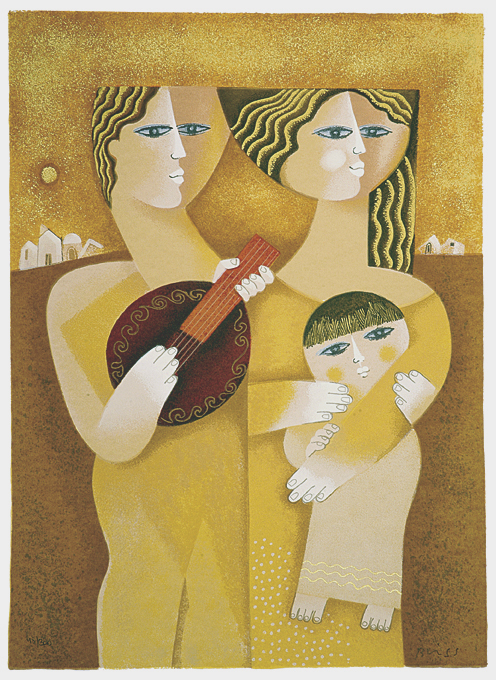
Briss Sami
Musical Family
$95
14" x 19" Serigraph Edition 300
Shipping & Handling: $30
SAMI BRISS
Sami Briss was born in Jassy, Rumania, in 1930, and the influence of his youthful surroundings pervades his artwork even to this day. The artist was strongly impressed by the peaceful, rolling beauty of the landscape and the stately architecture of his home city. The churches of his motherland touched his artist’s soul as well, as did their outer frescos of vivid color. Briss inherited a love for design from his mother, a dressmaker. Continually evincing an interest in the rich embroidery of the cloth, Briss early surprised his delighted mother with his own drawings. She encouraged his interest in the arts, and applauded his entering the Beaux-Arts of Bucharest.
At the beginning of his career, Briss painted beautiful still-lifes, which showed his undeniable concern for construction. He experimented successfully with lithography and wood cutting, but in the early sixties devoted his time to painting. The artist works in both oils and water colors. He was taught the art of iconography, another asset stemming from his Rumanian heritage, and made the art his own by the practice of the ancient technique which he has completely transformed by adapting it to the marvelous images he renews in each of his works.
Briss’ paintings, in which the blues, pinks, deep greens, off-whites and blacks predominate, as well as gold leaf, are pieces full of both mystery and certainty. He often calls upon the world of the Bible and the Rumanian folklore of his youth, incorporating both Saints and peasants. But Briss has broken with the past, and created a world quite his own by screening his memories and feelings through his subconsciousness, renewing them continually in his own way. In his art, which is connected to no precise code of contemporary art, he calls upon varied legends to create his own vocabulary of symbols.
The fish appears in his works as the symbol of abundance, hands evoke strength and happiness, and birds in flight emphasize a hope of detachment. Based in his two kingdoms of Paris and Tel Aviv, the land of Israel is evoked in Briss’ paintings by the ruins of the temples. Briss’ art depicts a series of figures, some perturbed, some serene, while his paintings are just as much dynamic as calm, complex and precise.
….Sami Briss is a painter of the magical and the marvelous, whose nostalgia for icons comes straight from his native Moldavian plains. His surrealistic artistic experience makes him brother to Paul Klee and Victor Brauner. But his images are symbolic their naivete has a genuine popular essence expressed in a subtly metamorphosed conventionalized style. Briss’s choice and use of colors are remarkable. As inventive as it is nuanced and captivating, it evokes the tones of enamels, bisque-fired pottery, and the sober luminosity of the primitives. Briss’s painting is one of myth and memory rooted in the web of time – in other words, in universal “childhood”.
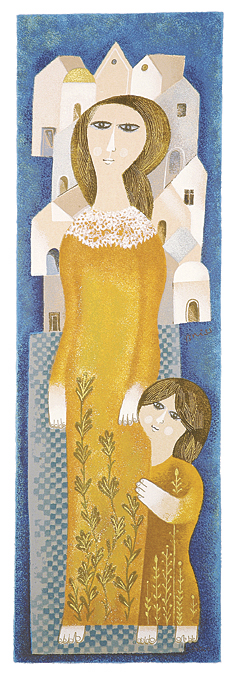
Briss Sami
Walk in the Park
$95
8.5" x 21.5" Serigraph Edition 300
Shipping & Handling: $30
SAMI BRISS
Sami Briss was born in Jassy, Rumania, in 1930, and the influence of his youthful surroundings pervades his artwork even to this day. The artist was strongly impressed by the peaceful, rolling beauty of the landscape and the stately architecture of his home city. The churches of his motherland touched his artist’s soul as well, as did their outer frescos of vivid color. Briss inherited a love for design from his mother, a dressmaker. Continually evincing an interest in the rich embroidery of the cloth, Briss early surprised his delighted mother with his own drawings. She encouraged his interest in the arts, and applauded his entering the Beaux-Arts of Bucharest.
At the beginning of his career, Briss painted beautiful still-lifes, which showed his undeniable concern for construction. He experimented successfully with lithography and wood cutting, but in the early sixties devoted his time to painting. The artist works in both oils and water colors. He was taught the art of iconography, another asset stemming from his Rumanian heritage, and made the art his own by the practice of the ancient technique which he has completely transformed by adapting it to the marvelous images he renews in each of his works.
Briss’ paintings, in which the blues, pinks, deep greens, off-whites and blacks predominate, as well as gold leaf, are pieces full of both mystery and certainty. He often calls upon the world of the Bible and the Rumanian folklore of his youth, incorporating both Saints and peasants. But Briss has broken with the past, and created a world quite his own by screening his memories and feelings through his subconsciousness, renewing them continually in his own way. In his art, which is connected to no precise code of contemporary art, he calls upon varied legends to create his own vocabulary of symbols.
The fish appears in his works as the symbol of abundance, hands evoke strength and happiness, and birds in flight emphasize a hope of detachment. Based in his two kingdoms of Paris and Tel Aviv, the land of Israel is evoked in Briss’ paintings by the ruins of the temples. Briss’ art depicts a series of figures, some perturbed, some serene, while his paintings are just as much dynamic as calm, complex and precise.
….Sami Briss is a painter of the magical and the marvelous, whose nostalgia for icons comes straight from his native Moldavian plains. His surrealistic artistic experience makes him brother to Paul Klee and Victor Brauner. But his images are symbolic their naivete has a genuine popular essence expressed in a subtly metamorphosed conventionalized style. Briss’s choice and use of colors are remarkable. As inventive as it is nuanced and captivating, it evokes the tones of enamels, bisque-fired pottery, and the sober luminosity of the primitives. Briss’s painting is one of myth and memory rooted in the web of time – in other words, in universal “childhood”.
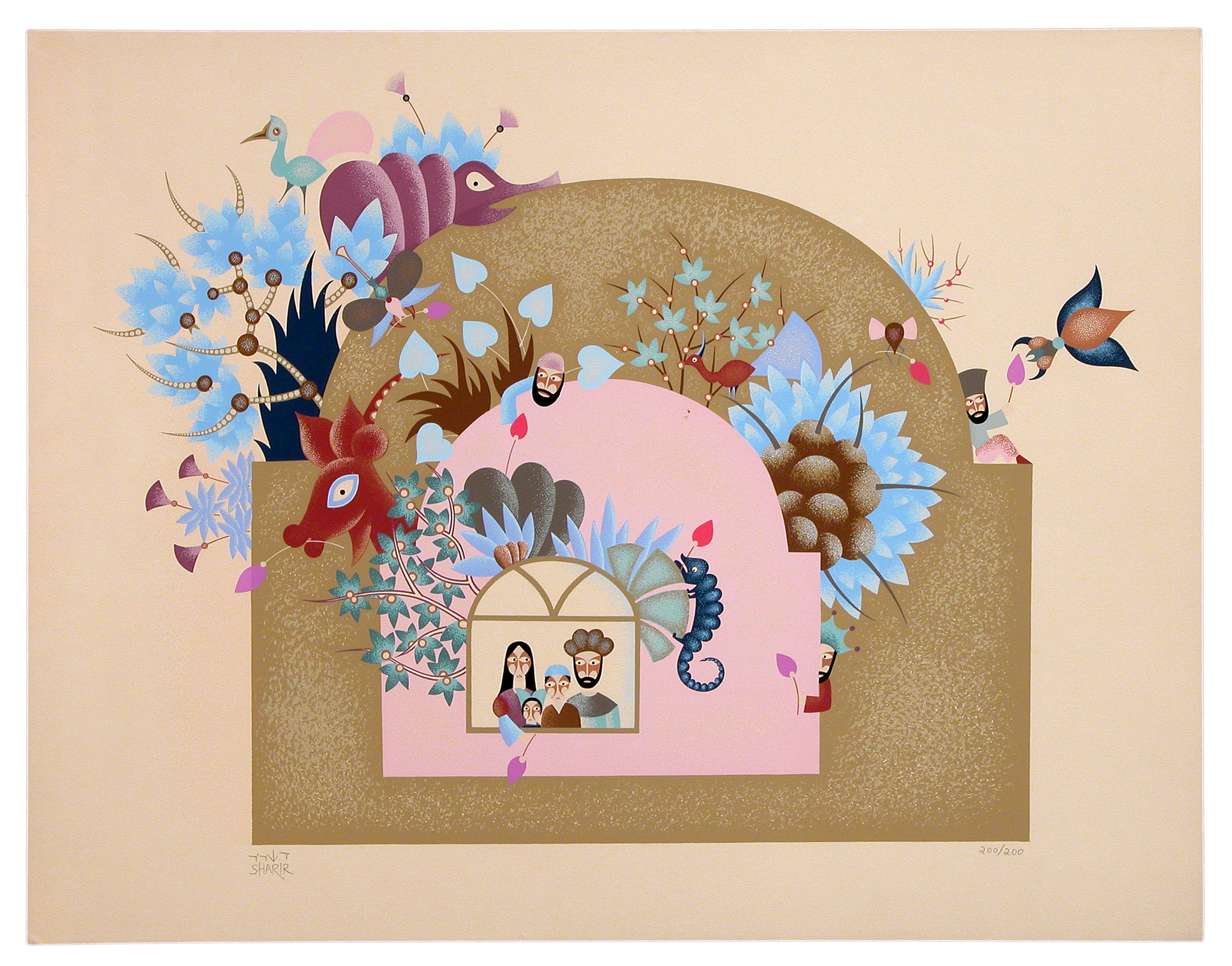
Sharir David
Family at the Studio
$400$200
28" x 21.5" 71x55cm Serigraph 1974 Edition 200
Shipping & Handling: $30
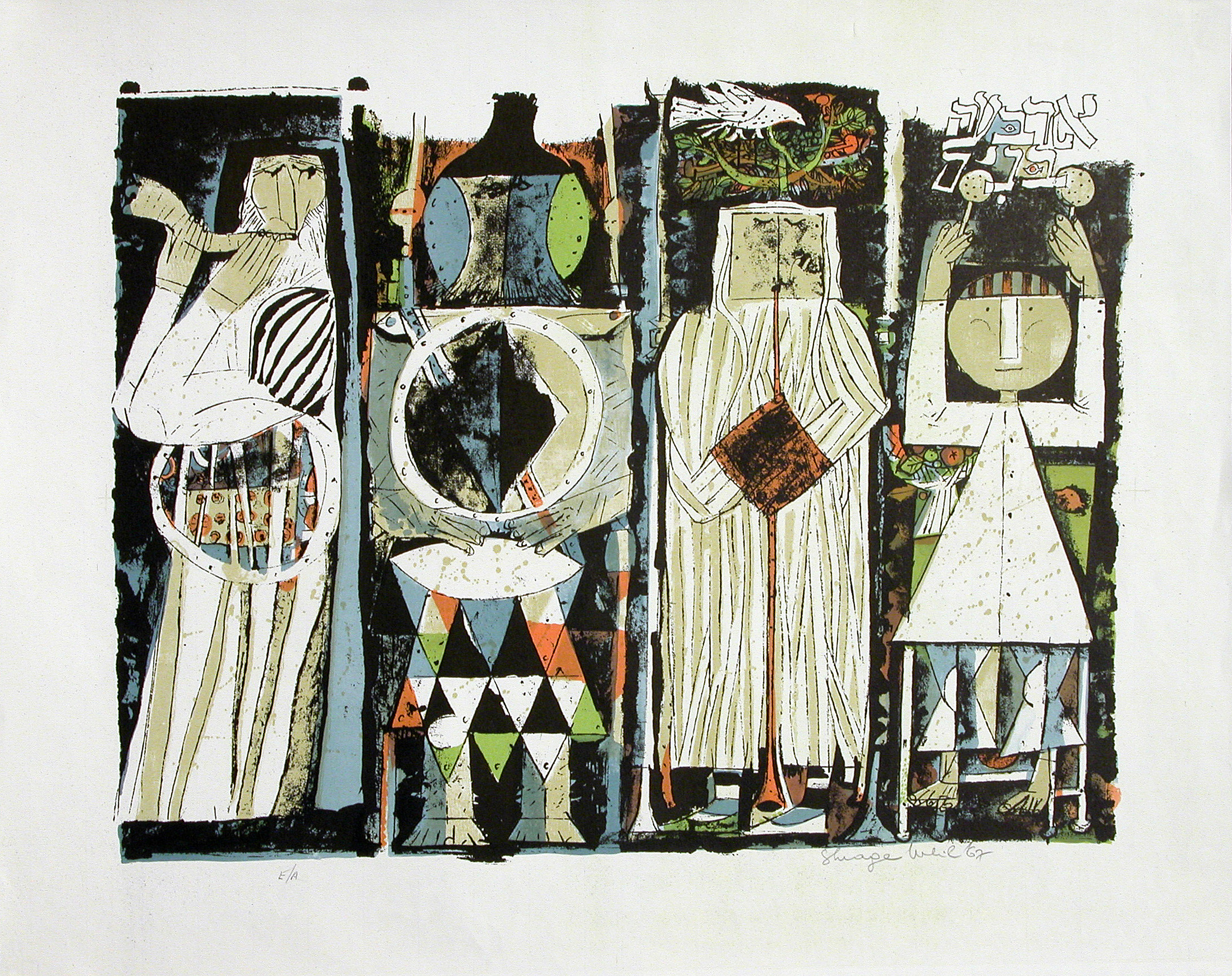
Weil Shraga
S-3 Four Sons
$400
24.5 inches wide x 19 Inches high 62 cm wide x 48 cm high Serigraph 1963
Shipping & Handling: $30
“The Rabbis enumerated four kinds of sons: the wise, the wicked, the simple, and the one who does not even know how to ask. Each one should be told the story of the Exodus (of Passover) in a different manner.” Likewise, each generation presents its artists with different costumes for each of the sons. For example, medieval illustrations depicted the ‘wicked’ son as a murderous crusader, the early 20th century artist showed him as a Prussian officer. Weil has drawn from ancient and modern garb for his “Four Sons”.
Shraga Weil was born in Nitra, Czechoslovakia in 1918 to a family of teachers, journalists and merchants. His father, a building engineer, who was an amateur painter, sent him to study with a local sculptor and then to the Prague School of Art.
He produced his first graphic works during World War II, part of which he spent as a prisoner. After the war, Weil sailed for Israel on an illegal immigrant ship, eventually arriving in the new country in 1947 and becoming a member of Kibbutz Haogen, where he has been living ever since.
In 1954 Weil spent some time studying murals and graphic techniques at the Academie des Beaux Arts, Paris and Ravenna mosaics with Prof. Severinl.
Shraga Weil’s works have been exhibited in the United States, South America, Canada, Australia, France, the USSR, Switzerland, and in the International Exhibition of Graphic Arts, in Lugano. In 1959, Weil was awarded Tel Aviv’s Dizengoff Art Prize.
Museums and Public Collections
Brandeis University, Waltham, Massachusetts
Boston Public Library
Israel Museum, Jerusalem
William Rockhill Nelson Gallery, Kansas City, MO
Fogg Museum, Harvard University
Los Angeles County Museum
Jewish Museum, New York
Philadephia Museum of Art
Joslyn Museum, Omaha, Nebraska
Judah Magnes Museum, Berkeley, CA
Loading...