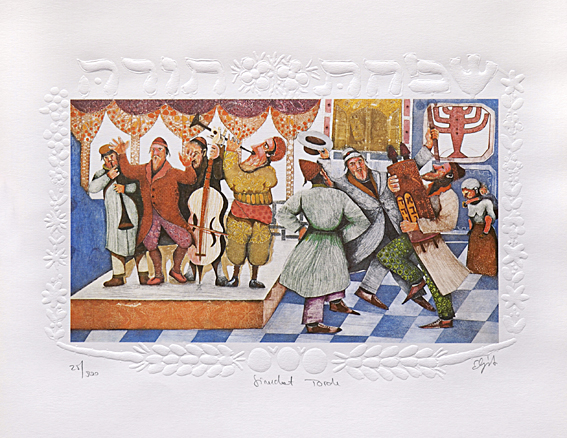
Ebgi Amram
Simchat Torah
$200
13 inches wide x 9.5 inches high 33 cm wide x 24 inches high Lithograph
Shipping & Handling: $30
AMRAM EBGI
Amram Ebgi immigrated to Israel from Morocco under the auspices of Kibbutz Kfar Blum. He received his early art training in Israel at the Tel Chai Institute, the Avni Institute and the School of Advance Painting in Tel Aviv. As painter and graphic artist, Amram also served as the official state-designer for the Organization Kibbutzim in Israel.
In 1969 Amram came to the United States as a recipient of a scholarship to the Brooklyn Museum of Art in New York. He developed his dedication to the graphic arts at Pratt Graphic Center for Contemporary printmaking.
In art work that is dedicated to a culture that has long endured struggles and pain, Ebgi, the Optimist prefers to reflect harmony, balance and joy in a simplified, decorative stylized execution – lighthearted, in a universal language and one of the artist’s own personal vision.
Ebgi does not consider his work to be of a “religious man,” but rather as being representative of Judaism. Almost every work incorporates the cherished symbol of the bird, symbolizing Israel’s Freedom. Other symbols which radiate from his work include vineyards, menorahs, men in taleisim, Noah’s Ark, doves and flora.
An average work takes two months to create, with some being composed of as many as 60 separate elements or pieces. Yet, the work, when finished, is like a masterful symphony orchestrated by a perfect team of musicians, a meticulous shimmering blend of design and color. The versatile artist also works in many other mediums including oils, watercolor, stained glass, ceramic, woodcarving and more.
Ebgi’s etchings have been featured on the cover of the Washington Post, World of Art, Israel, The Miami Herald and Decor Magazine, as well as holiday cards published by UNICEF and Hallmark. His work has found its way into the hearts and homes of numerous collectors including President George Bush.
Ebgi has been called a visionary whose imagination combines warmth, sensitivity and light and gives the complexities of life a subtle structure. And if art has the power to bring smiles of joy to individuals and peace amongst nations then Ebgi is the man who can accomplish that great task.
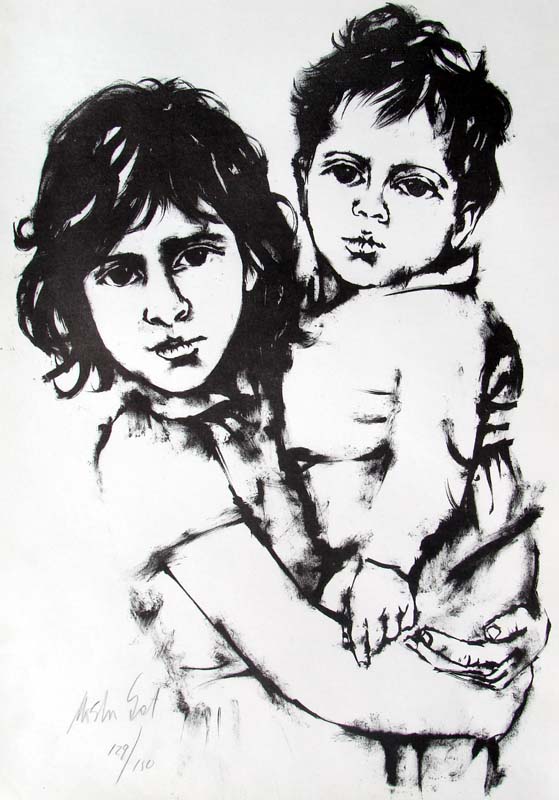
Gat Moshe
Sisterly Love
$150
13.5" x 19.5" Lithograph 1964 Edition 150
Shipping & Handling: $30
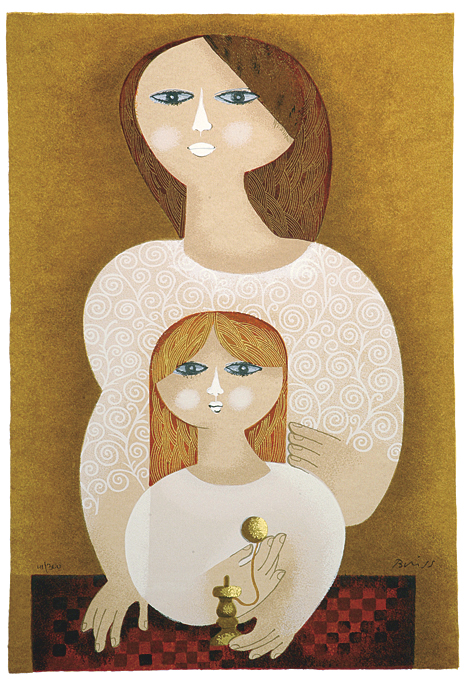
Briss Sami
Blue Eyes
$95
14" x 19" Serigraph Edition 300
Shipping & Handling: $30
SAMI BRISS
Sami Briss was born in Jassy, Rumania, in 1930, and the influence of his youthful surroundings pervades his artwork even to this day. The artist was strongly impressed by the peaceful, rolling beauty of the landscape and the stately architecture of his home city. The churches of his motherland touched his artist’s soul as well, as did their outer frescos of vivid color. Briss inherited a love for design from his mother, a dressmaker. Continually evincing an interest in the rich embroidery of the cloth, Briss early surprised his delighted mother with his own drawings. She encouraged his interest in the arts, and applauded his entering the Beaux-Arts of Bucharest.
At the beginning of his career, Briss painted beautiful still-lifes, which showed his undeniable concern for construction. He experimented successfully with lithography and wood cutting, but in the early sixties devoted his time to painting. The artist works in both oils and water colors. He was taught the art of iconography, another asset stemming from his Rumanian heritage, and made the art his own by the practice of the ancient technique which he has completely transformed by adapting it to the marvelous images he renews in each of his works.
Briss’ paintings, in which the blues, pinks, deep greens, off-whites and blacks predominate, as well as gold leaf, are pieces full of both mystery and certainty. He often calls upon the world of the Bible and the Rumanian folklore of his youth, incorporating both Saints and peasants. But Briss has broken with the past, and created a world quite his own by screening his memories and feelings through his subconsciousness, renewing them continually in his own way. In his art, which is connected to no precise code of contemporary art, he calls upon varied legends to create his own vocabulary of symbols.
The fish appears in his works as the symbol of abundance, hands evoke strength and happiness, and birds in flight emphasize a hope of detachment. Based in his two kingdoms of Paris and Tel Aviv, the land of Israel is evoked in Briss’ paintings by the ruins of the temples. Briss’ art depicts a series of figures, some perturbed, some serene, while his paintings are just as much dynamic as calm, complex and precise.
….Sami Briss is a painter of the magical and the marvelous, whose nostalgia for icons comes straight from his native Moldavian plains. His surrealistic artistic experience makes him brother to Paul Klee and Victor Brauner. But his images are symbolic their naivete has a genuine popular essence expressed in a subtly metamorphosed conventionalized style. Briss’s choice and use of colors are remarkable. As inventive as it is nuanced and captivating, it evokes the tones of enamels, bisque-fired pottery, and the sober luminosity of the primitives. Briss’s painting is one of myth and memory rooted in the web of time – in other words, in universal “childhood”.
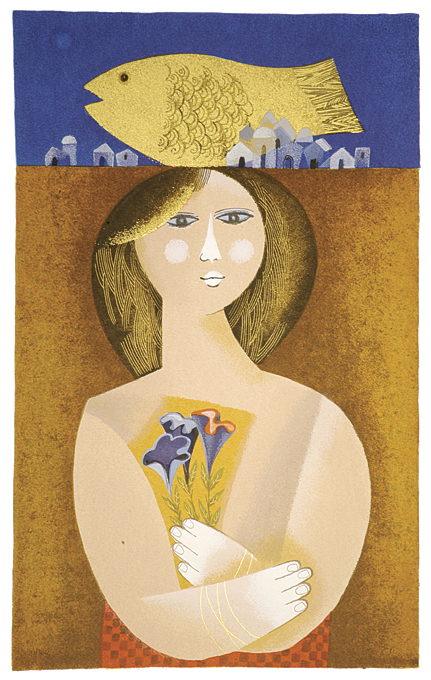
Briss Sami
Le Poisson du Bonheur
$95
13" x 19.5" Serigraph Edition 300
Shipping & Handling: $30
SAMI BRISS
Sami Briss was born in Jassy, Rumania, in 1930, and the influence of his youthful surroundings pervades his artwork even to this day. The artist was strongly impressed by the peaceful, rolling beauty of the landscape and the stately architecture of his home city. The churches of his motherland touched his artist’s soul as well, as did their outer frescos of vivid color. Briss inherited a love for design from his mother, a dressmaker. Continually evincing an interest in the rich embroidery of the cloth, Briss early surprised his delighted mother with his own drawings. She encouraged his interest in the arts, and applauded his entering the Beaux-Arts of Bucharest.
At the beginning of his career, Briss painted beautiful still-lifes, which showed his undeniable concern for construction. He experimented successfully with lithography and wood cutting, but in the early sixties devoted his time to painting. The artist works in both oils and water colors. He was taught the art of iconography, another asset stemming from his Rumanian heritage, and made the art his own by the practice of the ancient technique which he has completely transformed by adapting it to the marvelous images he renews in each of his works.
Briss’ paintings, in which the blues, pinks, deep greens, off-whites and blacks predominate, as well as gold leaf, are pieces full of both mystery and certainty. He often calls upon the world of the Bible and the Rumanian folklore of his youth, incorporating both Saints and peasants. But Briss has broken with the past, and created a world quite his own by screening his memories and feelings through his subconsciousness, renewing them continually in his own way. In his art, which is connected to no precise code of contemporary art, he calls upon varied legends to create his own vocabulary of symbols.
The fish appears in his works as the symbol of abundance, hands evoke strength and happiness, and birds in flight emphasize a hope of detachment. Based in his two kingdoms of Paris and Tel Aviv, the land of Israel is evoked in Briss’ paintings by the ruins of the temples. Briss’ art depicts a series of figures, some perturbed, some serene, while his paintings are just as much dynamic as calm, complex and precise.
….Sami Briss is a painter of the magical and the marvelous, whose nostalgia for icons comes straight from his native Moldavian plains. His surrealistic artistic experience makes him brother to Paul Klee and Victor Brauner. But his images are symbolic their naivete has a genuine popular essence expressed in a subtly metamorphosed conventionalized style. Briss’s choice and use of colors are remarkable. As inventive as it is nuanced and captivating, it evokes the tones of enamels, bisque-fired pottery, and the sober luminosity of the primitives. Briss’s painting is one of myth and memory rooted in the web of time – in other words, in universal “childhood”.
Loading...