Composition
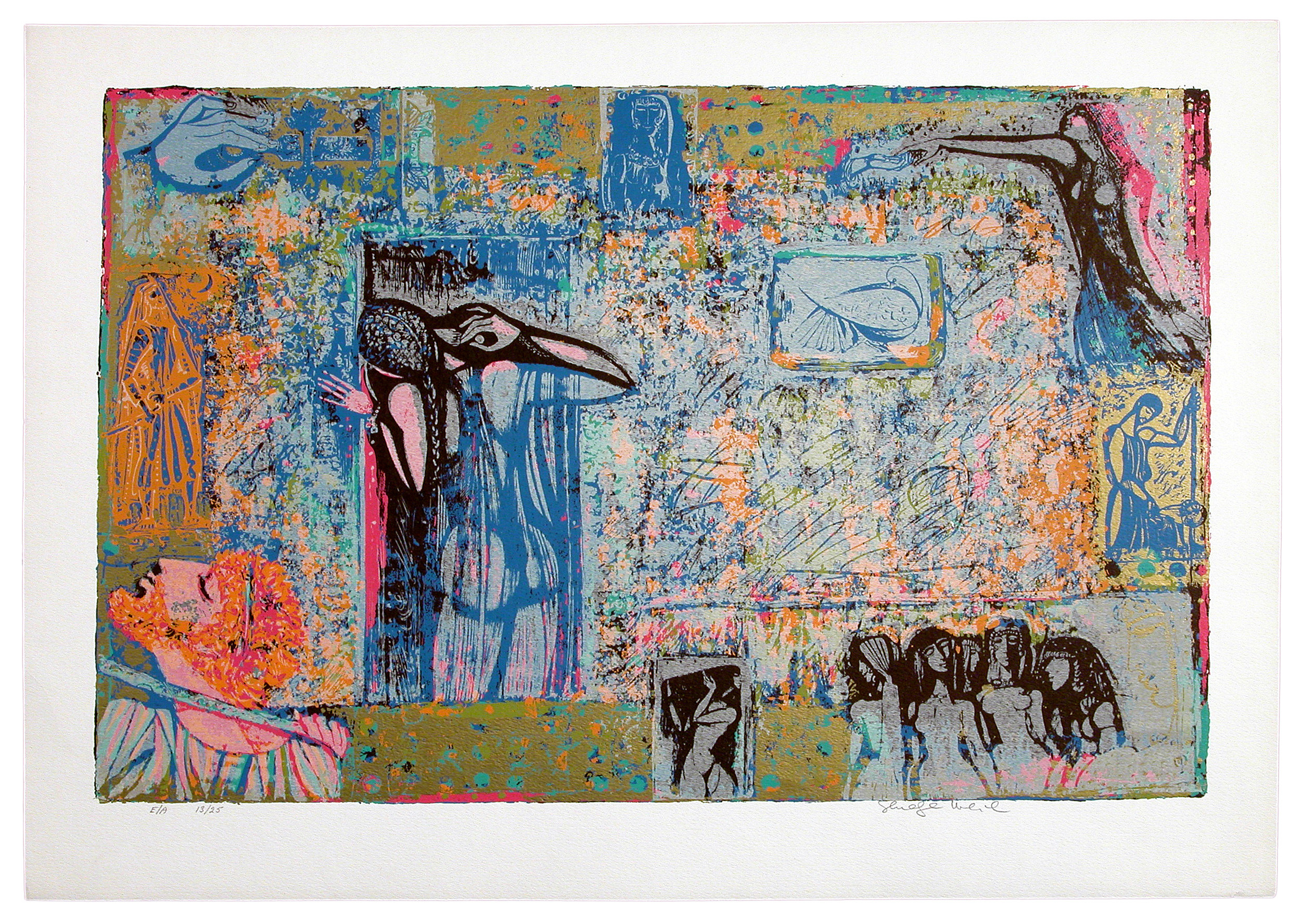
Weil Shraga
S-18 Song of Songs
$500
27.5 inches wide x 19.75 inches high 70 cm wide x 50 cm high Serigraph 1968
Shipping & Handling: $30
Shraga Weil was born in Nitra, Czechoslovakia in 1918 to a family of teachers, journalists and merchants. His father, a building engineer, who was an amateur painter, sent him to study with a local sculptor and then to the Prague School of Art.
He produced his first graphic works during World War II, part of which he spent as a prisoner. After the war, Weil sailed for Israel on an illegal immigrant ship, eventually arriving in the new country in 1947 and becoming a member of Kibbutz Haogen, where he has been living ever since.
In 1954 Weil spent some time studying murals and graphic techniques at the Academie des Beaux Arts, Paris and Ravenna mosaics with Prof. Severinl.
Shraga Weil’s works have been exhibited in the United States, South America, Canada, Australia, France, the USSR, Switzerland, and in the International Exhibition of Graphic Arts, in Lugano. In 1959, Weil was awarded Tel Aviv’s Dizengoff Art Prize.
Museums and Public Collections
Brandeis University, Waltham, Massachusetts
Boston Public Library
Israel Museum, Jerusalem
William Rockhill Nelson Gallery, Kansas City, MO
Fogg Museum, Harvard University
Los Angeles County Museum
Jewish Museum, New York
Philadephia Museum of Art
Joslyn Museum, Omaha, Nebraska
Judah Magnes Museum, Berkeley, CA
Weil Shraga
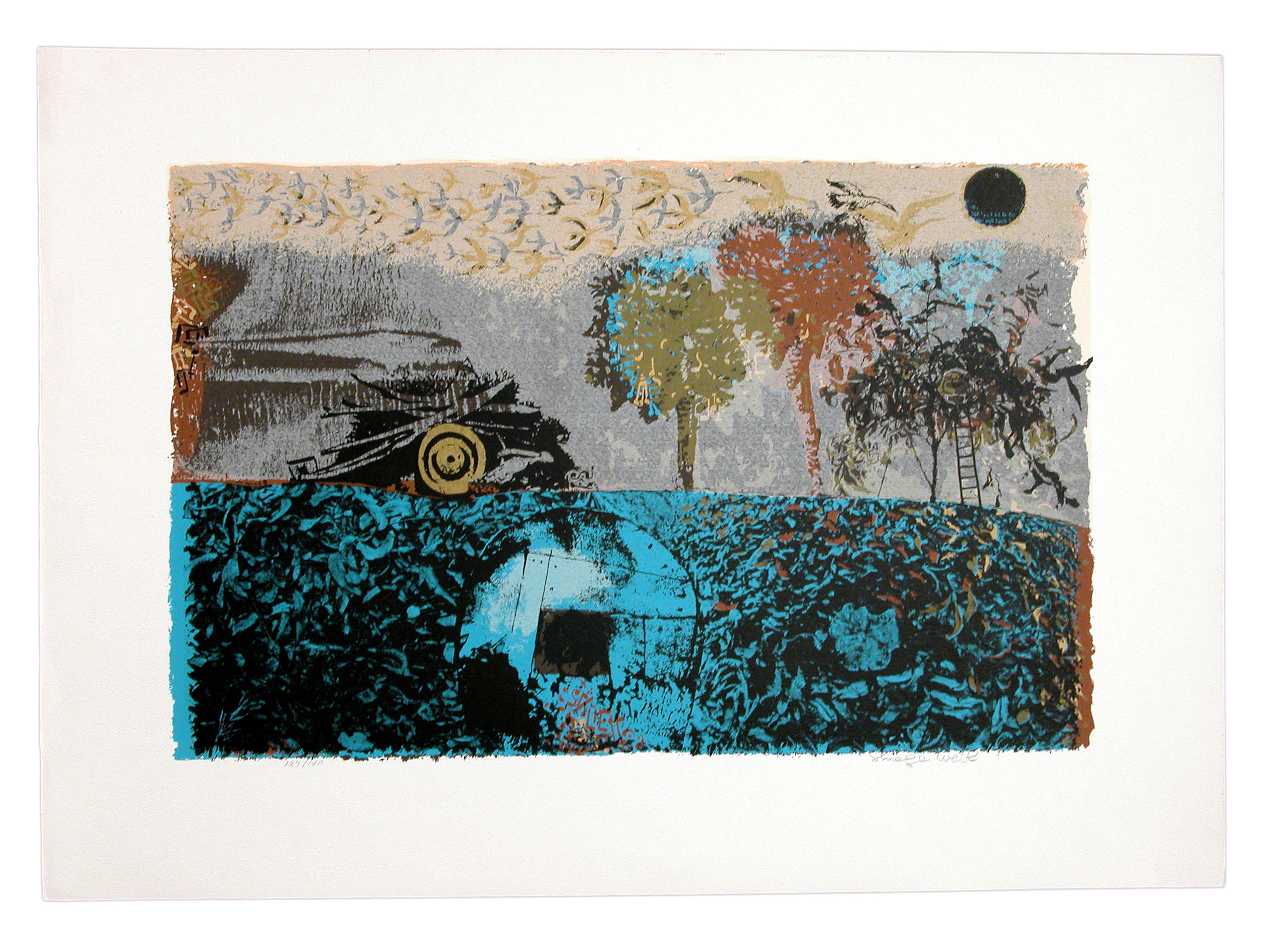
S-19 Seasons I
$500
27.5 inches wide x 19.75 inches high 70 cm wide x 50 cm high Serigraph 1968
Shipping & Handling: $30
Also when they shall be afraid of that which is high,
And terrors shall be in the way;
And the almond-tree shall blossom,
And the grasshopper shall drag itself along
And the caperberry shall fail;
Because man goeth to his long home,
And the mourners go about the streets
Before the silver cord is shattered.
And the pitcher is broken at the fountain,
And the wheel falleth shattered into the pit. . . .
-Ecclesiastes 12:5-6
Here, Weil presents the prince of pessimism at his most pessimistic – all colors are muted as if a dark cloud has dimmed the light. The fallen leaves, the broken wheel, the ragged birds all testify to the sorrow of despair. Koheleth is elegiac poetry, born of the artist’s awareness that “all is vanity.”
Shraga Weil was born in Nitra, Czechoslovakia in 1918 to a family of teachers, journalists and merchants. His father, a building engineer, who was an amateur painter, sent him to study with a local sculptor and then to the Prague School of Art.
He produced his first graphic works during World War II, part of which he spent as a prisoner. After the war, Weil sailed for Israel on an illegal immigrant ship, eventually arriving in the new country in 1947 and becoming a member of Kibbutz Haogen, where he has been living ever since.
In 1954 Weil spent some time studying murals and graphic techniques at the Academie des Beaux Arts, Paris and Ravenna mosaics with Prof. Severinl.
Shraga Weil’s works have been exhibited in the United States, South America, Canada, Australia, France, the USSR, Switzerland, and in the International Exhibition of Graphic Arts, in Lugano. In 1959, Weil was awarded Tel Aviv’s Dizengoff Art Prize.
Weil Shraga
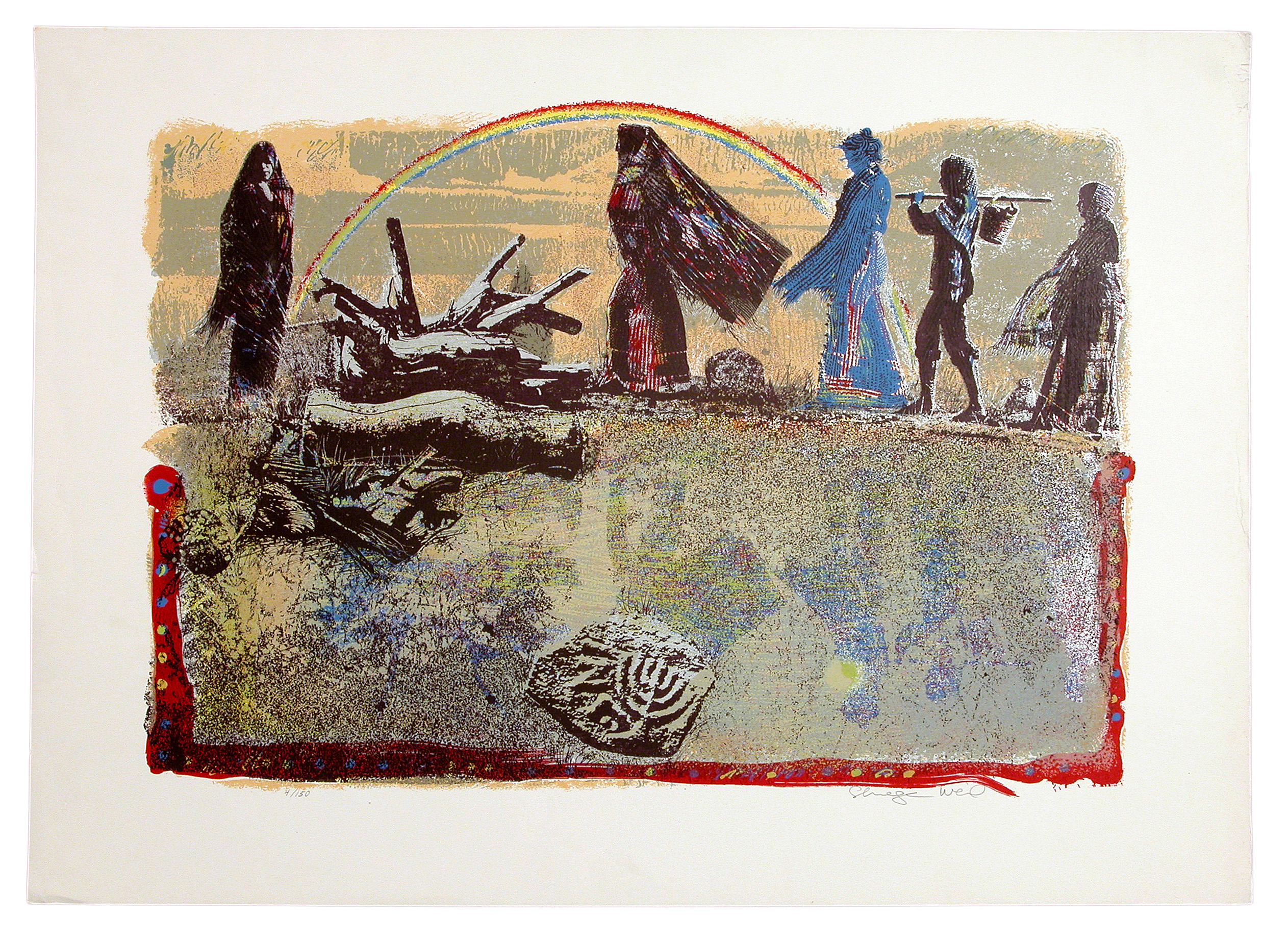
S-20 Seasons III
$500
27.5 inches wide x 19.75 Inches high 70 cm wide x 50 cm high Serigraph 1968
Shipping & Handling: $30
Weil has turned to the imaginative use of photographic material in this work. The major figures are reversed and refracted in their shimmering reflections. Color is broken down into confetti-like areas that seem to flicker against the contrasting starkness of flat color utilized in the tree-trunk and figures.
“Winter” makes elliptical reference to the Bible and Jewish history by Weil’s inclusion of the rainbow (the symbol of God’s covenant with Noah) and the menorah in the foreground. This particular menorah is taken from a coin fragment of the Maccabean period under the reign of Matthias Antigonus (40-37 B.C.E.). Weil thus poignantly illustrates the position of an artist sustained in his work by (and sustaining by his work) memories of his people’s past and the hope for peace almost as unattainable as a rainbow.
Shraga Weil was born in Nitra, Czechoslovakia in 1918 to a family of teachers, journalists and merchants. His father, a building engineer, who was an amateur painter, sent him to study with a local sculptor and then to the Prague School of Art.
He produced his first graphic works during World War II, part of which he spent as a prisoner. After the war, Weil sailed for Israel on an illegal immigrant ship, eventually arriving in the new country in 1947 and becoming a member of Kibbutz Haogen, where he has been living ever since.
In 1954 Weil spent some time studying murals and graphic techniques at the Academie des Beaux Arts, Paris and Ravenna mosaics with Prof. Severinl.
Shraga Weil’s works have been exhibited in the United States, South America, Canada, Australia, France, the USSR, Switzerland, and in the International Exhibition of Graphic Arts, in Lugano. In 1959, Weil was awarded Tel Aviv’s Dizengoff Art Prize.
Museums and Public Collections
Brandeis University, Waltham, Massachusetts
Boston Public Library
Israel Museum, Jerusalem
William Rockhill Nelson Gallery, Kansas City, MO
Fogg Museum, Harvard University
Los Angeles County Museum
Jewish Museum, New York
Philadephia Museum of Art
Joslyn Museum, Omaha, Nebraska
Judah Magnes Museum, Berkeley, CA
Weil Shraga
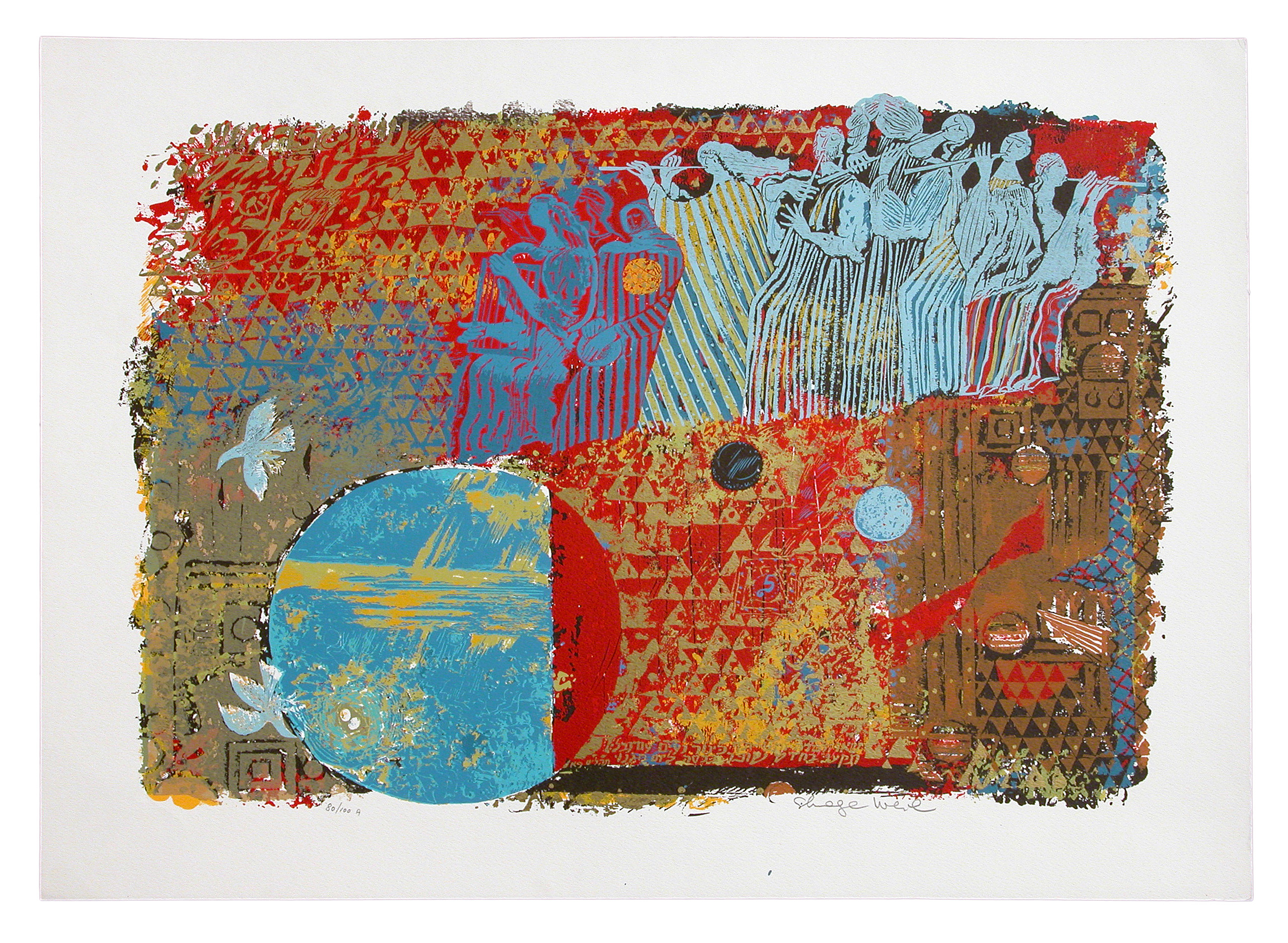
S-21 Take Up the Melody
$1200
27.5 inches wide x 19.75 inches high 70 cm wide x 50 cm high Serigraph 1973
Shipping & Handling: $30
Shraga Weil was born in Nitra, Czechoslovakia in 1918 to a family of teachers, journalists and merchants. His father, a building engineer, who was an amateur painter, sent him to study with a local sculptor and then to the Prague School of Art.
He produced his first graphic works during World War II, part of which he spent as a prisoner. After the war, Weil sailed for Israel on an illegal immigrant ship, eventually arriving in the new country in 1947 and becoming a member of Kibbutz Haogen, where he has been living ever since.
In 1954 Weil spent some time studying murals and graphic techniques at the Academie des Beaux Arts, Paris and Ravenna mosaics with Prof. Severinl.
Shraga Weil’s works have been exhibited in the United States, South America, Canada, Australia, France, the USSR, Switzerland, and in the International Exhibition of Graphic Arts, in Lugano. In 1959, Weil was awarded Tel Aviv’s Dizengoff Art Prize.
Museums and Public Collections
Brandeis University, Waltham, Massachusetts
Boston Public Library
Israel Museum, Jerusalem
William Rockhill Nelson Gallery, Kansas City, MO
Fogg Museum, Harvard University
Los Angeles County Museum
Jewish Museum, New York
Philadephia Museum of Art
Joslyn Museum, Omaha, Nebraska
Judah Magnes Museum, Berkeley, CA
Loading...