Composition
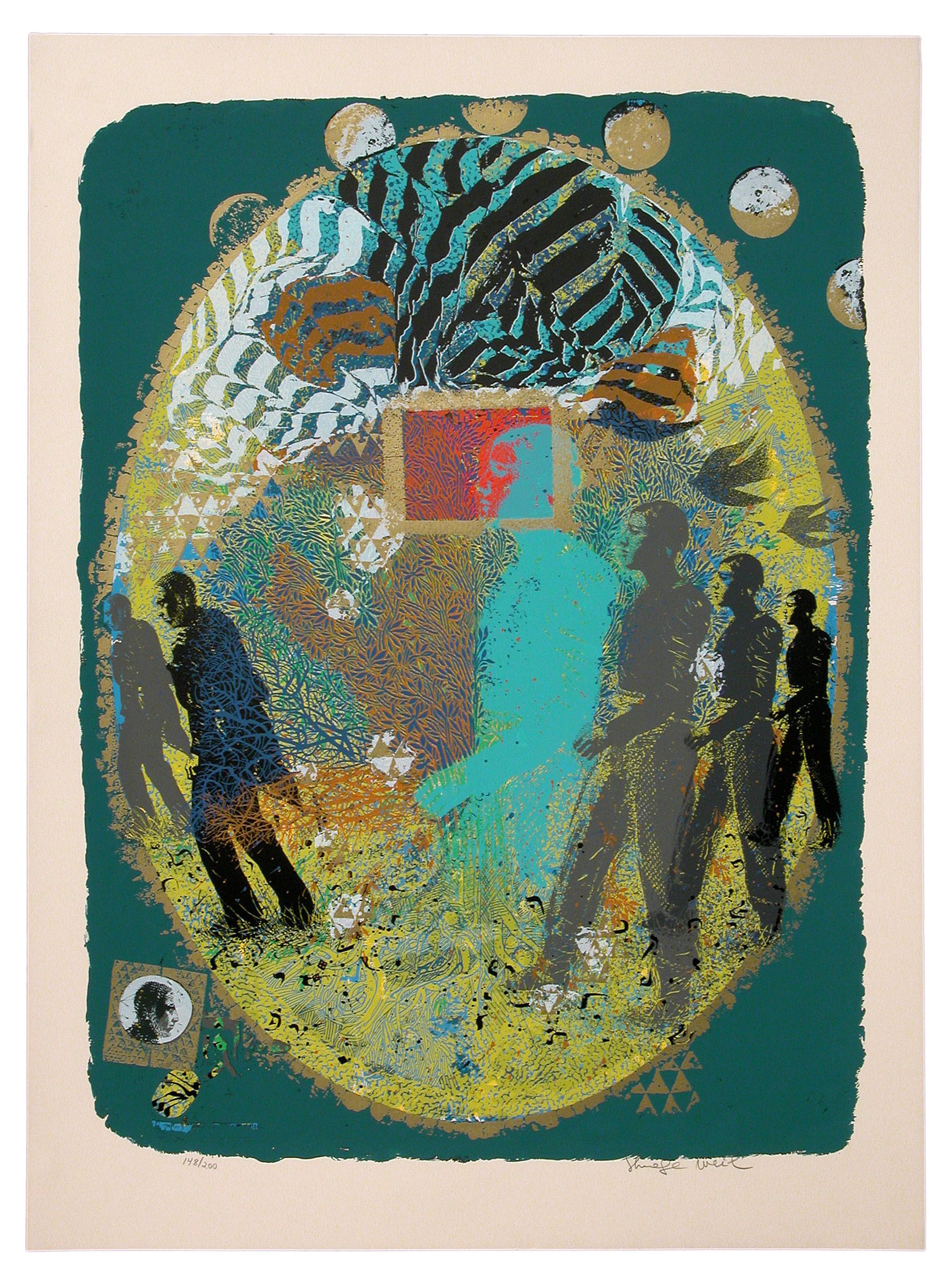
Weil Shraga
S-112 Hagadah
$500
21.5 inches wide x 29 inches high 55 cm wide x 74 cm high Serigraph 1976 Edition 200
Shipping & Handling: $30
The moon waxes and wanes above the oval realm of the world that Weil depicts here as a mass of changing textures, over and through which passes a single figure, entering at right and repeated as in stop-motion photography, then waxing enormous and ghostly at center, only to fade out, head downcast, at left. It seems a visual statement of life’s transience: phases and cycles, time passing and time eternal, the repetition of history itself. As the title suggest, the people of Israel were led out of the wilderness before, and very likely shall be agian.
Shraga Weil was born in Nitra, Czechoslovakia in 1918 to a family of teachers, journalists and merchants. His father, a building engineer, who was an amateur painter, sent him to study with a local sculptor and then to the Prague School of Art.
He produced his first graphic works during World War II, part of which he spent as a prisoner. After the war, Weil sailed for Israel on an illegal immigrant ship, eventually arriving in the new country in 1947 and becoming a member of Kibbutz Haogen, where he has been living ever since.
In 1954 Weil spent some time studying murals and graphic techniques at the Academie des Beaux Arts, Paris and Ravenna mosaics with Prof. Severinl.
Shraga Weil’s works have been exhibited in the United States, South America, Canada, Australia, France, the USSR, Switzerland, and in the International Exhibition of Graphic Arts, in Lugano. In 1959, Weil was awarded Tel Aviv’s Dizengoff Art Prize
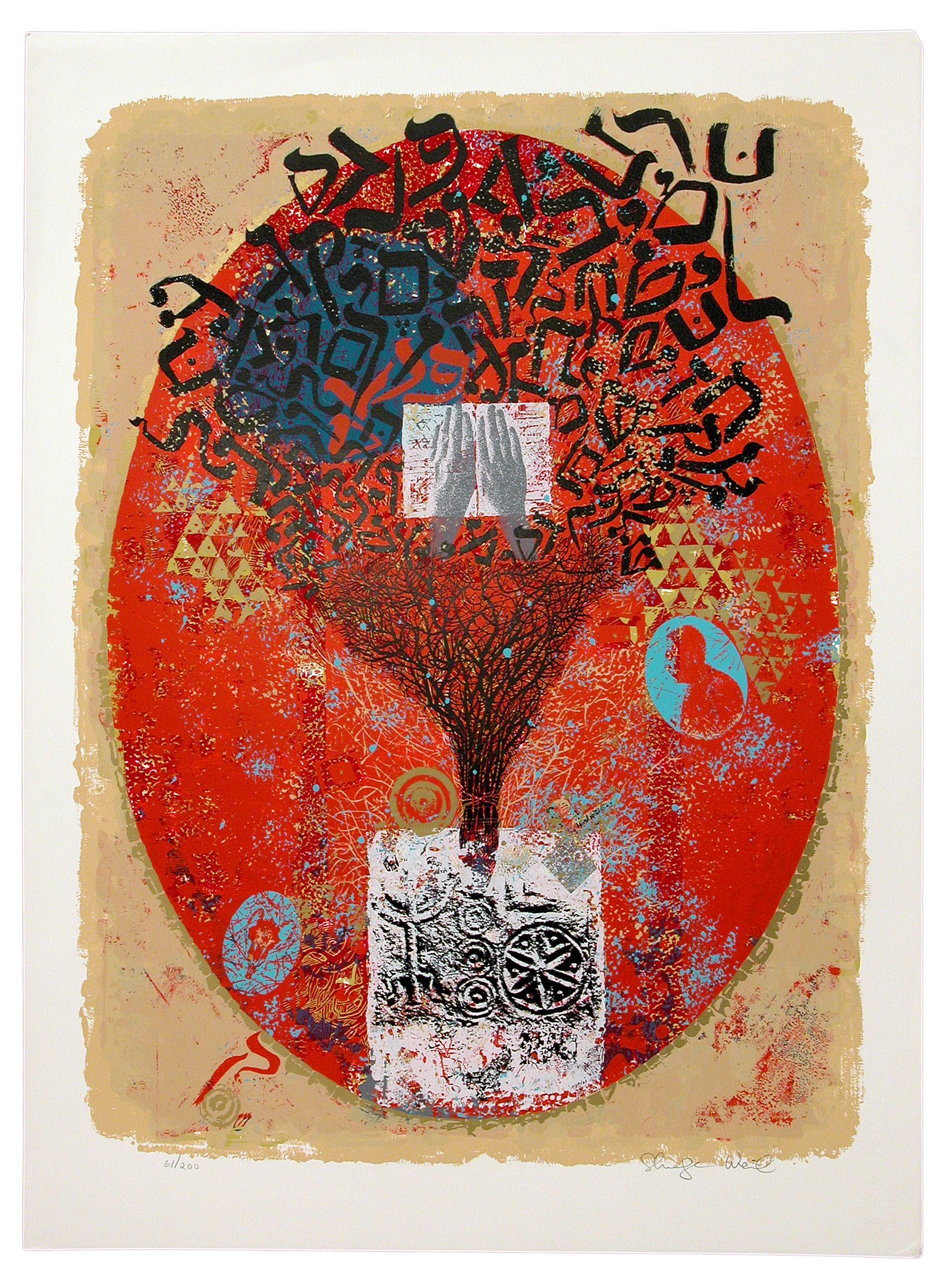
Weil Shraga
S-113 Kabbalah
$1200
21.5 inches wide x 29.5 inches high 55 cm wide x 75 cm high Serigraph 1976 Edition 200
Shipping & Handling: $30
Weil’s respect for the “the Word” is again evident here. The bond between tradition and a literary history remains unbroken and is visually expressed in the blossoming of the brambles of a thicket into the letters of the Hebrew alphabet. The hands and book superimposed on the “bouquet” of letters suggests reverence; while below, the vase-like bas-relief fragment depicting a candlestick and six-pointed star reminds us that all springs from a tangible historical past.
Shraga Weil was born in Nitra, Czechoslovakia in 1918 to a family of teachers, journalists and merchants. His father, a building engineer, who was an amateur painter, sent him to study with a local sculptor and then to the Prague School of Art.
He produced his first graphic works during World War II, part of which he spent as a prisoner. After the war, Weil sailed for Israel on an illegal immigrant ship, eventually arriving in the new country in 1947 and becoming a member of Kibbutz Haogen, where he has been living ever since.
In 1954 Weil spent some time studying murals and graphic techniques at the Academie des Beaux Arts, Paris and Ravenna mosaics with Prof. Severinl.
Shraga Weil’s works have been exhibited in the United States, South America, Canada, Australia, France, the USSR, Switzerland, and in the International Exhibition of Graphic Arts, in Lugano. In 1959, Weil was awarded Tel Aviv’s Dizengoff Art Prize
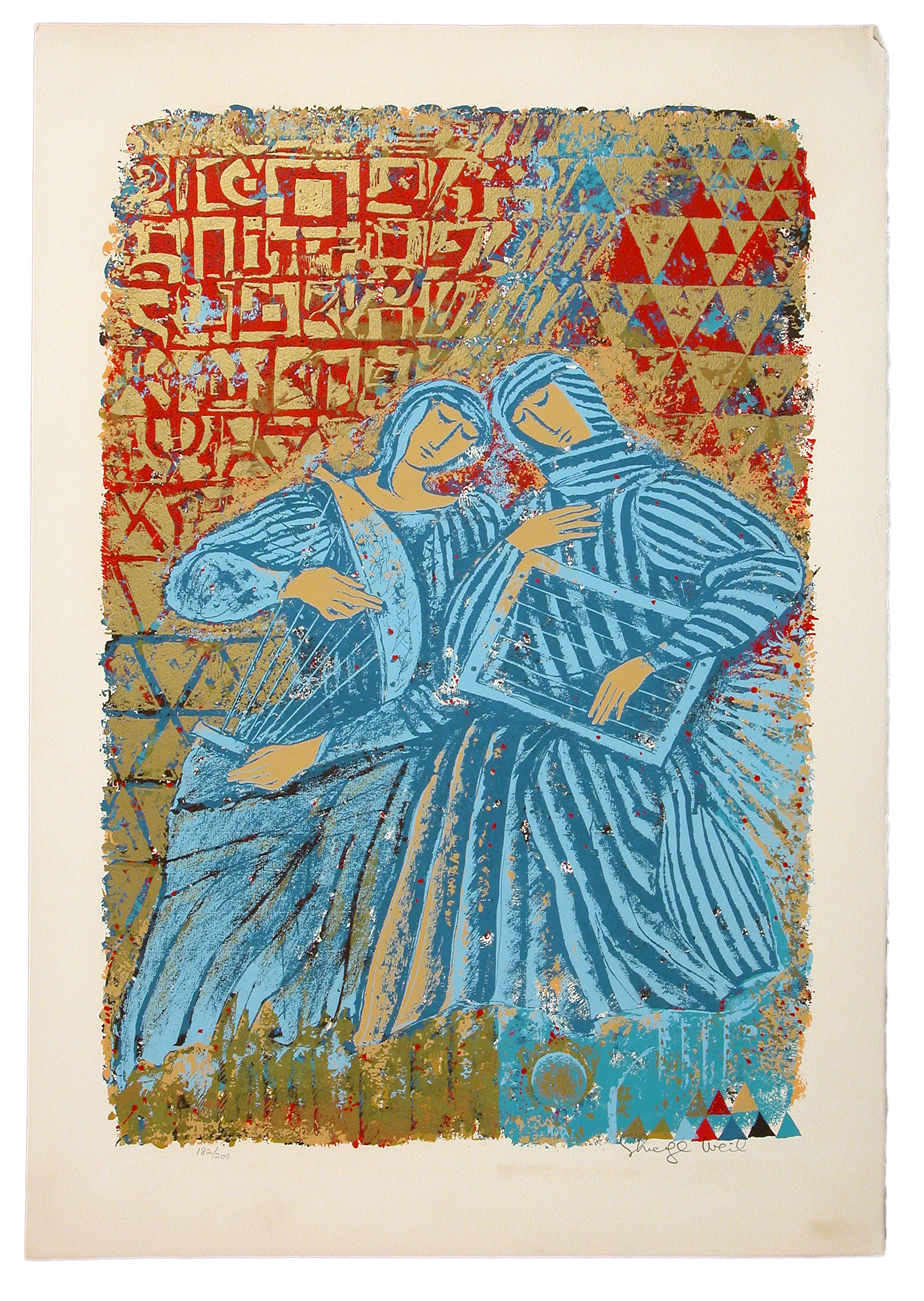
Weil Shraga
S-122 The Harpists
$500
21 inches wide x 29.5 inches high 53 cm wide x 75 cm high Serigraph 1975 Edition 200
Shipping & Handling: $30
Shraga Weil was born in Nitra, Czechoslovakia in 1918 to a family of teachers, journalists and merchants. His father, a building engineer, who was an amateur painter, sent him to study with a local sculptor and then to the Prague School of Art.
He produced his first graphic works during World War II, part of which he spent as a prisoner. After the war, Weil sailed for Israel on an illegal immigrant ship, eventually arriving in the new country in 1947 and becoming a member of Kibbutz Haogen, where he has been living ever since.
In 1954 Weil spent some time studying murals and graphic techniques at the Academie des Beaux Arts, Paris and Ravenna mosaics with Prof. Severinl.
Shraga Weil’s works have been exhibited in the United States, South America, Canada, Australia, France, the USSR, Switzerland, and in the International Exhibition of Graphic Arts, in Lugano. In 1959, Weil was awarded Tel Aviv’s Dizengoff Art Prize.
Museums and Public Collections
Brandeis University, Waltham, Massachusetts
Boston Public Library
Israel Museum, Jerusalem
William Rockhill Nelson Gallery, Kansas City, MO
Fogg Museum, Harvard University
Los Angeles County Museum
Jewish Museum, New York
Philadephia Museum of Art
Joslyn Museum, Omaha, Nebraska
Judah Magnes Museum, Berkeley, CA
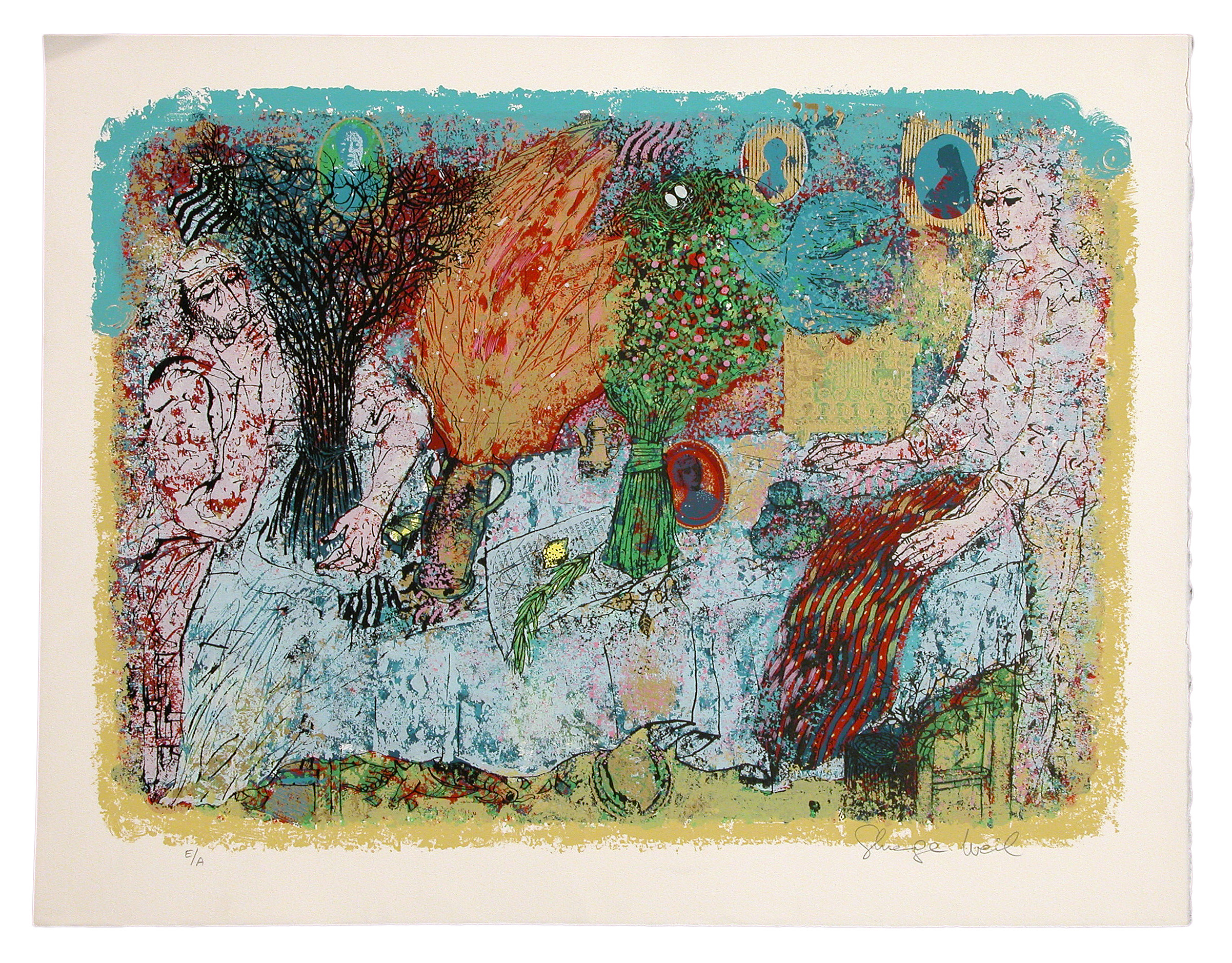
Weil Shraga
S-123 Vayehi
$500
26 inches wide X 19.75 inches high 66 cm wide X 50 cm high Serigraph 1977 Edition 200
Shipping & Handling: $30
An allegory of the Generations, beginning with the younger, at the right, and progressing to the older, at left, from whom the succeeding generation receives the personal symbols of life.
Shraga Weil was born in Nitra, Czechoslovakia in 1918 to a family of teachers, journalists and merchants. His father, a building engineer, who was an amateur painter, sent him to study with a local sculptor and then to the Prague School of Art.
He produced his first graphic works during World War II, part of which he spent as a prisoner. After the war, Weil sailed for Israel on an illegal immigrant ship, eventually arriving in the new country in 1947 and becoming a member of Kibbutz Haogen, where he has been living ever since.
In 1954 Weil spent some time studying murals and graphic techniques at the Academie des Beaux Arts, Paris and Ravenna mosaics with Prof. Severinl.
Shraga Weil’s works have been exhibited in the United States, South America, Canada, Australia, France, the USSR, Switzerland, and in the International Exhibition of Graphic Arts, in Lugano. In 1959, Weil was awarded Tel Aviv’s Dizengoff Art Prize.
Museums and Public Collections
Brandeis University, Waltham, Massachusetts
Boston Public Library
Israel Museum, Jerusalem
William Rockhill Nelson Gallery, Kansas City, MO
Fogg Museum, Harvard University
Los Angeles County Museum
Jewish Museum, New York
Philadephia Museum of Art
Joslyn Museum, Omaha, Nebraska
Judah Magnes Museum, Berkeley, CA
Loading...