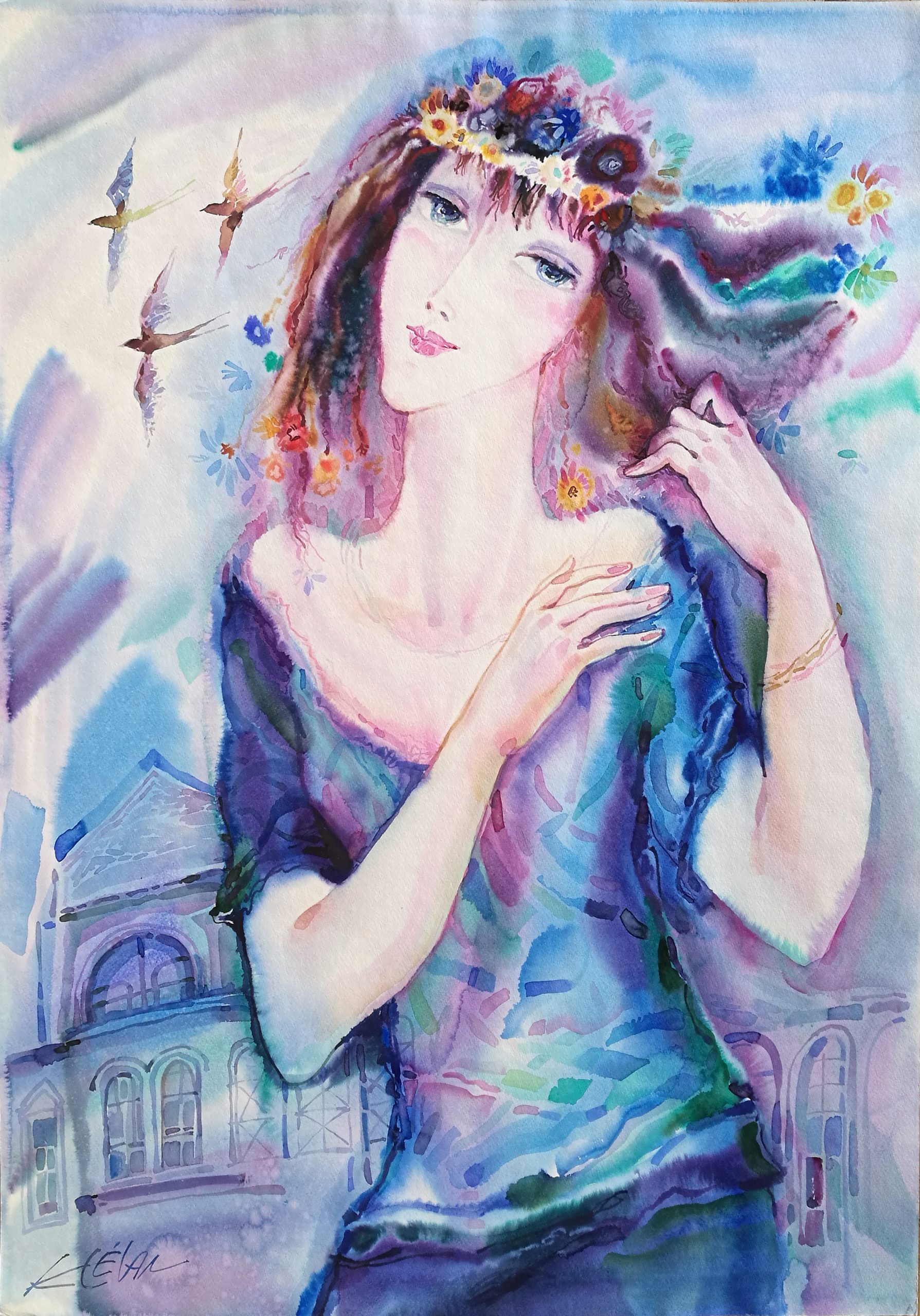
Klevan Alexander
K-1253
$600
25.5x35 65x90 Watercolors
Shipping & Handling: $30
Alexander Klevan was born in Siberia Russia, October, in 1950 and he learned from 1974-1979 at the Academy for Monumental, and Art Design in Lvov , Ukraina
It seems, that at the end of our cruel, so dramatic and tragic age, there is no room left for romanticism with its striving for happiness and passion for carnival-like metamorphoses. But deep down, even for a pragmatist and realist, this need exists and he, having at least for a little while shaken from his shoulders the load of everyday concerns, is again drawn towards mirages and nostalgic memories, as fragile as card houses. Only when reconstructed through art, this world receives a special reality, no less tangible, than that which is around us.
Alexander Klevan is a romanticist in his art, not because he has chosen this “role”, but due to the disposition of his soul, his world view and attitude. The artist sharply senses the movement of real life, its momentary changeability. Clocks, which are frequently present in A. Klevan’s still life, landscape paintings and compositions, measure the time, but there is no way of knowing whether the arms of the clock are going forward to the next day or back to the day before, returning our memory to the past. The houses have unexpectedly become displaced along their axes, ripples have obscured the town’s reflection in water, and on the quay in Jaffa a gray bearded Jew with a hat appears sitting on a chair and it seems, that Tel-Aviv does not yet exist, but only the old stones of Jaffa. Why then is there a modern road sign?…
According to Kant, art was created by the human need for “pure” play, without any practical interest. Shakespeare raised this to a comprehensive formula: the whole world’s a stage and men are the actors, the atmosphere of play, stage, a carnival, where people skilfully hide their faces, is also present in the many works of Alexander Klevan. He likes to paint clowns and jesters, made wiser by life, puppets play people, while people pull their strings, unaware that it may be painful to them. Or lay out cards, looking at the fickle and unstable signs of fate. Sometimes the artist dresses his characters in new clothes, the king changes his crown for a fool’s cap, and the girl from the cafe becomes a real lady… But now the show is over, the actors take off their masks and everything returns to usual – tired eyes, bitterness, hidden in the curve of the lips, a T-shirt instead of a king’s cloak…Only the asymmetry and disproportion, characteristic of acting, are not washed off with the make-up and stay forever. In love with the “Retro-style Bohemia” atmosphere, A. Klevan paints women’s portraits, with the reflection of the epoch of Toulouse-Lautrec and Modigliani, Parisian charm, some kind of understatement, hard to capture. In these portraits triumphs an eternal femininity, beauty, life completeness, but why, unexpectedly and sharply, a glance wet with tears sparkles beneath the lowered brim of a hat?!.. Life is only life, romanticism may adorn it, but is unable to change it.
The feelings of instability of the world and its object environment creates an instability of feelings, which wipes off the border between reality and imagination: reality is as fantastic, as fantasy is real. A. Klevan expresses this mobility, perhaps not so much in his topics, romantic or commonplace, as in colour. Water-colours, as it seems to me, became his favorite painting technique not because he controls it freely and confidently, but because it is adequate to his creative outlook. The specific character of water-colours is such, that is demands from the artist quickness and lightness of performance, purity and clarity of the colour layer and its interaction with the whiteness of paper, masterly control of colour, drawing and form. As a wide range artist, A. Klevan works willingly and successfully with oil paints as well. He knows their characteristics and possibilities, senses it not as a traditional technique, but as a spiritual creature, usually obedient, but sometimes unpredictibly capricious. He sees and hears its vibrating tonality, pitch of the “colour-sound”, harmony and dissonance, solo parts of one colour, colour multiplicity of chords, poliphony of arrangement. Probably this is why A. Klevan frequently returns to the theme of music. Musicians: violinists, cellists and conductors are welcome guests among his characters.
Grigory Ostrovsky
Doctor of History of Fine Art
Briss Sami
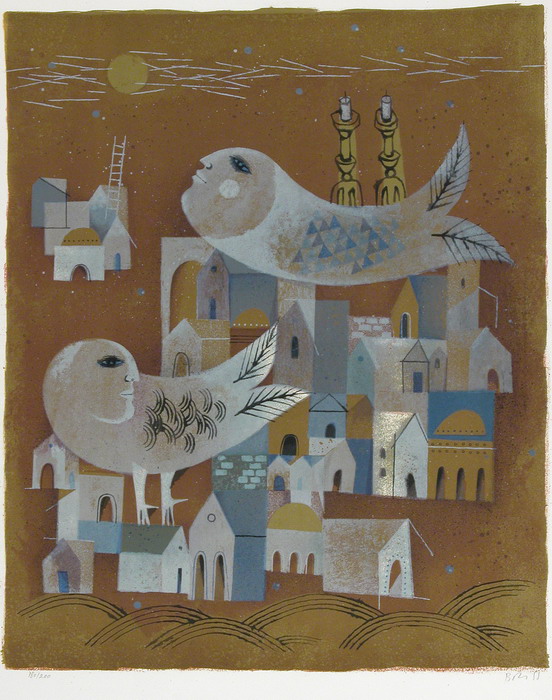
J’lem Candlesticks and Birds
$95
20" x 27" Serigraph 1975 Edition 200
Shipping & Handling: $30
SAMI BRISS
Sami Briss was born in Jassy, Rumania, in 1930, and the influence of his youthful surroundings pervades his artwork even to this day. The artist was strongly impressed by the peaceful, rolling beauty of the landscape and the stately architecture of his home city. The churches of his motherland touched his artist’s soul as well, as did their outer frescos of vivid color. Briss inherited a love for design from his mother, a dressmaker. Continually evincing an interest in the rich embroidery of the cloth, Briss early surprised his delighted mother with his own drawings. She encouraged his interest in the arts, and applauded his entering the Beaux-Arts of Bucharest.
At the beginning of his career, Briss painted beautiful still-lifes, which showed his undeniable concern for construction. He experimented successfully with lithography and wood cutting, but in the early sixties devoted his time to painting. The artist works in both oils and water colors. He was taught the art of iconography, another asset stemming from his Rumanian heritage, and made the art his own by the practice of the ancient technique which he has completely transformed by adapting it to the marvelous images he renews in each of his works.
Briss’ paintings, in which the blues, pinks, deep greens, off-whites and blacks predominate, as well as gold leaf, are pieces full of both mystery and certainty. He often calls upon the world of the Bible and the Rumanian folklore of his youth, incorporating both Saints and peasants. But Briss has broken with the past, and created a world quite his own by screening his memories and feelings through his subconsciousness, renewing them continually in his own way. In his art, which is connected to no precise code of contemporary art, he calls upon varied legends to create his own vocabulary of symbols.
The fish appears in his works as the symbol of abundance, hands evoke strength and happiness, and birds in flight emphasize a hope of detachment. Based in his two kingdoms of Paris and Tel Aviv, the land of Israel is evoked in Briss’ paintings by the ruins of the temples. Briss’ art depicts a series of figures, some perturbed, some serene, while his paintings are just as much dynamic as calm, complex and precise.
….Sami Briss is a painter of the magical and the marvelous, whose nostalgia for icons comes straight from his native Moldavian plains. His surrealistic artistic experience makes him brother to Paul Klee and Victor Brauner. But his images are symbolic their naivete has a genuine popular essence expressed in a subtly metamorphosed conventionalized style. Briss’s choice and use of colors are remarkable. As inventive as it is nuanced and captivating, it evokes the tones of enamels, bisque-fired pottery, and the sober luminosity of the primitives. Briss’s painting is one of myth and memory rooted in the web of time – in other words, in universal “childhood”.
Briss Sami
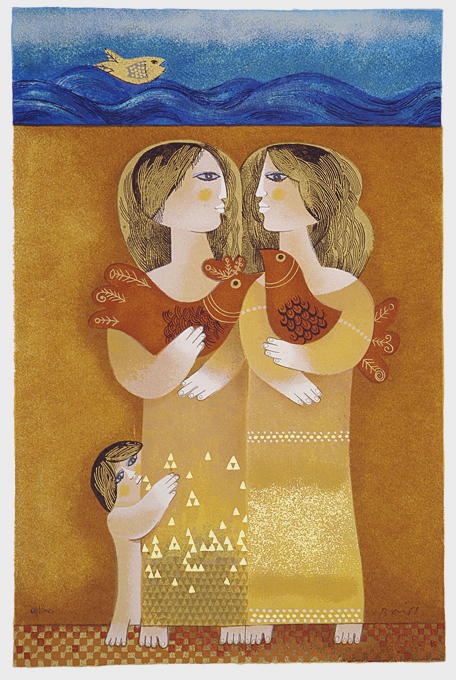
Love Birds
$95
13.5" x 19.5" Serigraph Edition 300
Shipping & Handling: $30
SAMI BRISS
Sami Briss was born in Jassy, Rumania, in 1930, and the influence of his youthful surroundings pervades his artwork even to this day. The artist was strongly impressed by the peaceful, rolling beauty of the landscape and the stately architecture of his home city. The churches of his motherland touched his artist’s soul as well, as did their outer frescos of vivid color. Briss inherited a love for design from his mother, a dressmaker. Continually evincing an interest in the rich embroidery of the cloth, Briss early surprised his delighted mother with his own drawings. She encouraged his interest in the arts, and applauded his entering the Beaux-Arts of Bucharest.
At the beginning of his career, Briss painted beautiful still-lifes, which showed his undeniable concern for construction. He experimented successfully with lithography and wood cutting, but in the early sixties devoted his time to painting. The artist works in both oils and water colors. He was taught the art of iconography, another asset stemming from his Rumanian heritage, and made the art his own by the practice of the ancient technique which he has completely transformed by adapting it to the marvelous images he renews in each of his works.
Briss’ paintings, in which the blues, pinks, deep greens, off-whites and blacks predominate, as well as gold leaf, are pieces full of both mystery and certainty. He often calls upon the world of the Bible and the Rumanian folklore of his youth, incorporating both Saints and peasants. But Briss has broken with the past, and created a world quite his own by screening his memories and feelings through his subconsciousness, renewing them continually in his own way. In his art, which is connected to no precise code of contemporary art, he calls upon varied legends to create his own vocabulary of symbols.
The fish appears in his works as the symbol of abundance, hands evoke strength and happiness, and birds in flight emphasize a hope of detachment. Based in his two kingdoms of Paris and Tel Aviv, the land of Israel is evoked in Briss’ paintings by the ruins of the temples. Briss’ art depicts a series of figures, some perturbed, some serene, while his paintings are just as much dynamic as calm, complex and precise.
….Sami Briss is a painter of the magical and the marvelous, whose nostalgia for icons comes straight from his native Moldavian plains. His surrealistic artistic experience makes him brother to Paul Klee and Victor Brauner. But his images are symbolic their naivete has a genuine popular essence expressed in a subtly metamorphosed conventionalized style. Briss’s choice and use of colors are remarkable. As inventive as it is nuanced and captivating, it evokes the tones of enamels, bisque-fired pottery, and the sober luminosity of the primitives. Briss’s painting is one of myth and memory rooted in the web of time – in other words, in universal “childhood”.
Briss Sami
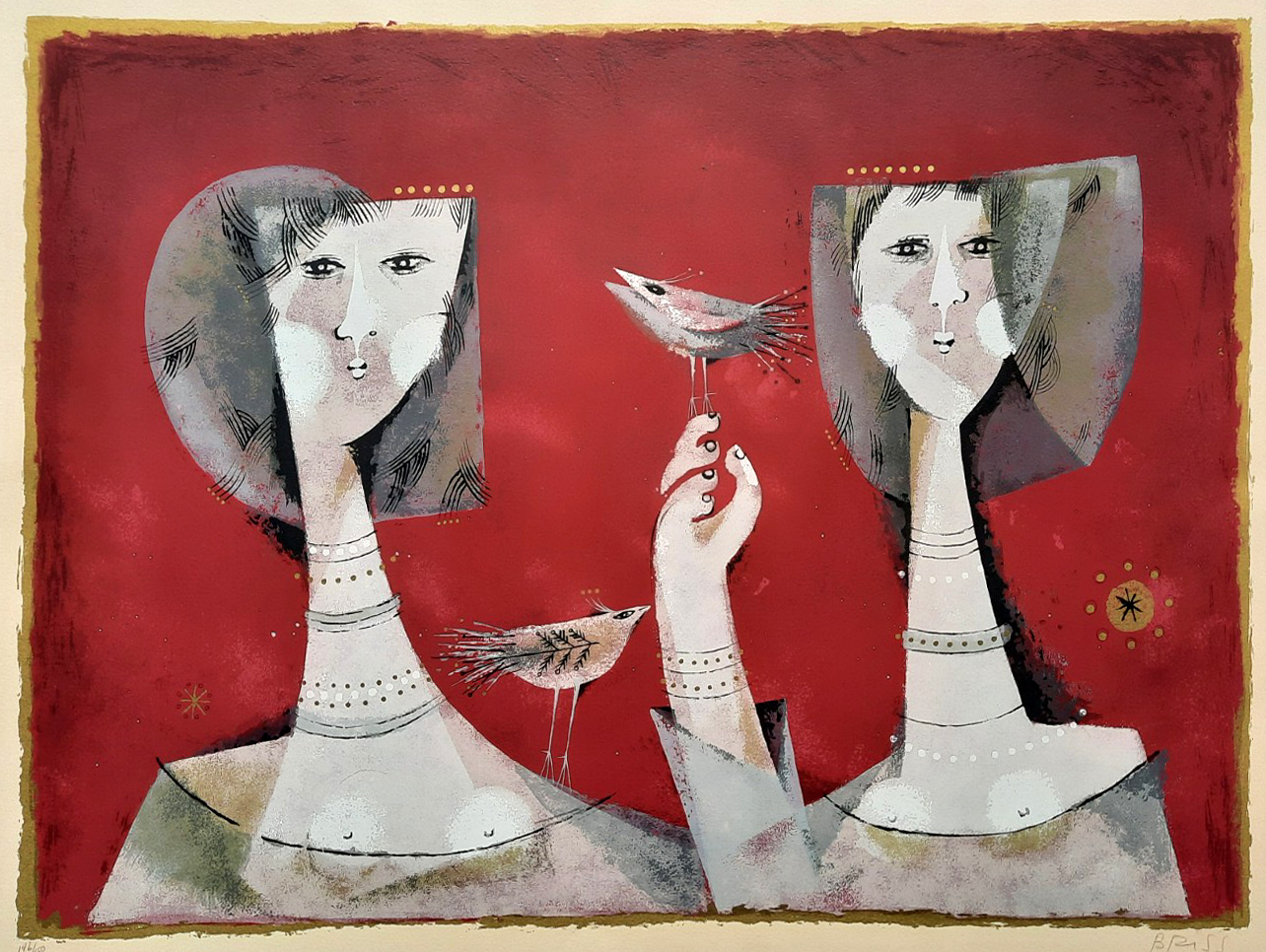
2 Girls 2 Birds
$95
25.5 inches wide x 19.5 inches high Serigraph
Shipping & Handling: $30
SAMI BRISS
Sami Briss was born in Jassy, Rumania, in 1930, and the influence of his youthful surroundings pervades his artwork even to this day. The artist was strongly impressed by the peaceful, rolling beauty of the landscape and the stately architecture of his home city. The churches of his motherland touched his artist’s soul as well, as did their outer frescos of vivid color. Briss inherited a love for design from his mother, a dressmaker. Continually evincing an interest in the rich embroidery of the cloth, Briss early surprised his delighted mother with his own drawings. She encouraged his interest in the arts, and applauded his entering the Beaux-Arts of Bucharest.
At the beginning of his career, Briss painted beautiful still-lifes, which showed his undeniable concern for construction. He experimented successfully with lithography and wood cutting, but in the early sixties devoted his time to painting. The artist works in both oils and water colors. He was taught the art of iconography, another asset stemming from his Rumanian heritage, and made the art his own by the practice of the ancient technique which he has completely transformed by adapting it to the marvelous images he renews in each of his works.
Briss’ paintings, in which the blues, pinks, deep greens, off-whites and blacks predominate, as well as gold leaf, are pieces full of both mystery and certainty. He often calls upon the world of the Bible and the Rumanian folklore of his youth, incorporating both Saints and peasants. But Briss has broken with the past, and created a world quite his own by screening his memories and feelings through his subconsciousness, renewing them continually in his own way. In his art, which is connected to no precise code of contemporary art, he calls upon varied legends to create his own vocabulary of symbols.
The fish appears in his works as the symbol of abundance, hands evoke strength and happiness, and birds in flight emphasize a hope of detachment. Based in his two kingdoms of Paris and Tel Aviv, the land of Israel is evoked in Briss’ paintings by the ruins of the temples. Briss’ art depicts a series of figures, some perturbed, some serene, while his paintings are just as much dynamic as calm, complex and precise.
….Sami Briss is a painter of the magical and the marvelous, whose nostalgia for icons comes straight from his native Moldavian plains. His surrealistic artistic experience makes him brother to Paul Klee and Victor Brauner. But his images are symbolic their naivete has a genuine popular essence expressed in a subtly metamorphosed conventionalized style. Briss’s choice and use of colors are remarkable. As inventive as it is nuanced and captivating, it evokes the tones of enamels, bisque-fired pottery, and the sober luminosity of the primitives. Briss’s painting is one of myth and memory rooted in the web of time – in other words, in universal “childhood”.
Loading...