Weil Shraga
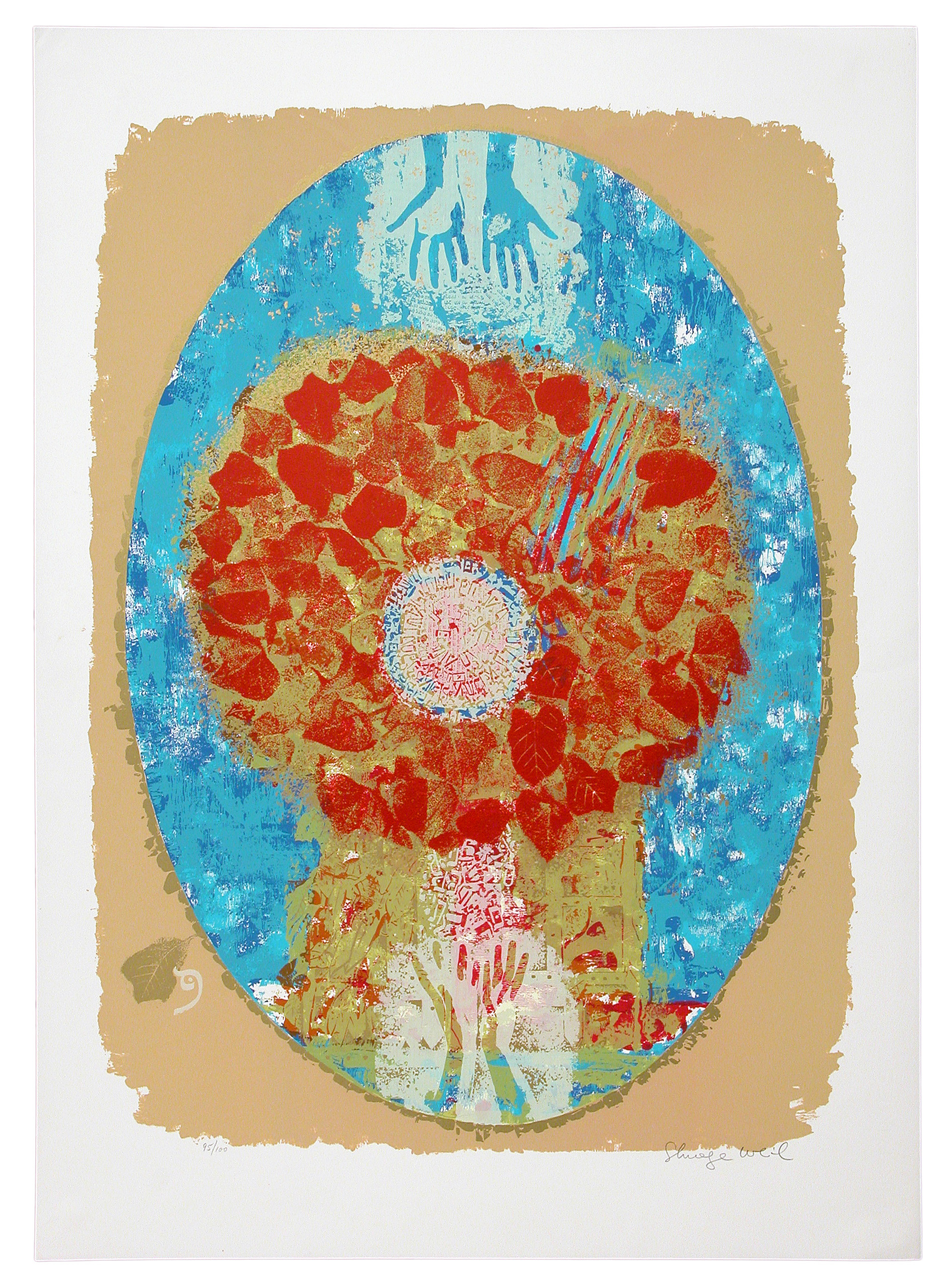
S-107 Peshat
$850
20 inches wide x 28 inches high 51 cm wide x 71 cm high Serigraph 1975 Edition 100
Shipping & Handling: $30
Peshat (literal) has at its center a spiral of Hebrew characters enclosed in a crown of leaves, suggesting the tree of knowledge. Hands from above and below reach toward the center. The symbolism suggests the hands of the Giver and receiver, or the hands of those who reach out for knowledge. One is left to contemplate the glowing colors and intimations of spirituality
Shraga Weil was born in Nitra, Czechoslovakia in 1918 to a family of teachers, journalists and merchants. His father, a building engineer, who was an amateur painter, sent him to study with a local sculptor and then to the Prague School of Art.
He produced his first graphic works during World War II, part of which he spent as a prisoner. After the war, Weil sailed for Israel on an illegal immigrant ship, eventually arriving in the new country in 1947 and becoming a member of Kibbutz Haogen, where he has been living ever since.
In 1954 Weil spent some time studying murals and graphic techniques at the Academie des Beaux Arts, Paris and Ravenna mosaics with Prof. Severinl.
Shraga Weil’s works have been exhibited in the United States, South America, Canada, Australia, France, the USSR, Switzerland, and in the International Exhibition of Graphic Arts, in Lugano. In 1959, Weil was awarded Tel Aviv’s Dizengoff Art Prize
Weil Shraga
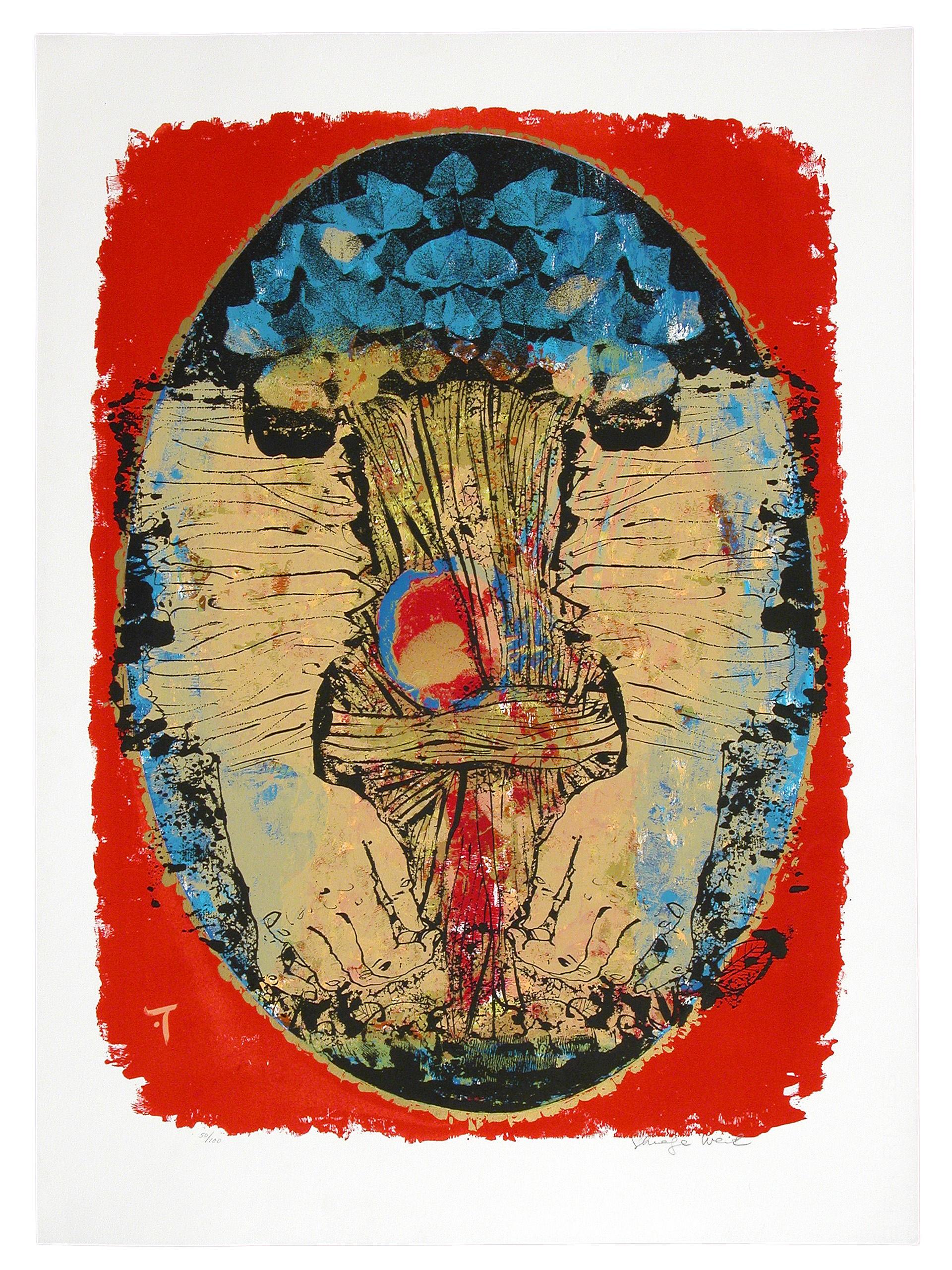
S-109 Derash
$850
20 inches wide x 28 inches high 51 cm wide x 71 cm high Serigraph 1975 Edition 100
Shipping & Handling: $30
The suggestion here is of tying together of ideas. The great hands, arranged symmetrically at the sides of the stalks convey a feeling of strength and formality.
Shraga Weil was born in Nitra, Czechoslovakia in 1918 to a family of teachers, journalists and merchants. His father, a building engineer, who was an amateur painter, sent him to study with a local sculptor and then to the Prague School of Art.
He produced his first graphic works during World War II, part of which he spent as a prisoner. After the war, Weil sailed for Israel on an illegal immigrant ship, eventually arriving in the new country in 1947 and becoming a member of Kibbutz Haogen, where he has been living ever since.
In 1954 Weil spent some time studying murals and graphic techniques at the Academie des Beaux Arts, Paris and Ravenna mosaics with Prof. Severinl.
Shraga Weil’s works have been exhibited in the United States, South America, Canada, Australia, France, the USSR, Switzerland, and in the International Exhibition of Graphic Arts, in Lugano. In 1959, Weil was awarded Tel Aviv’s Dizengoff Art Prize
Weil Shraga
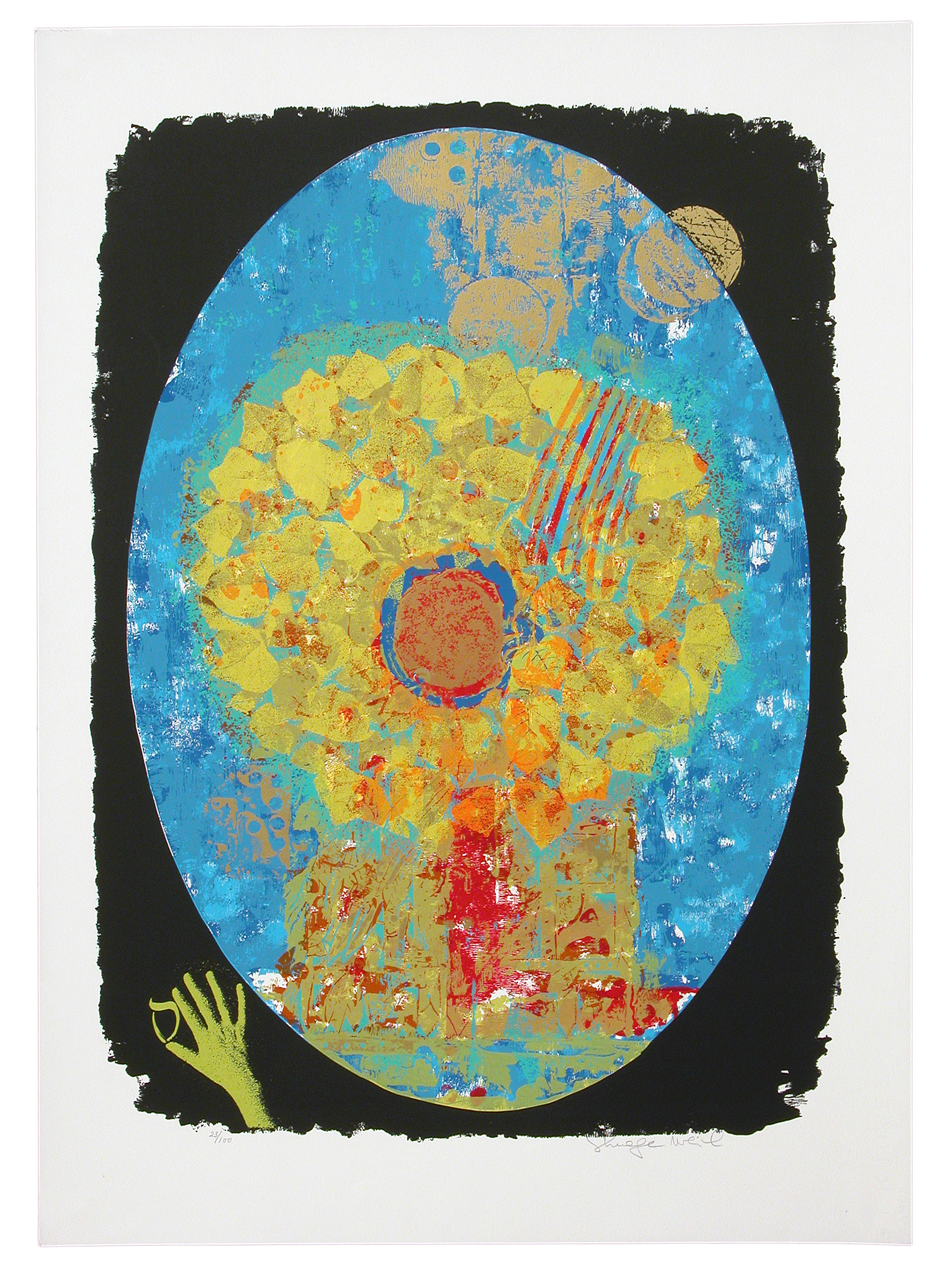
S-110 Sod
$850
20 inches wide x 28 inches high 51 cm wide x 71 cm high Serigraph 1975 Edition 100
Shipping & Handling: $30
Weil’s image is deliberately mysterious. The oval shape here seems to be the elliptical orbit of a foreign planet – or of the moon – or of an atom around the nucleus of leaves. The darkness beyond may be just a black border to set off the oval or a suggestion of the vast unknown of the universe. The only knowable fragment besides the leaves is the hand which holds the letter between its thumb and forefinger.
Shraga Weil was born in Nitra, Czechoslovakia in 1918 to a family of teachers, journalists and merchants. His father, a building engineer, who was an amateur painter, sent him to study with a local sculptor and then to the Prague School of Art.
He produced his first graphic works during World War II, part of which he spent as a prisoner. After the war, Weil sailed for Israel on an illegal immigrant ship, eventually arriving in the new country in 1947 and becoming a member of Kibbutz Haogen, where he has been living ever since.
In 1954 Weil spent some time studying murals and graphic techniques at the Academie des Beaux Arts, Paris and Ravenna mosaics with Prof. Severinl.
Shraga Weil’s works have been exhibited in the United States, South America, Canada, Australia, France, the USSR, Switzerland, and in the International Exhibition of Graphic Arts, in Lugano. In 1959, Weil was awarded Tel Aviv’s Dizengoff Art Prize
Weil Shraga
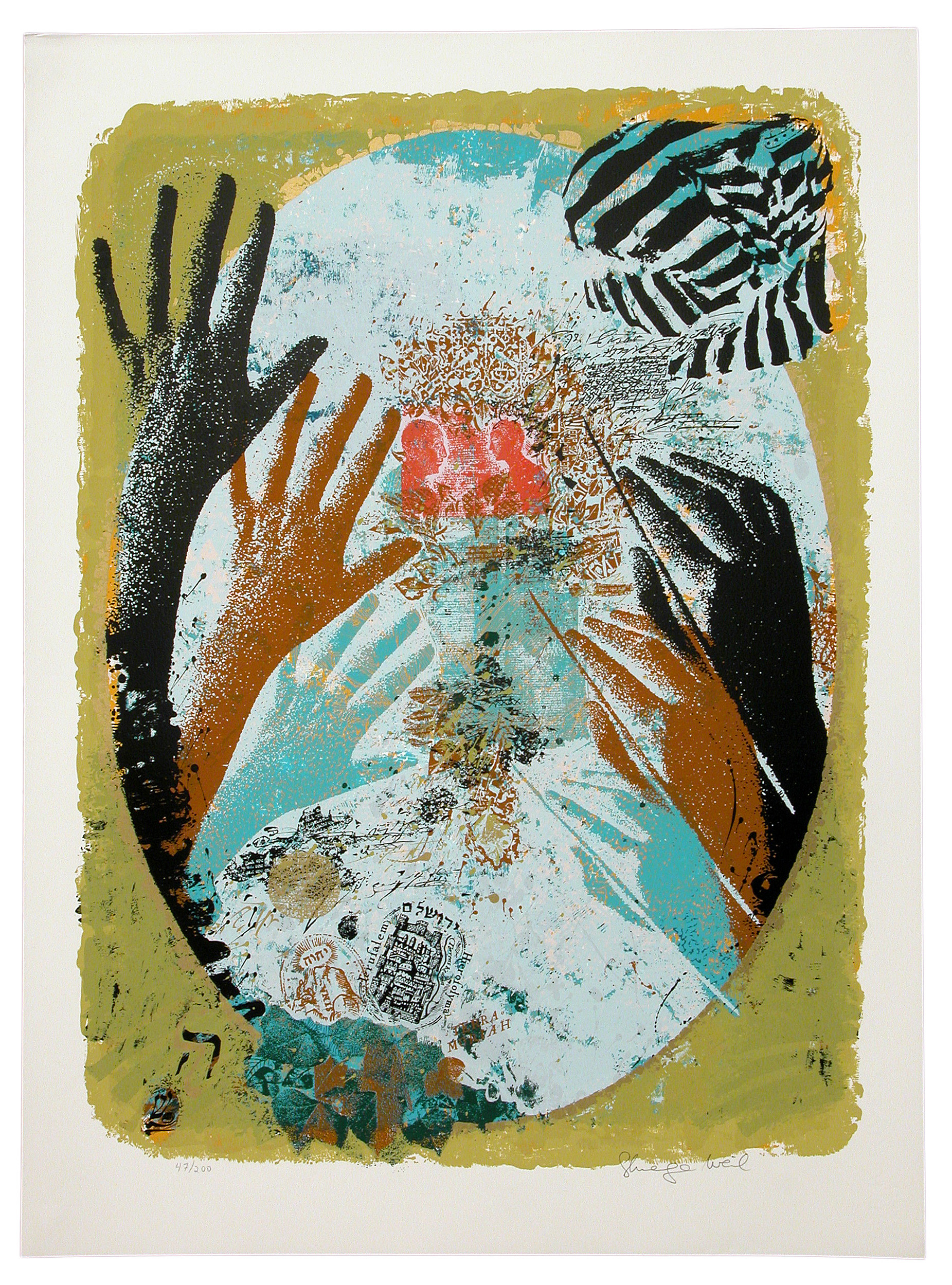
S-111 Hallacha
$500
21.5 inches wide x 29.5 inches high 55 cm wide x 75 cm high Serigraph 1976 Edition 200
Shipping & Handling: $30
The hands of the artist magically conjure up the past. At the bottom, emerging from leaves, are three geographical indices rich in Biblical connotation. The central passage of the work is strewn with suggestive fragments, a mix of writing, patterns, and figures, culminating at the upper right in the folded striped cloth (“coat of many colors”, symbol of the first born), and again as dark stripes (black and grey), symbolizing weightiness, dignity. The stripes are also associated with the clothing of prisoners of the concentration camps, a symbol of their sorrow and suffering.
Shraga Weil was born in Nitra, Czechoslovakia in 1918 to a family of teachers, journalists and merchants. His father, a building engineer, who was an amateur painter, sent him to study with a local sculptor and then to the Prague School of Art.
He produced his first graphic works during World War II, part of which he spent as a prisoner. After the war, Weil sailed for Israel on an illegal immigrant ship, eventually arriving in the new country in 1947 and becoming a member of Kibbutz Haogen, where he has been living ever since.
In 1954 Weil spent some time studying murals and graphic techniques at the Academie des Beaux Arts, Paris and Ravenna mosaics with Prof. Severinl.
Shraga Weil’s works have been exhibited in the United States, South America, Canada, Australia, France, the USSR, Switzerland, and in the International Exhibition of Graphic Arts, in Lugano. In 1959, Weil was awarded Tel Aviv’s Dizengoff Art Prize
Loading...